Aston Martin Dbx S, here's what the suv that challenges the Ferrari Purosangue looks and drives like
The new version extends the British brand's super-performing S family thanks to an upgraded twin-turbo V8 that now offers 727 horsepower and an extensive overhaul of the rest of the mechanics

Key points
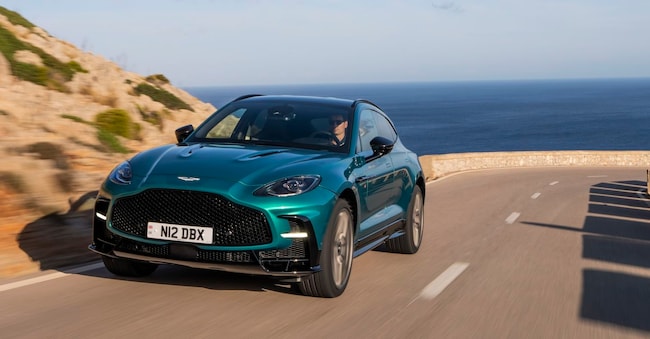
The escalation of power peaks at Aston Martin continues with the Dbx, its only suv. The new version is distinguished by the letter S that has characterised the brand's most powerful and dynamic versions for decades. A repertoire that is a showcase for the brand's technological state of the art into which, for the record, will also enter the fruits of the recently announced collaboration with Pirelli to equip future models with Cyber Tyre as standard. In other words, the world's first system capable of collecting data and information from sensors positioned inside the tyres, processing them using proprietary Pirelli software and algorithms and communicating in real time with the vehicle's electronics to manage dynamism according to driving and driving conditions. Meanwhile, with a load of technologies specifically developed by Aston Martin comes the Dbx S, which can already be ordered at a price of over 260,000 euro.
Aston Martin Dbx S, enters top three most powerful suvs
Thanks to the 727 horsepower contained in its twin-turbo V8, the Dbx boasts an output that is 222 horsepower more than that of the version with which it debuted in the range in 2019 and 20 horsepower more than that of the later 707 whose name conveys the power of its engine and thus climbs the ranking of the supersuvs. In fact, it firmly enters the hypersuv rankings, taking the second step on the podium behind the electrified Porsche Cayenne Turbo E-Hybrid with 739 horsepower and finishing just 2 horsepower ahead of the Ferrari Purosangue with 725 horsepower powered by a 6.5-litre V12 that is not supercharged and, like that of the Dbx S, not electrified.
Aston Martin Dbx S, thanks to Valhalla power goes up
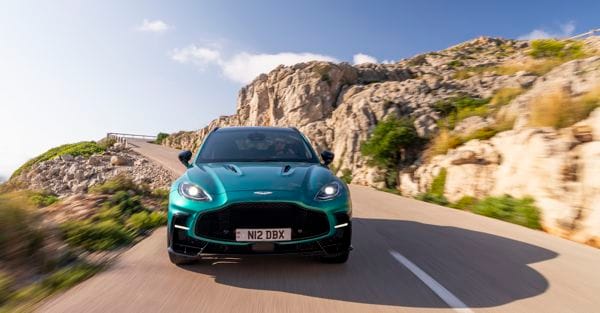
In order to take the Dbx to the top of the restricted hypersuv family, Aston Martin has revised the twin-turbo 4-litre V8 of Mercedes AMG origin for the third time. The new edition still offers a torque of 900 accompanied, however, by 727 horsepower. This power was achieved thanks to new-generation turbines derived from those of the Valhalla plug-in hybrid hypercar with 1,079 horsepower, 999 of which were built, redefining some internal components, recalibrating the electronics to make the power delivery more full-bodied at every speed and adopting an exhaust system that supports the engine's power boost and allows it to emit a specific and satisfying tone. The revamped twin-turbo V8 pushes the Dbx S up to 310 km/h, allowing it to reach 100 km/h in 3"3 and the 200 km/h mark in 11"1. The tuning also includes a revision of the automatic gearbox without converter, also of AMG origin, to offer optimised gear shift points in Sport and Sport+ modes and the calibration of the power steering. Unchanged from the Dbx 707 are the all-wheel drive, which can distribute traction up to 50 per cent to the front and up to 100 per cent to the rear, the adaptive set-up with pneumatic elements, the braking system with carboceramic discs and the driving aid safety systems. To increase dynamism by slightly reducing the Dbx S's standard weight, which is close to 2,400 kg, carbon fibre body elements are available as an option, including the almost 3-square-metre roof (which alone eliminates 18 kg of weight) as well as 23-inch magnesium wheels that reduce unsprung mass by 19 kg.
Aston Martin Dbx S, body kit and specific interior
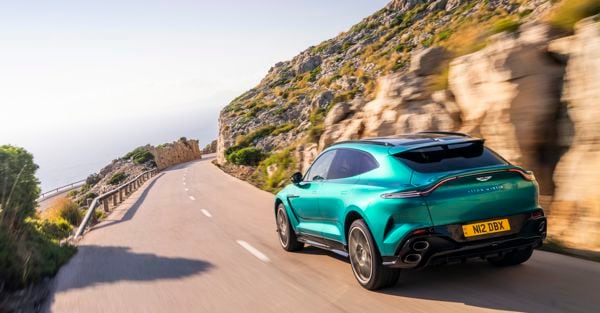
.With a length of 5.04 metres, a width of 2 metres, a height of 11.68 metres and a wheelbase of 3.06 metres, the S retains practically the same dimensions as the other Dbxs. It differs from these in the customisation of its robust bodywork. The specific body kit redefines the appearance of the front and tail. At the front, the redesigned grille stands out, which on request can have a honeycomb grille like the one on the Dbs 770 Ultimate, a new splitter, while at the rear the diffuser and bumper shield have been redesigned, as on the front, with a red profile that integrates the new vertical arrangement of the two pairs of exhaust tailpipes. On the sides, modified miniskirts and the iconic S logos can be seen.
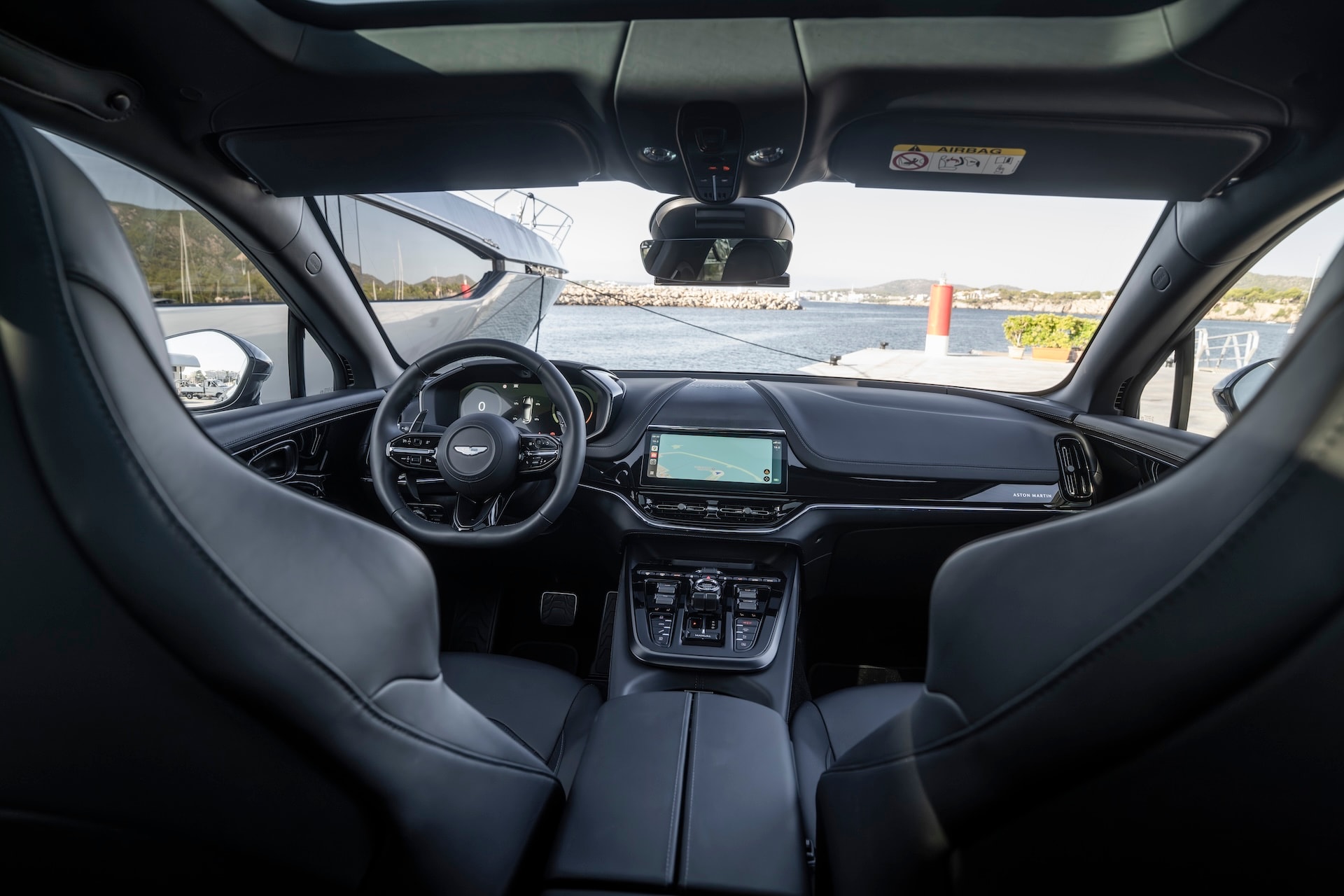
The presentation of the sumptuous interior follows that of the 707 and features the configurable 12.3" digital instrumentation and the display of the responsive 10.25" infotainment system with a clear graphic interface, as well as clearly identifiable physical buttons on the centre console where the gear selector, which on previous Dbx cars was controlled by awkward buttons on the dashboard, has been placed since the 707. However, the interior design stands out for the customisation entrusted to specific colour combinations and, above all, to the materials and herringbone workmanship of the central part of the wide Alcantara or semi-aniline leather upholstery, as well as the headlining when the latter is made of carbon.