
At the Food&Science Festival in Mantua the future of agribusiness in 10 thematic strands
One of the most important moments of confrontation between scientific research, the agri-food industry and the world of innovation returns with 150 meetings and more than 140 guests

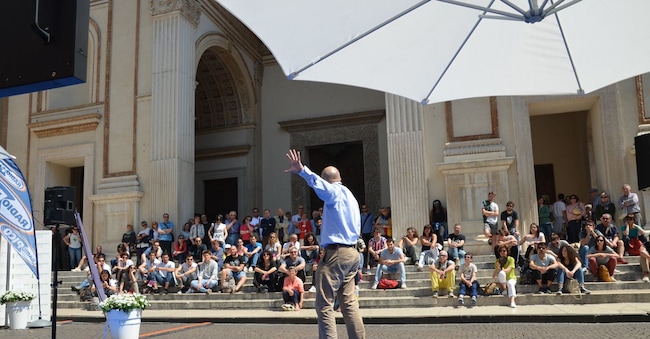
From 15 to 17 May 2026 the Food&Science Festival returns to Mantua, one of the main moments of confrontation in Italia between scientific research, the agrifood industry and the world of innovation. Promoted by Confagricoltura Mantova, conceived by Frame-Divagazioni scientifiche and organised by Mantova Agricola, the Festival transforms Mantua into a laboratory of ideas applied to the agrifood world. Three days of meetings, dialogues, debates, workshops and shows bringing scientists, researchers, popularizers, economists, historians and protagonists of contemporary culture to the city: from the geneticist Vittoria Brambilla to the agricultural genomics expert Luigi Cattivelli, from the chemist and popularizer Dario Bressanini to the climatologist Serena Giacomin, from the master pastry chef Iginio Massari to the star chef Chiara Pavan.
The 2026 edition, celebrating the event's first ten years, is centred on the concept of trajectory, which acts as a magnifying glass and key to exploring and understanding the evolution of the agrifood sector. A web of knowledge woven by ten thematic paths, dedicated to: genetics, technology, ecology, health, strategy, society and ethics, culture, perception, creativity and exploration.
As has been the case since the first edition, the approach of the Food&Science Festival is multifaceted and multidisciplinary. In fact, the "menu" includes 150 meetings with more than 140 guests, distributed among eight different locations in Mantua, flanked by the interactive exhibition "Cultivating the future: the trajectories that are changing food" and an open-air campus, where you can meet researchers, universities and research centres and discover the work that goes on every day between laboratories and experimental fields.
Among the highlights of the scientific programme are those dedicated to the role ofnew technologies in advancing agricultural techniques and optimising production chains. With a special look at therole of artificial intelligence applied to precision agriculture and the fruit production chain, and with a focus on biosensors based on organic electronics to monitor food freshness. Still on the subject of innovation, ample space is also reserved for technologies for precision agriculture, the aware approach to agropharmaceuticals and the new role of plants as biofactories, capable of producing biopharmaceuticals and cosmetics.
As it has always done, the Festival devotes a great deal of attention to scientific research in the field of gene editing, continuing to explore its evolution and practical implications in agriculture, but also its governance and regulation.

