
Berlucchi invests in the premium segment and resists falling sales
The 2011 Riserva Ziliani was presented, but the strategy is to increase the value generated on the entire range, which accrues 70% of its business in retail. Growth abroad and in restaurants are also among the objectives

Key points
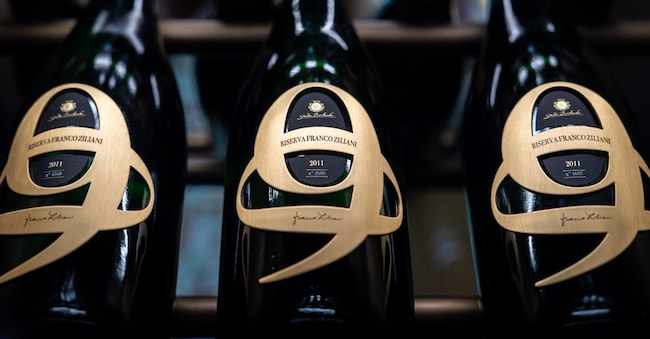
Berlucchi has just presented the new edition of the Riserva Franco Ziliani, dedicated to the histrionic pioneer of Franciacorta and driving force behind the winery's rise. With the 2011 vintage, the second release after 2008, it becomes a permanent part of the Berlucchi collection. Fewer than 5,000 bottles that alone will not change the fate of the company's balance sheet, but which represent an important step ina strategy that is investing in premium to act as a driving force for an overall repositioning of the brand, with a view to creating value across the entire product line.
"In a complex phase such as the current one, high-end products do not only represent a strategic segment, but an authentic value presidium. It is in this segment that our identity is concentrated," says CEO Arturo Ziliani, "with the meticulous attention to detail, the search for the maximum expression of the terroir, and the ability to wait for the ideal moment for each cuvée. Investing in excellence allows us to give continuity to the vision that has guided Berlucchi for more than sixty years: to create prestigious Franciacorta wines, capable of exciting today and standing the test of time".
Retail accounts for 70% of turnover
Working on excellence does not mean neglecting the large-scale retail channel, which accounts for 70% of Berlucchi's domestic market, thanks above all to the Cuvée Imperiale, with the festive season weighing in at around 60% of sales.
"After the years of growth post Covid, in 2024 we recorded a slowdown with a drop in turnover of about 2% to 53.5 million," says Berlucchi's sales director, Alessandro Ramagini. "This year we have worked very well and the results are rewarding us: if the estimates are confirmed, we should close 2025 with an increase in volumes of 0.5%-1% and a little more for turnover. A hold that would be a success in the current context, where if the reds are suffering the most, the bubbles are not immune to difficulties.
'If the estimates are confirmed,' continues Ramagini cautiously, 'it would be a result achieved not only through a focus on quality and sustainability, which are the prerequisites of our work, but also thanks to a constancy in maintaining optimal business relations, in particular with a correct pricing policy pursued over the years. Having tried not to push too hard on price lists in the past, we are now not forced like others to resort to special discounts.
Export still limited but growing
More than on the domestic market, however, the result was achieved abroad, where the growth was 9%. "While it is true that exports account for 5% of our turnover, it is also true that in terms of absolute numbers we sell around 200,000 bottles across the border (out of an average annual production of around 4 million, ed.), far more than other wineries with higher foreign quotas. At the same time, we are consolidating our presence in the restaurant sector, a channel that is certainly not going through a good moment for the well-known reasons: less purchasing power, the tendency to drink less, traffic sanctions, and price increases that are difficult to sustain in the current economic situation. But our presence in the on-trade remains fundamental, not only because it accounts for a third of our business, but because it allows us to assert quality and brand strength. And a presence in the lists of great chefs and sommeliers is built over time and with constant work, just as it is with the general public".


