
Franciacorta with French oysters but not only: 'Target 20% export in 5 years'
Bubbles from Lombardy took the place of champagne at the PDO oyster festival in Marennes-Oléron: for Consortium President Rabotti, it is possible to grow across borders from the current 12% without eroding the domestic market

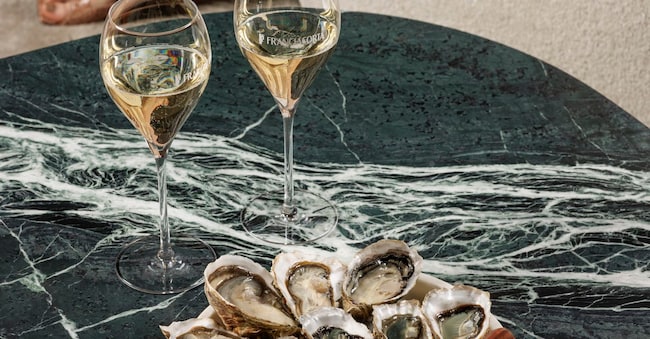
At the end of October, in Marennes-Oléron, on the French Atlantic coast, accompanying the famous PDO oysters at the 'Fêtes de l'Ostra' was not Champagne, but the labels of Franciacorta, the event's official partner. A 'victory away from home' that was perhaps unthinkable until not so long ago, but which has now become a reality, testifying to how Lombardy's bubbles are not afraid to compete strongly on foreign markets, even in the home of those with centuries of history behind them.
"Our strength comes from the fact that Franciacorta has a strong and recognisable identity. This has recently been asserting itself abroad as well,' Emanuele Rabotti, president of the Consorzio Franciacorta, tells Food24 where in the past we did not record significant numbers, but now the time is ripe for growth. In general, the whole made-in-Italy agri-food industry is asserting itself in the world and we are certainly a symbol of this. We believe the time has come to seize this potential'.
In 2024, the export share stood at 12% of total production (19.12 million 'bottle equivalents', down 2% compared to 2023). Turnover fell by 1.4% on a production turnover that the Consortium does not officially communicate in its Observatory, but which can be estimated at over 260 million euro (and almost double that at consumption).
The trend rewards exports
However, if we broaden our view to pre-Covid, in 2024 Franciacorta recorded +8.9% in volume, +24.8% in turnover, and +14.6% in average prices. And if exports last year were -3%, compared to 2019 they grew by more than 15. And in 2025? In the first nine months, the overall volume decline is 2.8%, but if the domestic market is down 4.4%, exports are up 5.8%. Figures that could change by the end of the year, considering that the last quarter and in particular the Christmas period, despite the seasonal adjustment efforts underway, are still worth 50% of sales, with domestic purchases prevailing, which will presumably cause the export quota to drop. The latter, however, rose from January to September to 16.8% from 15.4% in the same period of 2024.
For Rabotti, the road is marked out: "The objective is to reach a 20% export quota in 5 or 6 years," he says. "It will certainly not be easy, but I do not believe it is an unreachable quota. That's why we are investing to support internationalisation with promotional initiatives in the main foreign markets, partnerships with local operators, training and tasting events aimed at the press and consumers, and a digital communication plan aimed at enhancing the identity of the territory. And the tariffs? For now, 'the impact is marginal' and we are working not only with the USA but also with reference markets such as Japan, Switzerland, Germany (where there were negative signs in 2024). 'There is a lot of interest,' adds the president, 'also in Eastern and Northern Europe.


