Use

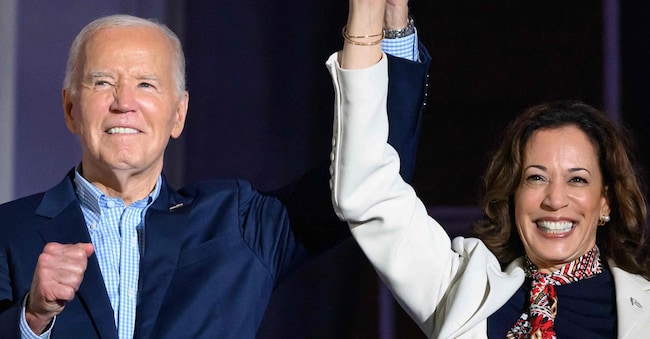
Biden withdraws from the race and endorses Kamala Harris: an unprecedented move. The vice-president: 'I will beat Trump'

Biden drops out of the presidential race and supports Kamala Harris, opening up new unknowns in the US political landscape

by Marco Valsania

Joe Biden e Kamala Harris guardano i fuochi d’artificio del 4 luglio

5' min read

5' min read

Joe Biden has withdrawn from the race for the White House and endorsed his vice-presidential Kamala Harris in his own place as the candidate to beat Republican Donald Trump. Harris stated that he intends to 'earn the Democratic nomination' for the November presidential election with the goal of 'beating Donald Trump'. Harris praised the "selfless and patriotic act" of the 81-year-old Democratic president, who announced his support for her as a candidate. "I will do everything in my power to unify the Democratic Party - and unite our nation - to defeat Donald Trump," she wrote.

It is the first time in modern American history that a president running for re-election has withdrawn at such an advanced stage of the campaign, and the extraordinary move reopens the electoral games, both among the Democrats and in the clash with Donald Trump (video), among many unknowns.

Loading...
Loading...

Dem pressure

Faced with mounting pressure within the party and among voters, who are concerned about the fragility he has shown at the age of 81, Biden has decided to throw in the towel. Biden announced his retirement in a letter to the American people, in which he said it was "the greatest honour of my life to serve as your President" but that it is now in the "best interests of the party and the country to step aside and focus entirely on completing my mondate. The President pre-announced an address to the nation in the coming days. Subsequently, Biden has via social media voiced his support for Harris to pick up the campaign baton.

The uncertainty of the next steps

.

The next steps are now less certain. The Democrats and have two roads ahead of them: they could decide to unite around Harris and carry out a virtual early vote of the delegates, now free to vote for other candidates ahead of Biden's withdrawal, focusing on the choice of vice-president for the new ticket, perhaps one of the most popular state governors in the party. In the event of a majority of delegates in favour, the nomination would be decided. Without a majority or without an agreement on Harris, the other possibility is a multi-candidate race and an open convention, where the new standard-bearer for the election would be debated and decided. Among the risks, especially in the second option, is that of generating chaos in the party. There is no shortage of objections from the Republican rivals that could cast doubt on the legality and legitimacy of the proocess.

The Party Rebellion

.

The only certainty at the moment is the story of Biden's retreat in the face of rebellion in the party. It began, perhaps unusually, with a small faction of moderate and centrist members of the party. But it gradually infected wider and wider ranks of the party, supported by increasingly ruthless polls that saw the President trailing in all the swing states, indeed the list of battleground states was getting longer by the day, not only Wisconsin, Pennsylvania, Michigan, Georgia and Arizona, but also Nevada, New Mexico, Virginia, New Hampshire. Finally it has made inroads among the Democratic leadership and the President's closest allies themselves. The internal rebellion that led to Biden's retirement is a story that began with factional battles and disagreements between leaders. Before the withdrawal, some 40 Congressmen had asked him to step aside and secretly 80% of the Democratic group in Congress was in favour of his stepping down.

After the disastrous debate

Resistance to Biden had begun before the disastrous debate with Donald Trump: discontent had been raised at the breaking of his promise to be a transitional President, to pave the way for a new generation of Democratic leaders by committing to a mission to first restore normality to American politics and democracy after the escalation of chaos and crisis during Trump's first term. Biden explained his decision to run again by citing the still high stakes for the country represented by Trump's return. Actually decisive to his decision would have been the result of the Midterm elections in 2022, when a feared Republican wave in Congress failed to materialise and a number of Trump-sponsored candidates failed at the ballot box. Biden read that result as a vote of confidence in his leadership and pushed him to minimise the risks.

The White House's careful management of these risks was shattered by the televised debate. The spectacle of Biden exhibiting shocking fragility after having wanted the duel brought out the initial handful of dissidents among the parliamentarians, among those who saw their seats, especially in the House, in danger in the face of Joe Biden's decline. These were first and foremost centrists, almost always candidates in uncertain constituencies with a strong presence of independent voters. Among these voters even more than among the Democrats, the polls were failing Biden. The first congressman to take the field in early July was 77-year veteran Lloyd Doggett of Texas, later followed by dozens of colleagues, from Arizona to Michigan, from Illinois to Colorado. A senator with an independent tradition also broke ranks, Peter Welch, later followed by four others.

The initial frond

.

The initial fray was met, in addition to Biden's anger, with support for him from the party's left wing and the African-American group in Congress. Biden's connection with black voters is historic, and reflects in part their tendency to support establishment figures in the party: Biden's initial bid in the 2020 Democratic primary was saved by a landslide victory in South Carolina due to the mobilisation of the black vote. The Congressional Black Caucus representing a quarter of the deputies in the House had maintained its support for the President to the last.The left, of Senator Bernie Sanders and Congresswoman Alexandria Ocasio-Cortez, initially squared off seeing in Biden an ally, after he had governed with more progressive policies than those dictated by his reputation as a moderate, from support for the union to the energy transition plan to anti-trust. This despite disagreements over the war in Gaza.

The Last Stand

.

Biden's resistance, as the revolt spread, was also motivated by scepticism towards some senior party figures. Biden has never forgiven Barack Obama and apparently the Democratic nomenclature for pushing him aside in 2016 to make way for Hillary Clinton's candidacy, which was then beaten by Trump.But with Biden's inability to deliver convincing performances, at Nato as well as in interviews and on TV, the faction has grown. It forced the postponement to August of a virtual delegate count to formalise Biden's nomination before the party convention in Chicago. The names of the open rebels became increasingly heavy. Among them Californian congressman and candidate for senator Adam Schiff, Trump's grand inquisitor.Obama, formally neutral, has nevertheless sent growing messages today in favour of a withdrawal. He gave the go-ahead to an appeal to this effect by George Clooney, until then among the most influential donors.

Donor exodus

.

The exodus of donors, from Hollywood to tech who have blocked new funds to force an alternative, has multiplied the pressure from outside. Even Biden's campaign co-chairman, mogul Jeffrey Katzenberg, in face-to-face talks with the President confirmed the evaporation of money. Obama then for his part broke ranks by expressing concerns more directly to other influential Democratic leaders. And the party leadership moved more and more explicitly: Nancy Pelosi, respected former Speaker of the House, privately warned Biden that any electoral hopes in the House were compromised by his candidacy. Similar alarm was brought to Biden by House Majority Whip Hakeem Jeffries, while Senate Leader Chuck Schumer also warned the President of the spectre of overwhelming defeat. At this point the informal coalition included leaders, centrists and progressives, donors and even confidants of the President, including media personality Je Scarborough. And even the inner circle of family members and loyal aides lowered their weapons, preparing for Biden's surrender.

Copyright reserved ©
Loading...

Brand connect

Loading...

Newsletter

Notizie e approfondimenti sugli avvenimenti politici, economici e finanziari.

Iscriviti