
Blue crab: the crisis continues, with efforts to curb its spread alongside research into its cosmetic and biochemical uses
Alongside measures to contain and combat the species, attempts are also being made to exploit it commercially for the substances that can be extracted from its carapace

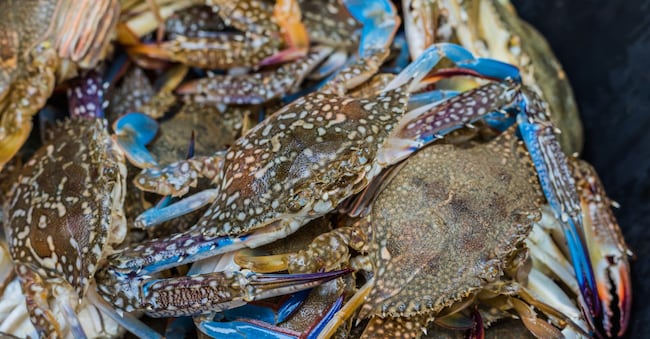
The blue crab crisis is far from over. What was once an ‘exceptional’ case has almost become the norm, with the crustaceans attacking clam farms in particular. It is mainly the fish farms in Veneto and Emilia-Romagna, and the ponds in Sardinia, that are having to deal with this situation. “The emergency is certainly not over,” confirms Mauro Steri, head of Legacoop Pesca . “What appears to have stabilised is the presence of the blue crab. This does not mean the end of the problem, given that reports of difficulties are coming in on a daily basis.”
On farms in Emilia-Romagna and Veneto, in order to continue farming clams, attempts have been made to find alternative solutions by ‘enclosing the areas where the clams are kept’. Federagripesca, part of Confcooperative, also highlights the difficulties faced by operators: “The problem has by no means disappeared,” the organisation stresses, “and cases are being reported not only in the northern Adriatic but also in the Tyrrhenian Sea and on the islands.”
Indeed, the blue crab is now firmly established on the Tyrrhenian coast, in the Orbetello lagoon and at the mouth of the Arno, as well as in Sardinia, Sicily and Calabria. The situation has also taken a turn for the worse in Friuli Venezia Giulia, where – according to Confcooperative – the catch in the first four months of 2026 equalled the total for the whole of 2025; the invasion is no longer confined to the lagoons but has spread to the open sea, as far as four miles from the coast.
“The Po Delta is the ideal area for them to thrive,” explains Giuseppe Castaldelli, Professor of Ecology at the University of Ferrara, “ the perfect habitat for their reproductive cycle: the males migrate upstream to freshwater during moulting, whilst the females remain near the estuary to reproduce several times over the course of their lives.” In the Scardovari lagoon, Confcooperative points out, “before the arrival of the blue crab, 25,000 quintals of PDO clams were produced; since the crab’s appearance, this figure has fallen to 15,000 quintals. Now, due to the heatwave a few weeks ago which caused the mass die-off of many mussels, production in the lagoon has been suspended.”
To tackle this emergency, a number of studies have been carried out. “In Sardinia,” continues Steri, “a study has been launched by the universities of Sassari and Cagliari, specifically to find alternative solutions”. Other initiatives are underway in Veneto and Emilia-Romagna. Operators are also on the ground, trialling new initiatives. One such initiative, announced by the Polesine Fishermen’s Co-operative Consortium – one of the areas hardest hit by the crisis – involves selling blue crab meat and claws in jars.

