The dispute with Austria

Brenner border closures: EU Court of Justice Advocate General rules in Italia’s favour: ‘Unlawful bans’

According to the Advocate General, the night-time, sector-specific and winter driving bans imposed by Austria along the Alpine motorway are contrary to EU law

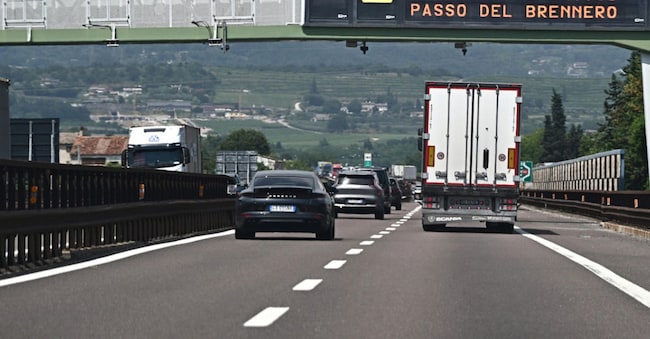
 (Ansa)

3' min read

Translated by AI
Versione italiana

Key points

3' min read

Translated by AI
Versione italiana

In the never-ending tug-of-war between Italia and Austria over bans and restrictions on the movement of HGVs (heavy goods vehicles) along the Brenner Alpine Corridor, the government in Rome has scored a point in its favour that could prove decisive.

Rome and Vienna are currently embroiled in a legal dispute before the European Court of Justice, where Italy has lodged an appeal against the policy of unilateral blockades imposed by Tyrol and endorsed by Vienna.

Loading...

According to Italia, the Austrian restrictions run counter to the founding principle of the European Union – namely, the free movement of goods and people – and seriously harm the interests of the Italian economy.

“The night-time, sector-specific and winter driving bans imposed by Austria on heavy goods vehicles on the A12 Inn Valley and A13 Brenner motorways are contrary to EU law.” This is the  Opinion of the Advocate General of the Court of Justice of the European Union, Manuel Campos Sánchez-Bordona, proposing that the action for failure to fulfil obligations brought against Italia be upheld on these points.

The lawyer, however, considers the system for regulating access to the A12 (a quota system, i.e. a cap of 300 vehicles per hour at the border crossings between Germany and Austria) to be lawful, as Rome has not demonstrated that it constitutes a quantitative restriction.

The lawyer’s conclusions are not binding, but the Court’s judgement often follows the line of argument set out therein.

The EU Court’s ruling on Italia’s appeal against Austria in the Brenner case is expected by the end of the year.

Brennero, porta dell’Europa. Parla il presidente di Confindustria Alto Adige

In detail. Italia has challenged, before the European Court of Justice, which is based in Luxembourg, the four bans imposed by Austria to restrict the movement of heavy goods vehicles.

For its part, Austria acknowledges that some of the measures taken have a restrictive effect on the free movement of goods, but maintains that they are justified on grounds of overriding reasons in the public interest: the protection of the environment, human health and road safety. The Advocate General proposes that the Court uphold the action for failure to fulfil obligations in respect of the three prohibitions, and dismiss it in respect of the fourth measure (the dosing system).

Reactions

The Minister for Transport, Matteo Salvini, expressed his satisfaction: “The Advocate General at the European Court of Justice in Luxembourg has recognised the validity of Italy’s appeal against the Austrian bans on heavy goods traffic.” Whilst awaiting the Court’s ruling, Salvini states that this is a crucial step towards the full recognition of the right to free movement for all hauliers along the Brenner corridor.

Appreciation from trade associations: Anita (Confindustria) and Confetra. Riccardo Morelli, president of Anita, says: “The unilateral restrictions adopted by Austria have for too long undermined the proper functioning of the European internal market. Environmental protection is an objective we fully share, but it must be pursued through effective and non-discriminatory measures. Whilst we are aware,” continues Morelli, “that the Advocate General’s conclusions are not binding on the Court of Justice, we are confident that the forthcoming judgement will reaffirm the fundamental principles of the free movement of goods and the proportionality of national measures, ensuring legal certainty for operators and fair conditions of competition along the Brenner corridor.”

Carlo De Ruvo, president of Conferta, issues a warning: “There is a real risk that, once the bans criticised by the Advocate General have been lifted, Austria may continue to restrict transit via other administrative measures. For this reason, we are calling on the European Commission to take on a stronger and more binding coordinating role in the management of the TEN-T network corridors, particularly along the Alpine arc.”

Copyright reserved ©
Loading...

Brand connect

Loading...

Newsletter

Notizie e approfondimenti sugli avvenimenti politici, economici e finanziari.

Iscriviti