Brunello Cucinelli, the gentle visionary who knows how to play his cards
In the biopic shot by Giuseppe Tornatore, with music by Nicola Piovani, the story of the Umbrian entrepreneur becomes a medieval ballad, amid flowery fields, Sister Poverty, brilliant intuitions and tens of thousands of books

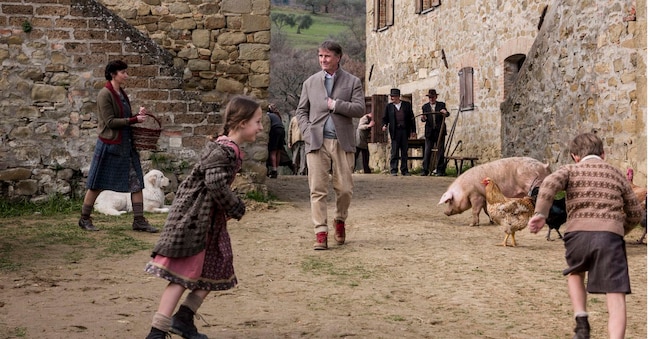
After an autobiography (The Dream of Solomeo, from 2018), press conferences for new collections or on philanthropic projects, honorary degrees and doctorates awards received all over the world, meetings with royalty and a speech at the G20 (in 2021, invited by the then Prime Minister Mario Draghi), to share his vision and life Brunello Cucinelli was missing something: a great tale in images, conceived as a contemporary version of those stories frescoed on the walls of medieval cathedrals where the didactic narrative becomes an evocation of a teaching, a warning.
There is something epic about it, the classic topos of the hero who is born, often in uncomfortable conditions, then grows, discovers and makes his talents, sometimes real powers, flourish in Giuseppe Tornatore's version of Cucinelli's life (with music by Nicola Piovani) in the film Brunello, the gracious visionary, presented on Thursday in Cinecittà's immense new Teatro 22, which in two hours sums up the Umbrian entrepreneur's 72 years of life with effectiveness, rhythm and poetry and will be in Italian cinemas from 9 to 11 December. A film produced by Brunello Cucinelli, a listed company since 2012, approved by the shareholders (also) as a communication project.
Although, as mentioned, much is known about Cucinelli, in the film as much is discovered and what is already known is better understood. We follow the birth of the hero-entrepreneur - whose talent and power was to create from nothing a company that employs 9,000 people in the world and whose revenues will reach 1.2 billion in 2024 (already over a billion in the first nine months 2025), one of the very few that is constantly growing in these difficult times for the fashion industry - in a large farming family in the high hills in the countryside of small Castel Rigone, famous for thousands of years for the healthiness of its air. With a gaze that is admired but capable of pausing before adoration, Tornatore follows Cucinelli as an adult meeting himself as a child (played by Francesco Cannevale), then as a young man (Francesco Ferroni) and as an adult (Saul Nanni) and returning to the places that have marked his life, starting from the old farmhouse where time and actions were marked by animals, wheat, snow and stars.
Cucinelli embraces the Sister Poverty of Saint Francis and with his own Umbrian eyes, despite the inevitable harshness, reads the manifestation of nature as harmony. Then there is the invitation of his father Umberto to trace straight furrows, an agricultural version of the cosmos, with the beauty of nature slowly becoming forma mentis, a land where one day his uncle Orlando, the most cultured of his family, sows the pages of Plato's Phaedo: they will sleep a long winter in the mind of young Brunello, who walks miles to go to school, even though the owner of the land would prefer him to work with his parents.
But it is while playing cards with his grandfather Fiorino that he discovers his super power: being able to read moves, anticipate them, combining intuition and calculation. He spends several years learning how to play in a bar on the outskirts of Perugia and it is precisely cards that Tornatore chooses as a narrative device. The director lingers on Cucinelli's subtle and enquiring gaze, which throughout the film plays with a mysterious companion (who it is, we will discover at the end), re-reading the knight Antonius Block's game with Death in Bergman's The Seventh Seal, but with the opposite outcome: Cucinelli will win, in the sense that he will succeed in tracing the furrow in which to sow his power and make it germinate, nourished by the other seed that finally grows all around, that of the passion for the spiritual quest that takes shape in the readings of philosophy.