
Italia’s most ‘Western’-style road trip along the Basentana
Bernalda on Screen and the White Lamie of Pisticci

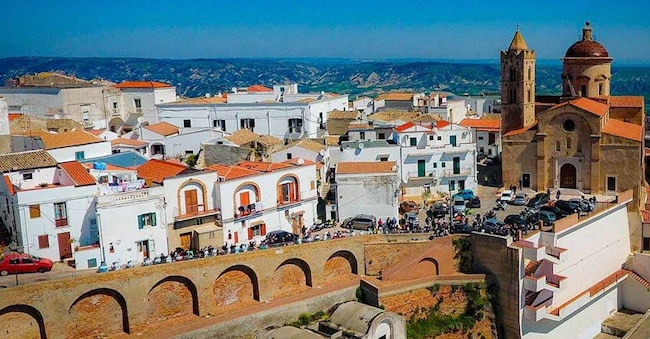
A dip at the Lido di Metaponto is always welcome if a September day still holds the warmth of the last of summer: here, Hollywood director Sofia Coppola and her family are happy to go for a swim before sunset. Certainly, Francis Ford’s children have chosen Bernalda as their Italian retreat – the very place from which the Coppolas set off to seek their fortune in America, with their descendants finding success in the film industry. There are many stories intertwined with Bernalda: the Hotel Giardino Giamperduto, for example, is a former dairy run by women who produced salted ricotta and freely expressed their views on the right to emancipation. The heir to the property, the curious and cultured Francesco Montemurro – a lawyer and novelist – inherited it and opened it as a guesthouse, preserving the cheese-making equipment and wooden carts as part of the décor. In this village nestled between the Bradano and Basento rivers, its very veins criss-crossed by clay-rich canyons, life flows along the nineteenth-century Corso Umberto I, where the villas boast charming façades. Thanks to the skilful guidance of architect Franca Digiorgio, many houses in the historic centre – mostly dating from the 18th century, clad in cocciopesto plaster and featuring arches and agave beams – are being restored around the Mother Church and the Norman-Aragonese Castle. Borgo San Gaetano is also an excellent example of architectural restoration, offering travellers the chance to stay in the very heart of Bernalda’s historic centre whilst enjoying modern comforts. Certainly, twenty years after its purchase by the Coppola family, Palazzo Margherita is enjoying a golden age, thanks first and foremost to the botanical foresight of Podestà Giuseppe Margherita, who loved Mediterranean and exotic species and therefore endowed the park with some truly remarkable trees – which have survived to the present day – as well as a vegetable garden. Phoenix canariensis palms also make an appearance outside, along the long central avenue: the interior of the palace is a veritable profusion of architectural decorations and frescoes in soft, soothing colours, whilst the devotion to cinema is evident in the screens, art books and photographs that provide company and inspire dreams, even in the bars and dining areas, which are furnished in a Mediterranean-Lucanian style, with the opportunity for guests to take part in cookery classes. The following day, you can make your way up to Pisticci to explore the Castle of San Basilio and the Mother Church of Saints Peter and Paul, which houses the bell tower built by the Lombard master builders Pietro and Antonio Laviola in 1542: the Baroque-style chapels and altars are truly remarkable, carved from wood and gilded, featuring paintings or papier-mâché statues by Salvatore Sacquegna, built above the underground chambers where the town’s prominent figures were buried. Whilst wandering through the Dirupo and Terravecchia districts, where you’ll also find the town’s ancient gate, the little Church of the Annunciation and the ruins of the Church of the Madonna della Stella, alongside various noble mansions and the tower of the Agri aqueduct dating from the Fascist era, one is enchanted by the whiteness of the ‘lammie’ – typical rows of small white houses – surrounding the little Church of the Immaculate Conception with its delicate frescoed wooden ceiling and small organ.

