Turmso and food

How do you eat on a cruise? Here are all the secrets of on-board dining

The choice of a cruise also depends on the richness of the gastronomic offer: we visited the kitchens as big as a football pitch and the 13 restaurants on an Msc ship to see how the shipping company wants to 'transform catering into an identifying element of the on-board experience'
by Maria Teresa Manuelli

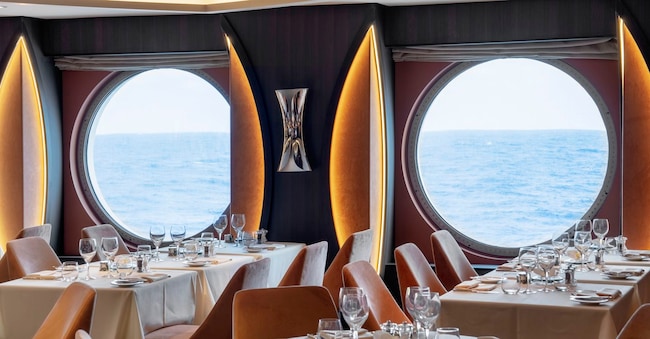
MSC World Europa, La Foglia Restaurant

4' min read

Translated by AI
Versione italiana

4' min read

Translated by AI
Versione italiana

Cruises are sailing at full force. According to estimates by Clia-Cruise Lines International Association, passengers numbered 31.7 million in 2023, became 35.7 million in 2024 and will reach 39.4 million in 2027. An escalation that shows no sign of stopping, driven by an ever-expanding supply and increasingly sophisticated demand. Especially when it comes to food. In Italia 15.3 million cruise passengers travelled in 2025, and about half of them - with peaks of 66% among millennials - declared themselves willing to pay more for a quality gastronomic experience, on board as well as on land.

For Msc Crociere, the cruise division of the Msc-Mediterranean Shipping Company Group, this is exactly the point: to distinguish itself by "raising the bar of service and transforming catering into an identifying element of the on-board experience". To see how it works, we went on board the Msc World Europa, the first ship in the company's World class - equipped with no fewer than 13 restaurants, including six thematic restaurants, and 20 bars and lounges - and descended into the galley of this flagship that produces 25,000 meals a day.

Loading...

Welcome to the galley

Let's start with terminology: the galley on board is not called a kitchen, it is called 'galley', in Italian 'galera'. Cesare Trani, sous chef at Msc Crociere, explains: "On ships, kitchens have no windows, as in Roman galleys, where prisoners rowed below sea level and the only light came in through the holes in the oars". Here, however, there is no imprisonment: 'They pay us well, I must say, and we have well-calibrated shifts,' he is keen to specify.

The galley of the Msc World Europa occupies over 2,500 square metres, 'almost as big as a football pitch', says Trani, and is the ship's only main galley (the theme restaurants have their own kitchens). Here 290 chefs work in shifts. In addition to the passengers - 6,762 at full capacity according to official Msc Cruises figures - there are 2,100 crew members, of 57 different nationalities, each with their own eating habits. "The crew's cook has a harder job than mine," admits Trani, "because in addition to different languages, they all have different eating habits that we respect.

Bread 9 times a day

The galley is divided into departments working in parallel. The cold area - dedicated to fruit, cheese, salads, canapés and appetisers - employs 27 people in shifts. The bakery, which is connected to the pastry shop, bakes bread nine times a day: "You cannot do it once," explains Trani, "the air conditioning has a terrible effect on the bakery products. At full capacity at least 1,000 kilos of flour per day are needed for bread alone, plus another 400 for pizzas. 62 people work in the bakery. All the bread and all the cakes on the ship - including those for the theme restaurants - come out of here.

In order not to waste, the galley relies on a digital system called 'crunch time meal count': waiters enter orders on tablets connected to monitors distributed in the various sections. The system updates the required quantities - steaks, lobsters, starters - in real time, allowing production to be calibrated and leftovers to be avoided. Added to this is a systematic waste control: scales with integrated camera measure in real time how much material is discarded in each section. "We must not go over one tonne per section," explains Trani. Even organic waste follows a strict sorting system: bones, egg shells and vegetable waste cannot be disposed of together, because the on-board shredders do not tolerate certain materials and must be protected.

Supply Logistics

Being at sea does not, however, mean being disconnected from the supply chain. Luca Cesarini, corporate executive chef Speciality Restaurant at Msc Cruises, explains: the fleet is restocked twice a week. The fresh - vegetables and fruit - arrives from Barcelona; the dry and frozen are loaded in Genoa. Meat and fish travel mostly frozen. Orders must be placed at least three weeks in advance, and each supplier must be pre-approved and certified. "You cannot say 'I lack flour, I'll go and buy it from someone else'," says Cesarini. "There is careful selection and certification work behind each of our partners.

On a fleet scale, the numbers give the measure of the operation: the 23 Msc ships are stocked annually with around 5,500 different food and beverage items. A total of 32 million eggs, 6 million litres of milk, 170 thousand oysters, 2 million tomatoes, 900 thousand kilos of apples and 800 thousand kilos of lemons are loaded each year. The menu changes twice a year - winter from November to April, summer from April to October - and is adapted to the routes: in the Mediterranean French, Spanish and Italian influences prevail; in the Caribbean it veers towards South American cuisine.

Wide selection and thematic restaurants

The fact that Msc Crociere focuses on catering as a distinctive element is also confirmed by the care and variety of the six themed restaurants in addition to the ship's six restaurants and the buffet. This is confirmed by Emma Di Nicuolo, the company's communications manager: throughout the fleet there are now some eighty themed restaurants, with formats ranging from Butcher's Cut steakhouse to Japanese Kaito, from Mexican Hola! Tacos & Cantina to Teppanyaki, through to more recent concepts such as La Pescaderia - a market-style Mediterranean seafood restaurant - and the Chef's Garden Kitchen on the Msc World Europa, the first hydroponic vegetable garden at sea, developed with Swedish star chef Niklas Ekstedt on the basis of the "farm to ocean" philosophy.

The Microbrewery Masters of the Sea produces Msc Signature craft beers on board using desalinated seawater, in collaboration with Teo Musso, founder of the Piedmontese brewery Baladin. While the small dairy produces fresh mozzarella (around 300 kg).

On the Msc World America, which will join the fleet in 2025, there is, instead, the only Eataly restaurant on board a ship. On the future Msc World Asia - due to be launched in November 2026 - the Italy restaurant will make its debut, a Made in Italy format already present on the World America and particularly successful on the US market, together with a new pan-Asian concept. Msc Crociere's industrial plan envisages increasing the fleet to 35 ships in 2035, for a total investment of €10.5 billion on the World class ships alone that are currently under construction.

Copyright reserved ©
Loading...

Brand connect

Loading...

Newsletter

Notizie e approfondimenti sugli avvenimenti politici, economici e finanziari.

Iscriviti