
Live
European Council, live coverage. Merz: ‘Make significant cuts to the EU budget’. ETS: letter from Finland, Denmark and Sweden
The EU Council is taking place at the Europa Building in Brussels on 15 and 16 October. Topics on the agenda include the EU budget, the Emissions Trading System and Ukraine
For feedback, please contact
english@ilsole24ore.com
 Aggiungi Il Sole 24 Ore
ai preferiti su Google
A lengthy summit on the budget may take place in December
The December European Council meeting, dedicated to the 2028–34 MFF, could be longer than usual. This is the view of German Chancellor Friedrich Merz, speaking on the sidelines of the summit in Brussels. “We are still a long way off, with two and a half months to go until the end of the year,” he said. “That does not mean we will not be able to find solutions in November and December. We will have to pack a few more shirts than usual for the December Council meeting,” he concluded. President Antonio Costa has set the end of the year as the deadline for reaching an agreement. The July 2020 summit to reach an agreement on the 2021–27 MFF and Next Generation EU lasted four days and four nights.
Costa: ‘We are working on energy solutions, including long-term ones’
At the European Council, ‘discussions are taking place on Europe’s response to high energy prices’, which ‘are putting pressure on households and businesses. They are undermining our competitiveness. The EU is working on a coordinated response. Targeted and temporary measures are essential to ease the burden and reduce price volatility. In the long term, we must continue to reduce Europe’s dependence on fossil fuels.” So said the President of the European Council, Antonio Costa, on X.
Zelensky is to meet Rutte in Brussels
The Ukrainian President Volodymyr Zelensky is due to meet the NATO Secretary-General Mark Rutte in Brussels today. This has been reported by NATO sources. The Ukrainian leader is expected to attend the European Council tomorrow.
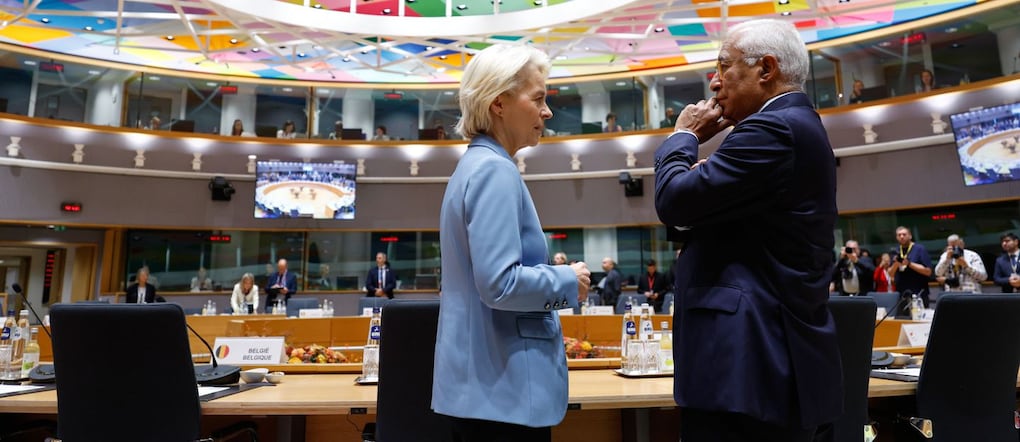
La presidente della Commissione europea Ursula von der Leyen parla con il presidente del Consiglio europeo Antonio Costa in occasione del Consiglio europeo (Apn)
Ask the editorial team
Have questions or feedback about this article? Contact our editorial team.
Sanchez: ‘The Irish budget proposal is insufficient. Migrants’ rights must be respected’
“We are faced with a proposal” for the 2028–2034 budget “that is clearly insufficient, closer to 1 per cent than to 2 per cent” of gross national income. “This is neither acceptable nor feasible for the Spanish Government. This is what I will convey to the European Council” This was stated by the Spanish Prime Minister, Pedro Sánchez, on his arrival at the European Council in Brussels. For Madrid, “there remains a substantial difference between Member States, not only regarding their own resources, but also regarding the allocation of the resources needed to address three key areas: all the EU’s ‘traditional policies’ such as the CAP and cohesion, competitiveness and, finally, everything relating to foreign policy’. Sánchez then thanked the EU leaders for the support they had shown during the Ceuta crisis: “When it comes to immigration, we need responsible management, solidarity and respect for human rights.”
Energy and the ETS, the cost of living and the EU budget: Meloni’s challenges at the European Council

“We must act immediately and in a coordinated manner.” Giorgia Meloni arrives at the European Council to urge the other heads of state and government to demand that Brussels take swift action against high energy prices and protection of households and businesses from runaway inflation. And to call once again for flexibility, this time on the grounds of soaring prices, which are also putting a severe strain on compliance with the spending rule at the heart of the new Stability and Growth Pact.
The first issue is energy. The escalation in Iran and the Gulf, and the instability in the Red Sea caused by Houthi incursions, offer no sign of a short-term solution for Hormuz and Bab el-Mandeb. For Italia, which remains heavily dependent on imports and has an energy mix in which gas accounts for a significant share, the impact on households and businesses is immediate.
Draghi: ‘High threshold for intervention in France; the priority is inflation’
The prospect of the ECB intervening in the markets to support France remains a distant one. This was stated by the former ECB President, Mario Draghi, in an interview with Bloomberg at the New Economy Forum in New Delhi, emphasising that the eurozone is still ‘a long way’ from a repeat of the sovereign debt crisis. ‘The threshold is high,’ said Draghi, adding that at the time ‘we were effectively in a deflationary situation, or at least with inflation rates just above zero, whereas today inflation is high and, moreover, rising’. The ECB’s top priority, he added, is therefore to fulfil its mandate on price stability. The EU’s excessive deficit procedure, to which France is subject, also complicates any intervention. “There is nothing to prevent the use of these instruments when a country is subject to the excessive deficit procedure,” Draghi clarified, “but certainly the threshold for using them is a little higher.” A further obstacle is the political debate in France. ‘The very fact that whether or not the ECB can intervene has become a subject of political debate in France,’ he observed, ‘makes intervention even more difficult, if anything.’ The central bank, he concluded, ‘I presume does not wish to be drawn into the internal political disputes of any single country’.
Further reading

 France: the debt boom – why crises come and go, but deficits remain
Meloni: ‘I am working with our friends in the Cohesion Group on shared priorities in the EU budget’
“Together with Nicusor Dan, I brought together the Heads of State and Government of the Friends of Cohesion group ahead of the European Council. We have decided to stand united in the negotiations on the next EU budget, focusing on four priorities: sufficient resources to address all our shared priorities; safeguarding cohesion and agriculture, both in terms of resources and funding rules; fair contributions from Member States; No to discounts on national contributions.” Italian Prime Minister Giorgia Meloni wrote this on X. “We will continue to work together to ensure these priorities are reflected in the final agreement!”, she added.
Insieme a @NicusorDanRO, ho riunito i Capi di Stato e di Governo del gruppo degli Amici della Coesione in vista dell'#EUCO.
— Giorgia Meloni (@GiorgiaMeloni) October 15, 2026
Abbiamo deciso di restare uniti nel negoziato sul prossimo bilancio UE attorno a quattro priorità:
1. Risorse sufficienti per affrontare tutte le priorità… pic.twitter.com/HsnnguAHSC
15 October 2026
Frugal countries: ‘Spend more wisely, not simply more’
On the sidelines of the European Council, a meeting of the ‘frugal’ countries was held to discuss the new EU multiannual budget. “Our group is growing. This morning I hosted the third meeting of the countries that share the same vision for the next EU budget for the period 2028–2034. I would like to thank German Chancellor Friedrich Merz, Danish Prime Minister Mette Frederiksen, Dutch Prime Minister Rob Jetten, Swedish Prime Minister Ulf Kristersson, Finnish Prime Minister Petteri Orpo and Belgian Prime Minister Bart De Wever”, writes Austrian Chancellor Christian Stocker. “We are in favour of a strong, competitive and secure Europe. Together, we contribute around 40 per cent of the EU budget and are prepared to continue supporting this share. However, the current proposal is still far too high and does not form a basis for an agreement. Without further substantial cuts, there will be no deal. We must spend better, not simply spend more,” he adds.
15 October 2026
Sweden: ‘We deeply regret the Trump-Putin agreement on diesel’
“We deeply deplore the ‘diesel deal’ reached between the US and Russian presidents, Donald Trump and Vladimir Putin, which ‘represents a step in the wrong direction. And any move that now helps the Russians to increase their funding for the war is a bad sign. We therefore fully share Volodymyr Zelensky’s view on this matter.” This was stated by the Swedish Prime Minister Ulf Kristersson upon arriving at the European Council summit in Brussels, according to The Guardian.
Further reading
15 October 2026
The European Council begins in Brussels
The European Council meeting on 15 and 16 October has formally begun at the Europa Building in Brussels.
15 October 2026
First summit between the presidents of the EU and the Gulf states to take place tomorrow
Tomorrow, the European Parliament will host “the first-ever summit of the presidents of legislative assemblies between the EU and the Gulf Cooperation Council”. This was announced by the President of the European Parliament, Roberta Metsola, on her arrival at the European Council in Brussels.
Further reading
15 October 2026
Merz: ‘Russian frozen assets must remain in Europe’
“These are assets that have been frozen in Europe and must remain frozen in Europe. This is a matter that concerns us, and it is up to us to decide on it.” This was stated by the German Chancellor Friedrich Merz, in response to a question about frozen Russian assets upon his arrival at the European Council in Brussels.
15 October 2026
Metsola: ‘The draft budget? You can’t do more with less’
“Whilst we are very grateful to the Irish Presidency for having attempted to reconcile, so to speak, the irreconcilable, we were very surprised to note the lack of progress on own resources, alongside cuts in the areas of innovation, defence and competitiveness. To put it very simply: you cannot do more with less.” This was stated by the President of the European Parliament Roberta Metsola upon arriving at the European Council. “If we do not take action on own resources and proceed with across-the-board cuts, we will not be able to make our citizens feel that anything has changed, nor will we be able to show them that we have addressed their concerns. And, crucially, it remains to be seen whether the necessary majorities can be found within the European Parliament to give their consent to all this,’ she added.
15 October 2026
Merz: ‘We need to make significant cuts to the EU budget. The Irish proposal is not enough’
“We must significantly reduce the common budget compared with the proposals. No EU Member State can afford to pay contributions on this scale.” This was stated by the German Chancellor Friedrich Merz on his arrival at the EU summit in Brussels, predicting “very, very difficult” negotiations. “I would like to thank the Irish Presidency of the Council for the negotiating proposal”, but “it is still a long way from where we need to be”, he said. “I would hope that we could reach an agreement on the multiannual financial framework by the end of the year, even though positions within the European Union are currently very far apart.”
15 October 2026
Bulgaria: ‘Russian diesel? Any measure to reduce fuel prices is welcome’
‘Do you know what our problem is in Europe at the moment? High fuel prices. We welcome any measures aimed at reducing fuel prices and ensuring our competitiveness.” This was stated by the Bulgarian Prime Minister, Rumen Radev, on his arrival at the European Council in Brussels, in response to a question about the United States’ decision to ease sanctions against Russian diesel.
15 October 2026
Pedro Sánchez is ready to oppose the draft budget
Spanish Prime Minister Pedro Sánchez is set to oppose, at today’s European Council meeting, the proposal for the 2028–2034 EU budget put forward by the Irish Presidency, which reduces the planned funding to 1,620 billion compared with the 1,760 billion proposed by the European Commission. According to sources at Moncloa cited by the Spanish media, Madrid considers the cuts – particularly those affecting competitiveness and security – to be unacceptable, and is calling for a more ambitious budget, financed in part by new European own resources and fairer contribution criteria. Among the priorities outlined by Sánchez are defence, security, interconnections, the fight against climate change, research and technological innovation.
15 October 2026
Tajani: ‘The EU should appoint a peace envoy for Ukraine soon’
On Ukraine, ‘the important thing is that Europe has a spokesperson authorised to negotiate in the name and on behalf of the entire Union. For Europe to carry more weight, it needs a spokesperson for everyone. The important thing is that this is decided swiftly.’ This was stated by the Foreign Minister, Antonio Tajani, on the sidelines of the EPP pre-summit in Brussels. “The President of the European Council, Antonio Costa, is an authoritative figure; it could be him, but it could also be someone else. The problem is that a consensus must be reached, and whoever speaks must do so on behalf of everyone. Let’s decide on this – it could even be a group of states,” he reiterated.
15 October 2026
The problems in Paris and Berlin are affecting the progress of the next EU budget
 from our correspondent Beda Romano
BRUSSELS – Between now and the end of the year, negotiations on the upcoming EU budget for 2028–2034 will dominate institutional life in Brussels. To date, the negotiations appear to be in limbo, partly because the two leading European countries, Germany and France, are bogged down in domestic political issues – Berlin grappling with the rise of extremist parties, and Paris with violent social protests. How much longer can the Franco-German duo afford to be absent from the table?
We are familiar with the terms of the issue. Whilst Germany wants to modernise the budget and reduce its size, France is calling for agricultural spending to be maintained and for new joint debt to be issued to strengthen the budget itself. The Irish Presidency of the European Union is expected to publish a new negotiating framework, broken down by expenditure chapters, on Saturday 10 October. It should be noted that the framework presented by the Cypriot Presidency was rejected out of hand by the 27 Member States.
15 October 2026
Letter from Finland, Denmark and Sweden: ‘We will not weaken the ETS system’
The ETS system “has been the main driver of this transition” and any “weakening would undermine the predictability on which investment decisions depend and risk slowing the pace of industrial decarbonisation”. This is according to the prime ministers of Finland, Denmark and Sweden in a letter to the President of the European Council, Antonio Costa, ahead of the summit getting underway in Brussels, where leaders will also discuss the review of the carbon market. The risk of such a weakening “is that it would shift the burden of emissions reductions onto other sectors of the economy”, they write. In the letter, the three prime ministers (Petteri Orpo, Mette Frederiksen and Ulf Kristersson) emphasise that the ‘transition to a clean Europe is entering a decisive phase’ and ‘whilst discussions on Europe’s competitiveness continue, we believe it is important to reaffirm our commitment to market-based climate instruments and to preserve the integrity and ambition of the ETS’.
15 October 2026
Meloni has arrived at the Europa Building for the European Council
The Prime Minister Giorgia Meloni has arrived at the Europa Building, the seat of the European Council in Brussels, for the 27-nation summit which will conclude tomorrow. Before the summit begins, she will co-host a meeting of the Friends of Cohesion with Romania.
15 October 2026
Netherlands: ‘Many countries are lagging behind in aid to Ukraine; more can be done’
“I call on all European leaders to do more, both financially and in military and non-military terms, because many European countries are lagging behind in their support for Ukraine: let us step up our efforts and ensure that they can win this senseless war.” This was stated by the Dutch Prime Minister Rob Jetten upon his arrival at the European Council. “There is only one reason why this war of aggression continues, and that is because Putin has chosen to wage it. He is the only one who can bring it to an end by initiating negotiations for a just and lasting peace. And until he does so, the Ukrainians will have to defend themselves and defend European values.”
