
Digital Divide

Dubai is accelerating the adoption of cryptocurrencies in everyday payments and the property market

From the travel sector to the general public, Dubai is integrating cryptocurrency into digital transactions, with mandatory conversions into dirhams and a strict regulatory framework.

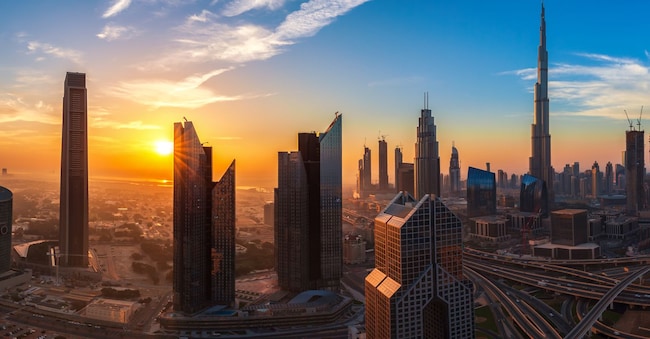
Skyline di Dubai stock.adobe.com

4' min read

Translated by AI
Versione italiana

4' min read

Translated by AI
Versione italiana

Airlines, government departments, retailers and property developers in Dubai are gradually embracing payments in digital assets, transforming what was until recently a niche channel into an increasingly tangible reality in everyday economic life. The growing acceptance of cryptocurrencies forms part of Dubai’s Cashless Strategy, which is part of the D33 economic agenda, aiming to digitise 90 per cent of transactions in the public and private sectors by 2027. One of the most visible signs of this comes from the travel sector.

Emirates has introduced Crypto.com Pay as a payment option for customers in the UAE booking in dirhams via the airline’s website or app. This integration follows the memorandum of understanding signed in 2025 between Emirates and Crypto.com to explore the use of cryptocurrencies in digital checkouts. The retail sector is also beginning to make moves.

Loading...

 Dubai Duty Free is allowing UAE residents to pay using Crypto.com Pay at Dubai’s airports and online, becoming the first airport retailer in the Middle East to introduce a regulated digital payment method of this kind. Here too, the infrastructure is set up so that the merchant receives payment in dirhams, whilst the user pays using their crypto balance via an authorised platform.

Cryptocurrency in the public sector and the property sector

Another potentially even more significant development concerns the public sector. Dubai plans to allow residents to pay fees for government services using crypto, as part of an agreement between the Department of Finance and Crypto.com. Under this model, payments made via the platform’s wallet are converted into dirhams before reaching public accounts.

The same principle applies to the property sector, one of the sectors that has contributed most to strengthening Dubai’s image as a hub for technological innovation. Buying a property with digital assets is legal, but with one specific caveat: payment in crypto must be converted into AED via an authorised intermediary before registration can be completed.

Therefore, ownership is not recorded directly in Bitcoin or other cryptocurrencies; the conversion takes place either before or during the official transfer. Acceptance also depends on the seller, but several major developers, including Damac, Emaar, Nakheel and Ellington Properties, have already embraced this option.

The Dubai Land Department has entered into agreements to develop a blockchain-based property investment environment and has already launched initiatives aimed at making fractional ownership more accessible, including through relatively low entry thresholds. Tokenisation and cryptocurrency, however, are not the same thing: the former digitally represents a real-world asset, such as a property, whilst the latter is a native currency of a blockchain.

However, the convergence of these two aspects could, over time, reshape the way in which value is invested, preserved and transferred within the property sector.

The regulatory system

Overall, the UAE is seeking to become a regulated ecosystem for digital assets, capable of attracting international operators, institutional capital and advanced financial infrastructure. In Dubai, this initiative is primarily being driven by the Virtual Assets Regulatory Authority (VARA), the body responsible for regulating virtual assets and virtual asset service providers across the emirate, excluding activities falling within the jurisdiction of the Dubai International Financial Centre.

Alongside Dubai, Abu Dhabi is also continuing to strengthen its position.

Loading...

The Abu Dhabi Global Market, through its digital assets framework, positions itself as a regulated platform connected to a global network of regulators and fintech hubs, offering companies in the sector a base from which to expand into multiple markets.

According to an analysis published in local newspapers, the country received over 56 billion dollars in crypto between 2024 and 2025, whilst institutional-scale transactions are among the fastest-growing segments. This suggests that local growth is not driven solely by retail adoption or consumer curiosity, but also by family offices, high-net-worth investors and professional operators seeking an environment compatible with compliance, banking and local currency regulatory requirements.

Market trends

According to Grand View Research, the UAE’s crypto market is projected to generate $104 million in revenue in 2025 and could reach $290 million by 2033, with an average annual growth rate of 13.9 per cent from 2026 to 2033. Although this is an industry estimate, the figure helps to illustrate a sector that no longer appears to be marginal, but is gradually becoming more established.

In the UAE, the Digital Dirham is emerging as one of the most significant elements of the country’s financial evolution. According to Gulf News, following pilot projects and the initial regulatory steps, the aim is to achieve wider use in peer-to-peer, commercial and cross-border transactions.

As of this year, the UAE Central Bank has registered USDU, described as the country’s first domestic stablecoin pegged to the US dollar and backed by local banks, whilst the dirham-denominated stablecoin DDSC has been given the green light to be distributed via regulated exchanges in Dubai, with potential future applications in retail and merchant payments. Of course, the dirham remains the sole official currency.

Furthermore, Dubai’s regulatory framework itself takes a selective approach: not all activities are permitted in the same way; operators must be authorised; and even the commercial promotion of virtual assets is subject to specific rules.

It is incorrect to describe the Emirates as a crypto paradise; it is a country that is seeking to integrate digital assets into the financial sector and the real economy without relinquishing regulatory control.

Copyright reserved ©
Loading...

Brand connect

Loading...

Newsletter

Notizie e approfondimenti sugli avvenimenti politici, economici e finanziari.

Iscriviti