

Cyber and AI calculate the time it takes for a situation to escalate. But it is up to the states to decide
Drones in Ukraine and the Middle East, and the use of artificial intelligence in theatres of war, have reduced the time required for tactical decision-making to a matter of moments. We must be equally adept at creating the time needed to understand. Because the next leap in deterrence may not be a more powerful weapon or a faster algorithm, but the ability to prevent speed from turning uncertainty into a military response.

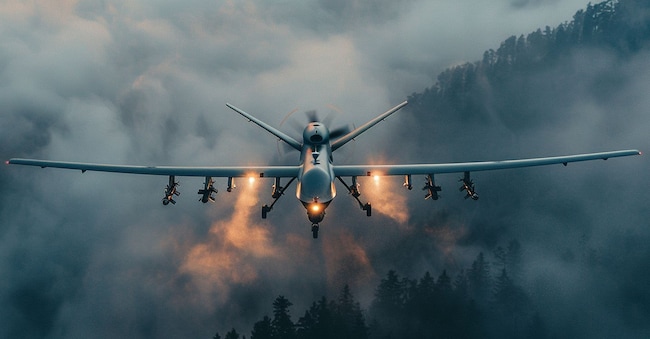
Two Eurofighters from Italy took off on a scramble mission and shot down a drone in Lithuanian airspace. In the hours that followed, it was still unclear where it had come from or why it was there. It is one of the most striking images of the war – or perhaps not a war – that is changing: we may be forced to act before we fully understand what we are reacting to. The problem has a name that is well known in cybersecurity: time. But there is a paradox. For years, we have been working to reduce the time needed to detect an attack and respond. In geopolitics, however, there is a timeframe that we should not compress too much: the time between the perception of a threat and the decision to raise the level of confrontation. We could call it Mean Time to Escalate – the average time to escalation.
At a political level, this timeframe is still lengthy: formal authorisations, consultations between allies, sanctions and military decisions take days, weeks, sometimes months. At a tactical level, however, the window narrows down to minutes and seconds. Sensors, drones, autonomous systems and AI observe, correlate and suggest responses at a speed incompatible with the traditional pace of politics. It is within this window that the newest risk lies: not so much the geographical spread of conflicts, but the fact that tactical time can drag political time into its own rhythm.
The Russian-Ukrainian front is already showing signs of this friction. Sub-threshold pressure – measured actions designed to produce effects without openly crossing the threshold of a military response – can force the adversary to react. A relatively inexpensive drone can trigger radar alerts, prompt fighter jets to take off and activate chains of command. Testing defences is nothing new: it was also done during the Cold War. What has changed is the cost and the scale. Today, this can be achieved using unmanned, expendable and reusable systems, whilst AI correlates what the response reveals with satellite imagery, communications and open-source intelligence. Today, it is perhaps even less politically risky. A drone may accidentally stray off course. In the past, spy planes were capable of moving the hands of the Doomsday Clock ever closer to zero.
The cyber issue
Cyber takes this asymmetry even further, as it allows the ground to be prepared before a confrontation takes place, whilst at the same time being incredibly difficult to detect and attribute. On 13 July, the European Union adopted the largest package of cyber sanctions ever imposed against the Russian ecosystem. The point is not merely the sanctions themselves. It is the difference in speed: a digital operation can be prepared and carried out in a matter of hours; formally attributing it, building political consensus and responding takes much longer. This gap between operational time and institutional time is in itself a strategic vulnerability. The Middle East highlights another aspect of the problem: the fragility of the nodes.
The Strait of Hormuz is the most obvious example. Before the conflict, an average of around 125 large ships passed through it each day; on 15 September Reuters counted just four. There is no need to capture a node to produce a global effect. It is enough to alter the risk for the entire network to begin reconfiguring itself. This applies to a maritime strait, but also to a submarine cable, a cloud region, a satellite constellation or an energy network. The new geopolitics is also the geopolitics of dependencies. And this is where the two theatres begin to resemble one another: not because there is necessarily a single central authority, but because infrastructure, technologies and decision-making timescales are becoming increasingly interdependent. Energy shapes industrial capacity; the cloud underpins civil and military services; satellites support navigation and targeting; drones consume interceptors. The distinction between the civil, technological and military spheres is becoming increasingly blurred.

