
De Luca wins challenge against Schlein, towards battle of appeals
The government would have no interest in challenging the regional law within the 60 days, but this would risk invalidating the next elections

3' min read
Key points
3' min read
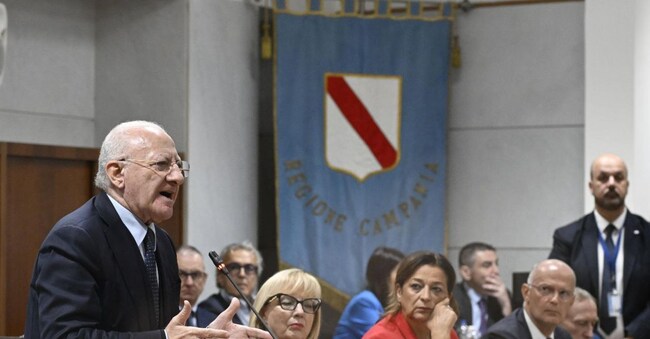
Said and done. With 33 votes in favour, 16 against and one abstention, the Campania Regional Council approved the regional law that effectively allows the candidature, the third, of governor Vincenzo De Luca in the 2025 spring elections. The trick is to make the calculation count from the current term of office and not from the first election in 2015: 'The calculation of the two consecutive terms of office shall start from the one in progress on the date of entry into force of this law', i.e. 15 days after its publication in the Campania Region's Official Bulletin.
For the Campania PD it is 'a technical vote' - as group leader Mario Casillo pointed out - that does not preclude the search for a shared candidate who 'takes into account the work done by De Luca'. But it is clear that this is an open challenge to Schlein (the Nazareno has immediately confirmed its rejection of De Luca's third term as governor), the outcome of which is unpredictable: what is certain is that at the moment it is a political defeat for the Dem secretary, given that the Campania councillors did not follow her instructions to vote against and given that ever since the primary campaign in February 2023 she herself had indicated the fight against the 'cacicchi' as one of her main objectives.
National law prevails: De Luca's is a losing battle
But the Campania issue does not only affect the political level, it also and above all affects the legal one. In fact, the 2004 national law states unequivocally that the limit on terms of office is to be set at two consecutive terms, so there is no margin for starting the count from the transposition of the law at regional level as De Luca and those who support him would like. It would have been different if the 2004 law had merely provided for the setting of a generic limit on terms of office. In the words of the constitutionalist Salvatore Curreri, an expert on parties and electoral regulations, 'the third regional term of office represents a blatant violation of the legislation in force: for De Luca it is from this point of view a losing battle, and his presence in next year's electoral competition would moreover risk invalidating the election itself'.
Why the government has no interest in challenging the electoral law
The point is that it is only the government that has the right to challenge the regional law before the Constitutional Court within 60 days. But does it suit the majority to prevent De Luca's 'third' candidature? Of course not, because a candidature of the governor of Campania in spite of the saints, and especially in spite of Schlein's PD, would undoubtedly divide the centre-left, handing yet another region - and what a region - to the centre-right on a silver platter. Especially if the official candidate of the wide camp, after the M5s has always been in opposition in Campania, were to be the former Pentastellist president of the Chamber of Deputies Roberto Fico: many Dem voters 'loyal' to the governor-sheriff (and not only) would not be willing to vote for Giuseppe Conte's candidate. The road is therefore paved for the deputy Foreign Minister Edmondo Cirielli, of Fratelli d'Italia, who just in the past hour has revealed that the party has asked him to be willing to run?
The strong risk of having to repeat the regional elections soon
.If the government decides not to challenge the regional law within the prescribed 60 days, there can only be appeals downstream. After the regional elections, therefore, any of the losing candidates could appeal to the TAR, which would then refer the matter to the Constitutional Court. If De Luca really decided to take part in the elections - and those who know him well assure us that the sheriff-governor wants to go all the way in his battle, also because he is convinced of winning - there would be a strong risk of invalidation of the election, with the people of Campania forced to go back to the polls at the very last minute. But it is precisely the risk of having to repeat the elections even in the event of victory that worries the majority, and it is no coincidence that Cirielli himself immediately commented 'I believe that the government will challenge the law...'. Certainly the candidate in pectore has no desire to leave his post at the Farnesina with the prospect of seeing his eventual victory immediately annulled.


