Circular economy

Faulty goods: from 31 July, the right to a repair comes into force in EU countries

Member States will be required to transpose the directive, which aims to promote the repair of items that are not working properly and to combat planned obsolescence. Here are the key changes

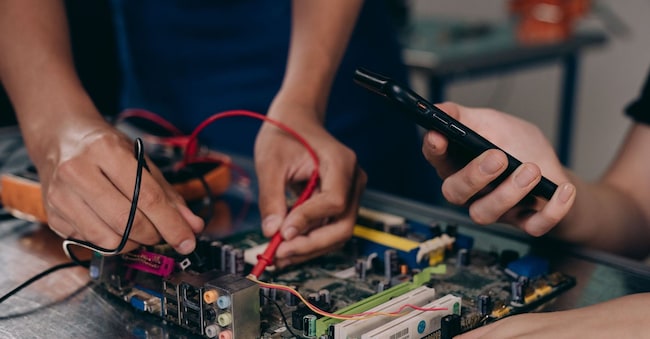
Credits: Pexels (Mikhail Nilov)

5' min read

Translated by AI
Versione italiana

5' min read

Translated by AI
Versione italiana

The deadline is fast approaching: by 31 July all EU Member States – including Italy – must transpose European Directive 2024/1799, which regulates the ‘right to repair’. This move is aimed at a long-standing objective: to reduce the premature disposal of items that are still in working order or can be repaired, and to educate citizens on the extended use of consumer goods, in line with the strategies put in place for the green transition, the circular economy and sustainability. Let’s take a look at what’s new.

The products concerned

The list of products set to benefit from the European directive is by no means short: washing machines, dishwashers, tumble dryers, refrigeration appliances, vacuum cleaners, smartphones, cordless phones, tablets, televisions, monitors, servers and external storage devices. But that’s not all: the list also includes battery-powered products such as e-bikes and electric scooters and welding tools. It is possible that this range of items may be expanded in the future.

Loading...

The module

One of the most interesting new developments is undoubtedly the obligation for manufacturers to repair goods that can be refurbished, even beyond the terms of the statutory guarantee. The text actually sets out a sort of roadmap to follow: before commencing repair procedures, the party responsible for managing them must provide the customer with a form containing a range of essential information: from the personal details of the repairer and the item in question, through to the type of work to be carried out and the time required to complete it, right up to the price. This information will remain valid for 30 days – a timeframe that allows the consumer to assess whether the proposal is worthwhile – and may also be extended if the repairer and consumer reach an agreement. That’s not all: the form must be provided free of charge and on a durable medium.

Should it be necessary, in order to assess the fault, to determine whether or not action can be taken and what strategy to adopt, to carry out a diagnostic check either in person or remotely, the repairer is required to inform the consumer in advance and also to advise them of the cost of the service.

Prices and consumer protection

Speaking specifically of the costs and economic value of repairing a faulty product, the directive specifies that this must be carried out either free of charge or at a proportionate price within a reasonable timeframe. Furthermore, as an additional safeguard, the consumer must be offered a replacement product for the duration of the repair work. This product must be returned once the work is complete.

Should the customer give the go-ahead to proceed, the repairer will be required to comply with the signed agreement: otherwise, the aggrieved party may avail themselves of all available remedies, ranging from termination for breach of contract to compensation for damages.

Finally, if the manufacturer responsible for the repair is based outside the EU, the obligation falls to the authorised representative within the European Union or the importer of the goods. If there is no importer, the distributor takes over.

Refurbished option

Should things not go smoothly and, despite attempting to use spare parts (which, under the directive, manufacturers must make available at affordable prices, with a view to minimising the need for new parts as much as possible and combating planned obsolescence), the manufacturer were to confirm that the item cannot be repaired, there are three options: on the one hand, you have the right not to proceed further with the repair; on the other hand, however, you may propose to the consumer the refurbished option. As a final alternative, they may choose to have the work carried out by a third party.

Extendable warranty

Another significant change concerns the warranty. If a washing machine, fridge or toaster is still covered by the warranty and the consumer opts for repair rather than replacement (a right that remains sacrosanct and in force), the directive allows for an extension of a further twelve months from the date of repair.

Towards more eco-friendly products

European legislation also covers design. This means new obligations for companies: they will have to place household appliances or technology on the market ‘environmentally friendly’, which are easy to repair and recycle. This is also intended to curb the overproduction of waste that is difficult to dispose of.

Loading...

A new platform

The text then goes on to discuss the launch of , a European online platform for repairs, which aims to facilitate contact between service providers and customers. Repairers, sellers of refurbished goods and buyers of faulty goods seeking refurbishment services will be able to register on the platform. Not only that: this range of options is further complemented by participatory repair initiatives (Repair Café), as well as those promoted by non-profit organisations, where people offer their skills to repair items such as computers, bicycles, phones and clothes.

By 31 July 2027, the European Commission must develop the platform and will also be directly responsible for its maintenance. The service will be free for the public to use, and the portal will be managed by the Ministry of Enterprise and Made in Italy, which has been designated as the point of contact responsible, amongst other tasks, for providing access to the section, monitoring data and removing invalid information.

Consumer protection

Last but not least, the measures implemented to protect the public . Article 127-novies of the Directive stipulates that the websites of the Mimit, the Ministry of the Environment and Energy Security, the AGCM and the tuttoconsumatori.it of the National Council of Consumers and Users must feature dedicated sections setting out consumers’ rights and a link to the national section of the EU platform.

As regards, however, penalties – with the exception of cases where a criminal offence has been committed – the manufacturer, the authorised representative, the importer, the distributor or the repairer who breaches the prescribed obligations shall be liable to an administrative fine, for each breach, of between 5,000 and 50,000 euros, taking into account the seriousness, duration of the breach and the economic and financial circumstances of the offender. In the event of serious offences or repeat offences, the maximum fines will be doubled. The AGCM will be responsible for investigating such breaches.

Support from the Observatory

To assist stakeholders in implementing the directive, a ‘National Observatory on Redress’ will also be set up. This will be a useful tool for monitoring compliance with the legislation: it will gather feedback on issues encountered by the public and businesses and help to promoteof best practices in the field of repair can certainly help ensure that behaviour complies with the law. The Observatory will be tasked with raising awareness of the goods repair sector, monitoring trends and facilitating coordination between social and institutional stakeholders in monitoring the effects of the transposition.

New tools for transparency

In line with the provisions of the directive and as part of its efforts to protect consumer rights, the EU is introducing a new measure to enhance transparency regarding guarantees for consumer goods. From 27 September, sellers will be required to display a ‘harmonised notice’ in a prominent place to inform the public of their rights under the statutory guarantee: this may be displayed in-store or published online on the seller’s website.

As for manufacturers, however, they will be able to offer a voluntary commercial durability guarantee, at no extra cost, via a ‘harmonised European Garan label’.

Both measures are designed to promote dialogue between businesses and consumers, by improving the provision of information and curbing unfair practices.

Copyright reserved ©
Loading...

Brand connect

Loading...

Newsletter

Notizie e approfondimenti sugli avvenimenti politici, economici e finanziari.

Iscriviti