Competitiveness

Draghi and Collison (Stripe) step in to boost growth in Europe: the Rhine Group is launched

Mario Draghi and Patrick Collison are bringing together economists, entrepreneurs, academics and key figures in European politics

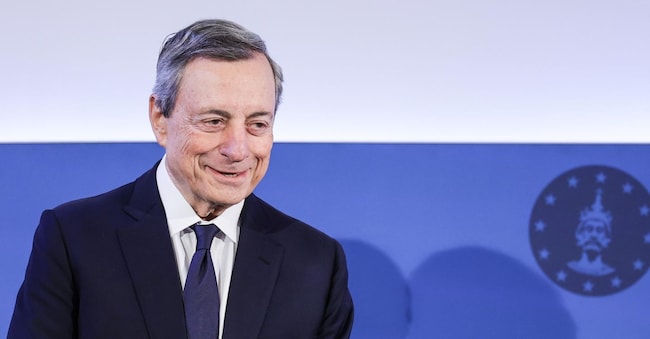
Mario Draghi  (EPA)

4' min read

Translated by AI
Versione italiana

4' min read

Translated by AI
Versione italiana

Mario Draghi and Patrick Collison are bringing together economists, entrepreneurs, academics and key figures from European politics. The aim is to transform the assessment of the Draghi report on competitiveness into a concrete reform agenda. The group also includes a sizeable Italian contingent, ranging from Andrea Pignataro to Lucrezia Reichlin, and from Francesco Giavazzi to Francesco Decarolis.

It is called the Rhine Group and is a new initiative launched in August 2026 to tackle what Mario Draghi now considers to be Europe’s central problem: the loss of competitiveness, productivity and capacity for innovation in a world that has become much tougher.

Loading...

It was founded by two figures who appear to have little in common, yet are united by the same concern: Mario Draghi, the economist who led the European Central Bank during the euro crisis and who, in 2024, authored the European Commission’s report on competitiveness, and Patrick Collison, co-founder and CEO of Stripe, one of the tech entrepreneurs most interested in the relationship between innovation, science and growth. The two are co-chairs.

The group is led in practical terms by Luis Garicano, a Spanish economist and former MEP. The starting point is a realisation that is far from reassuring.

A question of economic power and sovereignty

According to the Rhine Group, only four of the world’s fifty largest technology companies are European. And in virtually all the technology sectors set to shape the coming decades – from artificial intelligence to new platforms, from scientific research to emerging technologies – the continent is starting from a position of weakness. In the view of the organisers, this is not merely a question of industrial prestige.

It is a question of economic power and, ultimately, of sovereignty. Because a Europe with low growth is a Europe with fewer resources to fund what it considers essential: defence, healthcare, pensions, education, climate investment and social protection. The group’s argument is clear: economic stagnation, if it persists over time, ultimately becomes a political and strategic problem.

How to rebuild Europe’s capacity for innovation and competitiveness

It is here that the emergence of the Rhine Group takes on a broader significance. For decades, Europe was able to rely on a relatively favourable international environment. World trade was growing under the umbrella of multilateral rules, the United States guaranteed a decisive part of Western security, and many economic dependencies could be seen as reciprocal and therefore manageable. That world, according to Draghi and Collison, no longer exists. The United States has become more protectionist; China is a far more aggressive competitor both in international markets and within the European market itself; whilst strategic dependencies – in energy, technology and industry – have become riskier. The result is that Europe now finds itself more exposed to external events, just as its growth model is showing its limitations. Hence the tone of the group’s manifesto.

“Decline is not inevitable,” is essentially the argument, “but it is the direction we are heading in if we do not act urgently”. And the response should not be to resign ourselves to a Europe that has been reduced to a second-tier power. On the contrary: the continent must return to competing, building and growing.

This move is significant because it overturns a certain defensive narrative about Europe. The Rhine Group does not start from the premise of protecting what already exists, but from the need to rebuild Europe’s capacity to innovate and create businesses capable of competing on a global scale. This is also because, as the promoters point out, Europe is not a marginal market: it is the second-largest market in the world. The truly novel aspect of the Rhine Group, however, lies in its attempt to take a step further than the report published by Draghi in 2024. That document had produced a very comprehensive analysis and over 170 proposals on energy, industry, defence, digital infrastructure, capital markets and productivity. It has become one of the key references in the European debate on competitiveness. The challenge now is to transform those ideas into reforms that can actually be implemented.

Identity

The Rhine Group was established precisely in this space: between research and politics, between analysis and implementation. It is not formally a European institution and does not claim to take the place of the Commission or national governments. Rather, it aims to be a forum where people who would normally sit at different tables can come together to discuss the major reforms that Europe needs.

Loading...

Government, academia, finance, industry and technology are all brought together under one roof. And a glance at the list of participants makes it clear that this is no ordinary think tank. The group includes leading figures from the worlds of economics, business, finance and European politics: from Nobel laureate Philippe Aghion to former Estonian President Toomas Hendrik Ilves, from Beatrice Weder di Mauro, President of the Centre for Economic Policy Research, to Zanny Minton Beddoes, Editor-in-Chief of The Economist, right through to tech entrepreneurs such as Tobi Lütke of Shopify, Niklas Zennström of Atomico and Sebastian Siemiatkowski of Klarna. There are also leading figures from European industry, research and institutions. And the Italian presence is far from marginal. There is Andrea Pignataro, founder and CEO of Ion Group; there is Lucrezia Reichlin, an economist at London Business School; there is Francesco Giavazzi, professor emeritus of economics at Bocconi University; and there is Francesco Decarolis, professor of economics at Bocconi University. Joining them is Vittorio Colao, former chief executive of Vodafone and now vice-chairman for EMEA at General Atlantic.

Copyright reserved ©
Loading...

Brand connect

Loading...

Newsletter

Notizie e approfondimenti sugli avvenimenti politici, economici e finanziari.

Iscriviti