
EU funds: the regions oppose ‘double centralisation’
Italian regions, from Fontana (Lombardy) to the progressive governors, have rejected the new EU financial framework: the funds will go to central governments and regional operational programmes will be scrapped. “We may soon have to close some of our offices.” For Kata Tüttő, President of the Committee of the Regions, this represents a profound structural change, but confusion currently reigns over the negotiations.

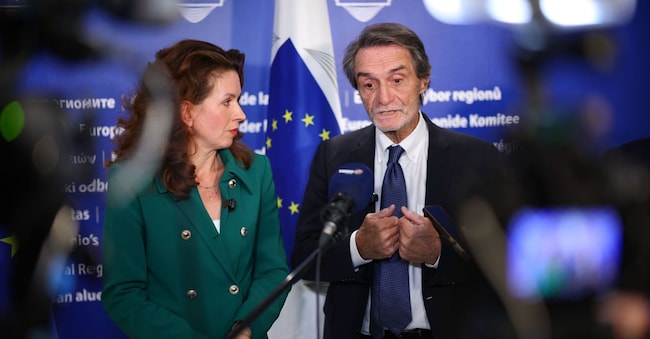
BRUSSELS – “If this is the way forward, we may soon have to close some of our regional offices.” Attilio Fontana, President of the Lombardy Region, who is on a mission to Brussels alongside many of his colleagues during the week dedicated to European regions and cities – which coincides with a crucial European Council meeting on the next long-term budget – is unequivocal in his rejection of the proposals on which heads of state and government are attempting to reach unanimous agreement by the end of the year. And whilst this applies to Lombardy, one of the EU’s wealthiest regions, the situation is even more worrying for the others. It is therefore no coincidence that on the very same day that Fontana met the Commissioner for Cohesion and Reforms, Raffaele Fitto, and the President of the Committee of the Regions, Kata Tüttő, six of his colleagues from the progressive group (Antonio Decaro for Puglia, Stefania Proietti for Umbria, Alessandra Todde for Sardinia, Michele de Pascale for Emilia-Romagna, Eugenio Giani for Tuscany and Roberto Fico for Campania) were making similar points in the European Parliament, signing a joint declaration calling for “a Europe of the regions, not a Europe of cuts”.
“The structure of the Union’s new multiannual financial framework has changed significantly, as the funds will now go to central governments, which will decide where to invest them,” summarised the President of the Committee of the Regions. “It will no longer be the regions that shape policies for their local areas. This is a major change: until now, cohesion policy has enabled investment across all regions of Europe, linking local areas to the single market.”
A dangerous road
So it is not so much a question of resources (the EU’s annual budget is equivalent to Lombardy’s GDP, as Tüttő pointed out) as, above all, of governance. “It is a very dangerous path,” explains Fontana, “because we are witnessing a dual centralisation of resource management – towards the national government and towards the European Commission – which is even more unacceptable to me, as an advocate of autonomy and a federalist.” To put this into perspective, the European Court of Auditors has calculated that the proportion of funds under shared management (such as the Cohesion Fund and the CAP) falls from 66 per cent of the 2021–27 budget to 46 per cent of the 2028–34 budget: a prospect which, according to the Court, may not only present ‘administrative challenges’ for the Commission, but may also compromise the geographical distribution of expenditure.”
The picture that is emerging, in fact, does not merely envisage a percentage cut in European funding allocated to the regions for cohesion and agriculture, but, above all, it abolishes the regional operational programmes – which currently give the regions full responsibility for managing the funds – and introduces a single plan for each Member State, under which the role of the regions and the amount of funding allocated to them will depend almost entirely on the decisions of each national government.
The PNRR model
This approach is modelled on the PNRR not only in terms of the single national plan but, above all, in terms of the method of disbursing funds, which is no longer based on expenditure reporting but on the achievement of specific objectives (milestones), which will largely consist of reforms requested by the EU from Member States, based on the specific recommendations issued annually by the Commission to national capitals. According to the intentions of its designers, the model should lead to ‘overcoming the fragmentation’ of the 500 current programmes (51 of which are in Italia) in an attempt to ‘create synergies’.


