

Europe in the crosshairs of the US and Russia: sabotage, propaganda and new powers
In the book The Secret War: Putin and Trump Against Europe, Antonio Talia reconstructs clandestine operations, disinformation campaigns and ideological alliances aimed at undermining the Old Continent. The investigation reveals that Washington and Moscow are far more complicit than is generally believed

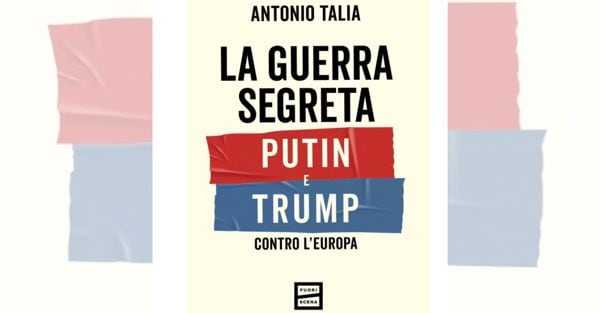
There are books that start with a thesis and seek out the evidence in historical events needed to support it. And then there are books that begin with the chronicle, gathering seemingly marginal episodes, tracing them over time, and only at the end attempting to understand whether there is an overarching pattern behind that series of fragments. The Secret War. Putin and Trump against Europe by Antonio Talia belongs to the second category, although over the course of its 192 pages the narrative gradually takes on a very precise thesis. The book is a journalistic investigation comprising a long sequence of cases, characters, documents and testimonies.
The starting point is the speech delivered by J.D. Vance at the Munich Conference in February 2025. On that occasion, it became clear that the political rift between the United States and Europe is no longer merely a divergence over security, trade or the war in Ukraine, but has taken on an ideological dimension. The book draws parallels between the accusations levelled by Vance at the European elites and the rhetoric developed over the years by the Kremlin, going so far as to establish a continuity between the language of Patriarch Kirill, Russian propaganda and certain currents within the new American right. The central idea of the book is that whilst Europe continues to perceive Russia and the United States as distinct and potentially reconcilable partners, a far deeper convergence is emerging between Moscow and a section of the new Trumpian America. Alongside this, an investigative element is woven into the narrative.
Talia is at her most effective when she immerses the reader in concrete places and situations. The border between Lithuania and Belarus, with jammers disrupting GPS signals, the balloons used to transport cigarettes and the gradual transformation of smuggling tools into means of pressure and sabotage, is a successful example of the author’s method. The thesis of the ‘arsenalisation’ of everyday tools – that is, the transformation of criminal practices into instruments of war – becomes clear precisely through these episodes.
The same applies to the ships in the Russian ‘ghost fleet’. The case of the Boracay, formerly the Pushpa, seized by the French Navy, allows the author to explain how the parallel economy built by Moscow to circumvent sanctions works: old oil tankers, flags of convenience, shell companies, forged documents, manipulation of the AIS (the Automatic Identification System used to track the movements of cargo in all the world’s waters), transhipments and companies that are difficult to trace back to the beneficial owner.
From the perspective of ideological analysis, Talia juxtaposes the Russian concept of ‘traditional values’ with the currents of the American Dark Enlightenment, drawing on figures such as Peter Thiel, Nick Land, Curtis Yarvin and Aleksandr Dugin. This analysis is interesting because it identifies common ground in their aversion to liberal universalism, representative democracy and certain forms of the Western order, and emphasises that Putin’s Russia and certain circles of the American tech right, whilst coming from different backgrounds, have developed a converging critique directed at the same target: the European liberal order.

