Fair Trade

Fairtrade Italia, 3.6 million generated in 2025 for the development of global supply chains

Market stable at €550 million in revenues, partly because it is less affected by international speculation and demand is tighter than prices

by Emiliano Sgambato

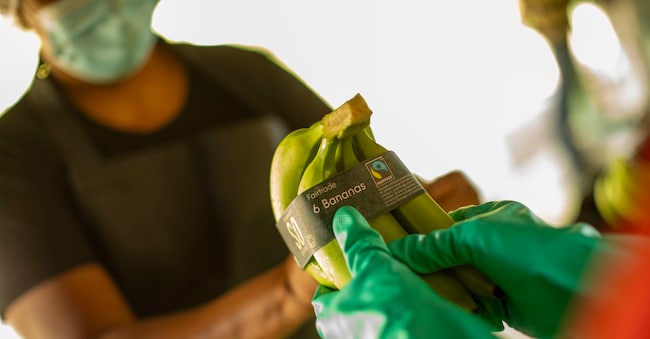
Fairtrade bananas are packed at a BANELINO farm. Tatiana Fernandez / Fairtrade Germany / Fairpicture

4' min read

Translated by AI
Versione italiana

4' min read

Translated by AI
Versione italiana

Fairtrade, by its very nature, is structurally more resistant than average both to speculative shocks on the commodity market and to the influence of the price variable with respect to consumer choice, who often prefer this channel for ethical reasons (which sometimes run counter to the market logic mentioned above). And so, also because of this, the results linked to the Fairtrade label manage to remain constant overall even in 2025. The value of sales in Italia of products with at least one certified ingredient has held steady, remaining at €550 million and generating €3.6 million in 'Fairtrade premium' for the top 6 categories.

Data from the social report of Fairtrade Italia - the organisation that has represented the international certification system for transparent and responsible supply chains in our country since 1994 - were presented at the meeting held in Milan entitled 'Sustainability, an asset for companies'

Loading...

A prize for development

The Fairtrade premium is an additional sum with which producers participating in the Fairtrade system can implement projects to improve productivity or community development based on a collective decision made by the members of local co-ops. The largest contribution came from the cocoa chain, which alone generated more than EUR 2 million; followed by bananas, the mainstay of certified consumption in Italia with more than 16.5 million kg sold and EUR 807,868 in premiums, coffee with EUR 328.939 euro, sugar with 234,065 euro, cotton with 134,273 euro and finally flowers with 89,151 euro.
Globally, this dynamic has contributed to the system's goal that, in the last five years, has redistributed over a billion euro to producers.

"The data of the 2025 Report confirm that for Italian companies, sustainability is now an indispensable strategic asset," says Paolo Pastore, general director of Fairtrade Italia. "In an ever-changing regulatory environment, guarding the integrity of global supply chains with reliable technical tools is the key to guaranteeing supply stability and solidity to one's business model.

Consumer loyalty

With regard to consumer behaviour there is 'an underlying loyalty: those who have chosen Fairtrade,' comments Thomas Zulian, commercial director of Fairtrade Italia, 'tend not to abandon it, and in some segments, such as bananas and coffee, certification is consolidating as an expected standard. This tells us that sustainability is becoming a structural purchasing criterion, not just an emotional one. And in a difficult year for food consumption, we can only be satisfied with the results achieved, as is also confirmed by the4% growth of partner companies and the 2,746 certified references on the Italia market.

More bananas, less cocoa

On the volume front, 2025 confirmed a differentiated picture by category, 'but with an overall resilience that we consider positive in a market context that is not easy. Bananas had the most brilliant performance, with a growth of 13% in volume: this was due not to new sales outlets, but to an increase in purchases on the existing network and to a strengthening in the collective catering channel,' explains Zulian, 'particularly in school and company canteens. Certified coffee closed with +3% in volume, a result that we consider very solid considering that consumer prices increased by over 20% during the year: in some cities the espresso at the bar exceeded EUR 1.50, and this inevitably compressed consumption throughout the sector".

For cocoa, on the other hand, there is a volume reduction of about 5%. "International quotations," Zulian continues, "have reached historic peaks in 2024-2025, with direct repercussions on shelf prices. Families have rationalised their purchases of non-essential products such as chocolate and biscuits, with a dynamic typical of inflationary phases: growth in value, contraction in volume. The fact that certified cocoa lost less than the market average is a significant indicator for us'.

How prices change

On the subject of prices, Zulian adds an important clarification: 'Cocoa and coffee are commodities listed on the stock exchange, and in 2025 they reached record levels. What characterises the Fairtrade system is that the price paid to farmers does not follow market fluctuations: it is a guaranteed Minimum Price, calculated by Fairtrade International, which acts as a safety net when prices fall. When prices go up, as happened in 2024-2025 for coffee and cocoa, the market leads companies to pay more, but Fairtrade farmers still benefit from structurally more stable conditions than in the conventional market'.

In any case, the Fairtrade minimum price is updated periodically. "The last update for cocoa dates back to 2025 and takes into account increases in inflation in the countries of origin and protects agricultural producers at a time when they face significant price volatility and in parallel have to respond to increasing regulatory requirements."

As for sugar, the drop of 20% 'was largely determined by contingent factors: some stock breaks along the supply chain and a partner's decision to favour domestic products'.

The Malawi Zero Hunger Project

The Social Report 2025 also documents the launch of the 'Malawi Zero Hunger' field project, a three-year initiative financed by the Italian Agency for Development Cooperation (AICS) and implemented with Fairtrade Africa and Agricane Malawi. "The project responds to the serious environmental disasters that continue to affect the districts of Chikwawa and Nkhotakota, causing huge crop losses and the blocking of sugar exports. The intervention,' the promoters explain, 'aims to safeguard the food security of more than 4,400 producers and their families, through the promotion of sustainable agricultural practices, the strengthening of water infrastructures with the installation of wells, and the launching of food education and empowerment courses aimed especially at women. The aim is to promote diversification of food and income sources, strengthening cooperative governance and building a model of socio-economic resilience for the benefit of local communities'.

Copyright reserved ©
Loading...

Brand connect

Loading...

Newsletter

Notizie e approfondimenti sugli avvenimenti politici, economici e finanziari.

Iscriviti