

Family doctors: stop to reform, community houses at risk. Schillaci: 'We will find a solution'
The decree shared by the regions that opens up dependency to fill the Community Homes envisaged by the NRP is blocked. Criticism in the majority and Meloni's doubts

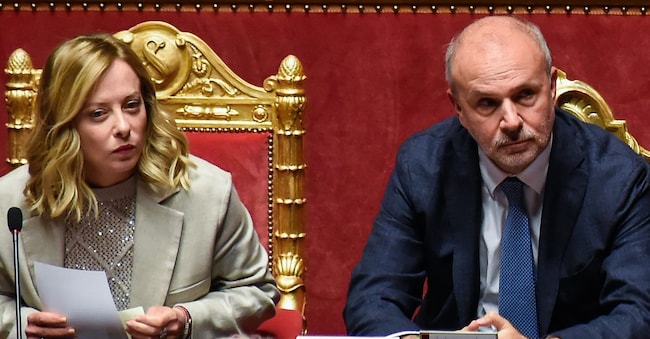
So much ado about nothing: the reform of family doctors created to fill the more than one thousand community centres that will open all over Italia at the end of June and about which there has been talk for months - actually for years, that is, since the time of Mario Draghi's executive - will not be done. Despite the unanimous support of the Regions, the government has decided to put back into the drawers the decree on which the Minister of Health, Orazio Schillaci, and the regional technicians had been working for weeks: the wall put up by the category, which has always 'threatened' to make its voice heard among the patient-voters, has made the sceptical voices prevail within the majority, first and foremost Forza Italia, which has always been critical of a revision, joined by Fratelli d'Italia and the League itself.
But it was the Prime Minister Giorgia Meloni herself, approached on the sidelines of last Thursday's Council of Ministers by Minister Schillaci, who has done so much for the reform, who expressed strong 'doubts'. A halt that, if confirmed, would sound like a resounding retreat, given that it was Meloni herself, over a month ago, who urged Schillaci to go ahead if there was agreement from the regions, an objective that had been achieved.
Minister Schillaci: 'Convinced that we will find a solution'
"I am convinced that we will find a square" on the reform of general medicine "because the square must be found in the interest of citizens. I only defend public health and I defend the weakest and most fragile people. This is a revolution from which we cannot back out, and I believe that no one will back out, understanding how important public health is for everyone and how important it is to endow the National Health Service with a more modern vision,' Health Minister Orazio Schillaci guaranteed, replying from the stage of the Innovation Festival in Venice to questions on the brakes that are slowing down the reform and the doubts expressed within the Centre-Right. The profession of general practitioner, Schillaci emphasised, 'is also made more attractive by finally having university-type training. Today, a young person graduating in medicine can choose between many specialisations - which are university-level specialisations, among other things paid for in a certain way - or be a general practitioner with a regional course paid for much less. So we must re-evaluate, together with the general practitioners, their professionalism, and ensure that they continue 'to have the fiduciary relationship they have with patients, because it is a cornerstone of our SSN, and see them together with other professionals within the Community Homes'.
The knots of the reform and the risk of the flop of Community Homes
The reform and its urgency arise from the fact that at the end of the month there is the date set by the National Reform Programme for the opening of Community Homes - maxi clinics on the territory where visits, examinations and prevention can be carried out to reduce the number of visits to emergency rooms - and beyond the opening of the facilities (the minimum target is 1,038) there is the problem of how to make them work and above all with which personnel. Two billion have arrived from Europe and when there will be Brussels' controls, not only on the opening but also on their operation, on paper there is the risk that they will ask for the funds back. In their last draft of the decree, Schillaci and the regions had imagined, alongside the current convention - family doctors are freelancers, and therefore autonomous in the management of their work even though they have an agreement with the SSN - to open up a residual channel that would provide for the recruitment as employees of a contingent of doctors to work in the most deprived Community Centres, where openings seven days a week must be guaranteed for at least 12 hours a day. But even the last, softer hypothesis on dependency has triggered off the reaction of the family doctors, who are convinced that the convention is the only way, so much so that there are already plans to work immediately on the next one (the 2025-2027 one), which would include an hourly 'obligation' of 6 hours a week to be spent in the Community Homes. However, times are really tight - in addition to the signing of the national convention, regional agreements are needed - and the risk of a flop for these facilities is now just around the corner.
The protest of the opposition and the weight of Enpam
The undersecretary for Health Marcello Gemmato (Fdi), who did not hide his doubts on the dependency, reassured that the Community Homes will be 'opened on schedule, with the shared availability of general practitioners'. The oppositions, on the other hand, rose up, evoking yet another failure in healthcare, with Mariolina Castellone (5 Stelle) calling for full light to be shed on 'possible conflicts of interest' linked to Enpam, the doctors' social security body, which 'manages billions' and 'intervenes on reforms that may affect its economic and contribution balances'.


