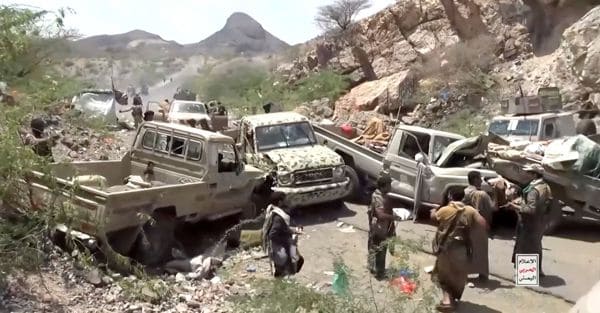
Fighting in Yemen is shifting northwards. There are already 100,000 displaced people
The Houthi blitz has shifted the internal balance of power within the country, probably due to the defection of National Resistance forces. However, military forces loyal to the government are regrouping around Taiz, and the Saudis are responding with air strikes. Russia has a strong interest in the blockade of Bab-el Mandeb, but its role has not yet been established.

The situation in Yemen, following the Houthis’ seizure of the Bab al-Mandab Strait, can be interpreted as a transition towards a new phase of the war, not merely as the end of a military campaign. A significant shift has taken place in the balance of power, but the situation remains unstable and the front lines are still open to developments that could redraw the balance of power in the coming period. The latest escalation began with the Mahan Air incident, followed by the Houthis’ declaration that what they termed the ‘de-escalation’ phase had ended, before they announced a naval blockade against Saudi ships under the slogan ‘blockade by blockade’. Since then, the escalation has accelerated, with both sides deploying drones and missiles. The Houthis’ attacks have focused on Yemeni army camps loyal to the legitimate government, the port of Mocha and Saudi energy facilities. On 3 September, Houthi forces launched a large-scale surprise attack on areas west of Taiz, specifically Maqbana, Al-Wazi’iyah and Jabal Habashi, deploying a significant number of fighters. In the initial phase, the Taiz Axis forces and the National Resistance loyal to the legitimate government managed to hold their ground and repel the initial assault. The Houthis achieved only limited success, capturing some hills and high ground overlooking Bab al-Mandab, before government forces recaptured several of them.
The retreat of the National Resistance
This phase is significant because the armed forces in Taiz are fighting whilst facing severe shortages of weapons and ammunition, and are experiencing irregularities in the payment of their salaries. Their resistance in the face of the initial attack is a crucial indicator of the nature of the battle and of the ability of local fighters to persevere despite limited resources. Subsequently, the Houthis deployed additional fighters, whilst the “Shield of the Homeland” forces – government forces whose leadership and composition are predominantly Salafist – arrived and managed to deploy and establish control over Hays and al-Khawkhah, north of al-Mukha. However, the most dangerous shift began with the withdrawal of units from the National Resistance forces led by Tariq Saleh, which upended the military landscape, particularly following the fall of the Khalid bin Walid camp. This fall gave the Houthis a greater ability to outflank and put pressure on the Homeland Shield forces, forcing government troops to withdraw from certain axes in order to reorganise. However, the withdrawals continued and intensified, evolving from mere repositioning into a decisive factor in changing the course of the battle. Field accounts we have gathered indicate that certain officers affiliated with the forces of Tariq Saleh co-ordinated the withdrawals, but this information requires an independent legal and military investigation before it can be considered conclusive.
The situation on the ground
On the ground, this resulted in a rapid Houthi advance, culminating in the fall of the city of Mocha and its port. This was accompanied by mounting accusations against Tariq Saleh, a member of the Presidential Leadership Council, or some of his associates, who were held responsible for the retreat. According to some allegations, there are links to the expulsion of forces backed by the United Arab Emirates and the Southern Transitional Council from Hadramaut. However, given the seriousness of these allegations, they should not be regarded as established facts. Subsequently, the Houthis continued their southward advance towards Dhubab, near the Strait of Bab al-Mandab, before entering the island of Mayyun, an extremely strategic location at the heart of the strait.
The fighting has been accompanied by a massive wave of displacement from Mocha and other areas, estimated at over 100,000 people. Some have headed towards Aden and Taiz, whilst others have reached Djibouti. There have also been reports and testimonies of abuses committed by Houthi forces in the areas they have entered, including the confiscation of homes and private property, the looting of belongings belonging to families and women, and the arrest of dozens of men. There are also reports of desecrations of the graves of opponents and shootings at these graves, practices which take on a dimension of revenge that goes beyond the military operations themselves. Furthermore, Taiz, Mocha and other populated areas have been the scene of indiscriminate shelling, which has exacerbated the risks to civilians and widened the scale of displacement and fear. However, the fall of Mocha and the capture of Bab al-Mandab do not signify the end of the battle. Clashes are continuing in Taiz, and government forces that had withdrawn from Mocha are reorganising. If the government’s statements translate into actual military movements, we are likely to see a resumption of fighting on the west coast and attempts to reopen the front towards Mocha and Bab al-Mandab.
The Saudi reaction
On the contrary, the Houthis have announced that maritime routes will remain open to shipping and that their presence at Bab al-Mandab will not hinder international trade. This rhetoric appears to aim to distinguish between military control of the strait and the disruption of shipping, as the Houthis understand that control of Bab al-Mandab affords them significant strategic leverage, but that disrupting shipping could quickly turn this advantage into a pretext for broader international intervention against them. At regional and international level, there are indications of an Iranian and Russian role, although the nature and scope of such a role require further verification. For Iran, the Houthis’ control of Bab al-Mandab represents a further strategic advantage, in addition to the Strait of Hormuz, particularly at this delicate juncture linked to the US elections and their potential implications for Tehran. The presence of an Iranian ally with significant capabilities in the vicinity of one of the most important strategic maritime chokepoints provides Tehran with a further advantage in any future confrontation with the United States or its allies, and could make Bab al-Mandab, together with Hormuz, part of a broader system of pressure on energy and trade routes. As for Russia, any disruption to energy flows and a rise in oil prices could serve some of its economic and strategic interests, particularly in light of the ongoing war in Ukraine, attacks on Russian energy infrastructure, Western pressure on oil exports and the ‘shadow fleet’. However, a distinction must be drawn between a convergence of interests and evidence of Russia’s direct involvement in the conflict, as the latter requires more concrete evidence.