Mediterranean Risiko

Following business deals, China is returning to Libya with military forces as well

Beijing reopened its embassy in 2025 and has focused on economic partnerships over the past year. Now, the Libyan Chief of the General Staff has met with representatives from the Ministry of Defence in Beijing. Against this backdrop, the Mediterranean – with port infrastructure and maritime security among the potential areas for the development of bilateral relations – takes centre stage.

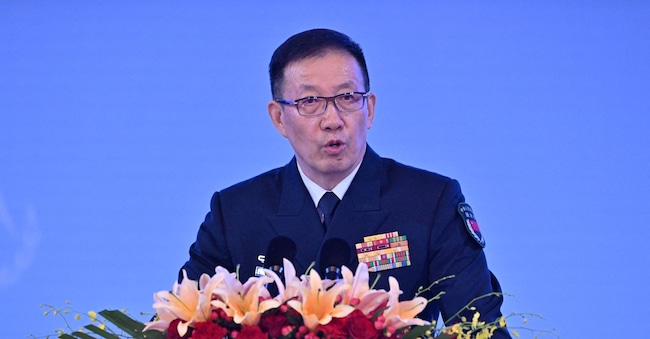
 Il ministro della Difesa cinese Dong Jun al Beijing Xiangshan Forum  AFP

3' min read

Translated by AI
Versione italiana

3' min read

Translated by AI
Versione italiana

On 12 November 2025, China announced the official resumption of diplomatic relations in Tripoli after ten years of silence. The two countries are now re-establishing relations on an economic and military level. The discussions launched in Tripoli concern investment in reconstruction, infrastructure, energy and telecommunications. At the same time, however, dialogue between the defence establishments has also been reactivated, with a particular focus on training and technical support.

The latest development came on 16 November, when the acting Foreign Minister of the Libyan Government of National Unity, Taher al-Baour, met with the Chinese Ambassador Ma Xueliang. The talks focused on the possibility of developing economic cooperation and encouraging Chinese companies to return to the North African country. The parties identified energy, telecommunications, infrastructure and reconstruction as some of the sectors on which to focus their efforts, making the most of the technical and financial capabilities of companies and institutions in Beijing.

Loading...

The Defence Channel

The economic dimension, however, does not encompass the full scope of the resumption of relations. Indeed, as early as September, the dialogue between the two countries had already directly involved their military establishments. On 20 September, the Libyan Chief of the General Staff, General Salah al-Namroush, met with representatives of the Chinese Ministry of Defence on the sidelines of the 13th Beijing Xiangshan Forum, an international event dedicated to security and military cooperation, held in the Chinese capital.

As recently as 8 July, Salah al-Namroush himself had been received in Rome by General Luciano Portolano, Chief of the Defence Staff. At that time, discussions centred on strengthening training activities and cooperation between the respective armed forces, as well as a wide-ranging package of training initiatives, including advanced courses in the cyber sector and Italian language programmes to be held in Tripoli, with the aim of preparing future participants for training courses at Italian military institutions.

Now, the meeting in Beijing, which took place at the invitation of the Chinese Defence Minister Dong Jun, reportedly addressed prospects similar to those currently being pursued by European countries, including Italia: namely, strengthening bilateral cooperation, with particular reference to staff training, technical support and the exchange of expertise.

It is now clear that Beijing is willing to re-establish direct dialogue with the Libyan military leadership. For the time being, the available information does not indicate that any agreements have been concluded regarding arms supplies or specific programmes for the modernisation of the armed forces. However, training and technical assistance are areas through which cooperation can gradually be expanded, particularly in a country where the fragmentation of military institutions has been one of the most persistent features of the crisis.

The maritime dimension

This prospect is particularly noteworthy on the Mediterranean side. Libya has a coastline stretching over 1,700 kilometres, bordering one of the region’s main trade and energy routes, as well as port infrastructure that will play a central role in reconstruction programmes.

Opportunities for collaboration cover areas ranging from the modernisation of port infrastructure and staff training to technologies for coastal surveillance and vessel traffic control. Technical assistance for maritime vessels could also be an area to monitor as relations develop.

Competition in the Mediterranean

Precisely because of the various problems afflicting and causing bloodshed in the country, Libya continues to be a forum for dialogue amongst various powers and a place of paramount importance for anyone seeking to exert control – even if only partial – over the Mediterranean. In addition to Italia, Russia, Turkey, Egypt, the United States and European countries all have economic, political and military interests there.

Proof of this is the fact that as recently as 18 November, just two days after the meeting between al-Baour and the Chinese ambassador, al-Namroush received the Russian ambassador, Aydar Aganin. It is understood that a Russian naval attaché also took part in the meeting. According to reports from the Libyan General Staff, the parties discussed the exchange of expertise, coordination between their respective military institutions and the possibilities for expanding cooperation in various defence sectors.

Loading...

After all, as early as mid-September we reported in these columns that two Russian ships had unloaded armoured vehicles in Libya. Moscow has embarked on a programme to refinance infrastructure projects at no fewer than six Libyan air bases: Al-Jufra, Al-Khadim, Al-Qardabiyah, Brak al-Shati, Maaten al-Sarra and Tamanhint. According to the Tearline Project of the National Geospatial-Intelligence Agency, the air bases are scattered throughout the country and are said to house a range of military equipment, including air defence systems, MiG-29 fighter jets and drones. They are run by Russian military personnel and mercenaries belonging to Africa Corps.

Copyright reserved ©
Loading...

Brand connect

Loading...

Newsletter

Notizie e approfondimenti sugli avvenimenti politici, economici e finanziari.

Iscriviti