

Former enemies join forces. The Kurds join the Syrian government
A historic handshake between Ahmed al-Sharaa and Mazloum Abdi, leader of the Kurdish militia. The Syrian Democratic Forces are disbanded and integrated into the army. An unimaginable development after many long years of clashes and bloodshed. The US and Turkey have played a significant role.

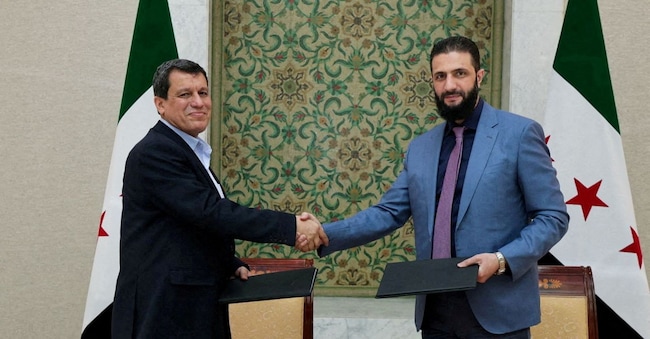
In an unstable and unpredictable Middle East, caught between an increasingly hardline Israeli government and far-reaching tensions between the United States and Iran, the Syrian president Ahmed al-Sharaa appears to have succeeded in resolving a long-standing issue that had been plaguing the country’s domestic politics: the civil and military integration of the Syrian-Kurdish militia, the Syrian Democratic Forces (SDF), into the Damascus establishment. On 25 August, at a meeting at the People’s Palace in the capital, the leader of what has long been the region’s most effective – and politically most contentious – paramilitary force, Mazloum Abdi, announced the ‘dissolution as an independent military force’ and the conclusion of the process of ‘integrating our forces into the Syrian Army’s brigades’. ‘We want this day to mark a genuine transition from the battlefields to the reconstruction sites, from the era of arms to that of peace,’ Abdi declared. Formed in 2015 as a rebel alliance during the Syrian civil war under US auspices, the SDF played a decisive role in the West’s fight against Islamic State, but also reignited the issue of Kurdish autonomy and self-determination, following decades of systematic discrimination under the autocratic regimes of Hafez al-Assad and his son Bashar. Following the fall of the Assad regime in December 2024, Mazloum Abdi and Ahmed al-Sharaa made several attempts at negotiation, each time stalling due to opposition from disgruntled factions and mutual accusations of deception and obstructionism.
The US stance on Syria
It was only in January of this year, following a central government offensive against the SDF in the north-east of the country, that a ceasefire was reached under the mediation of the US envoy Tom Barrack. The agreement on such a long-standing issue was largely facilitated by the more conciliatory approach of Damascus’s new head of state, who, with the January agreement, enshrined the national and linguistic rights of the Kurds by presidential decree – in addition, it must be said, the group’s military exhaustion following years of conflict. The announcement in August therefore marks the full implementation of that plan, and heralds a new phase in Syrian politics that will, it is hoped, be characterised more by pluralist and democratic cooperation than by armed conflict. In addition to formalising the dissolution and integration of the SDF, a few days later al-Sharaa appointed Mazloum Abdi as an adviser to the presidency, thereby institutionalising a direct channel of Kurdish influence within the central government – a move that appears aimed at allaying fears of the Kurds being marginalised following the end of their autonomy. On X, Special Envoy Tom Barrack hailed the agreement as “an example of true integration: not winners and losers, but former adversaries with differing visions who are working together to build a diplomatic solution to strengthen Syrian sovereignty”. On 28 August, the EU spokesperson for foreign affairs Anouar El Anouni also told the Syrian state news agency SANA that integration, alongside political representation and guarantees for the rights of Kurds as Syrian citizens, would help to strengthen civil peace.
The unknowns and Turkey’s next moves
However, doubts remain amongst supporters of the Kurdish cause, particularly regarding the risk that the appointment of Abdi may remain purely symbolic and that the guarantees promised to the Kurds may not actually be enshrined in the Constitution, as announced. Nevertheless, this development is a positive sign not only for Syrian domestic politics, but also for the stability of a region that has always been volatile. The parallel peace process between the Kurdistan Workers’ Party (PKK) and Ankara is also making encouraging progress, and the disbandment of the SDF is welcomed by Turkish President Erdogan, who has always been convinced that factions linked to the PKK should have no place anywhere in the region: a factor that could further facilitate the parallel negotiations. Last month, the Turkish parliament passed a historic law to facilitate the reintegration of PKK militants, with a view to the group’s disarmament and dissolution.
The coming months in Damascus
Echoing the optimism of American and European officials, as well as Abdi himself, Erdogan said he believed that ‘the disbandment of the SDF will usher in a new era for the entire region’, adding: ‘The chapter on terrorism must be closed; the era of weapons and violence must come to an end’. But in a country as ideologically fragmented as Syria, official optimism is not enough to completely quell the tensions in what remains, historically speaking, a political powder keg. Many Kurds will view the formal end of their dream of sovereignty with bitterness, and the agreement’s survival will depend to a large extent on the genuine willingness of al-Sharaa and his government to honour their promises of multi-ethnic and tolerant governance. The fact remains that a serious security risk has been defused in a country which, under al-Sharaa’s leadership, has committed itself to turning the page on the previous regime.

