US vs. EU

From the Digital Services Act to the visa ban: how the Breton case came about

Washington imposes entry restrictions on five Europeans in the US, accusing them of fuelling an alleged 'global industrial censorship complex'. The measure comes after months of tension over the Digital Services Act
by Angelica Migliorisi

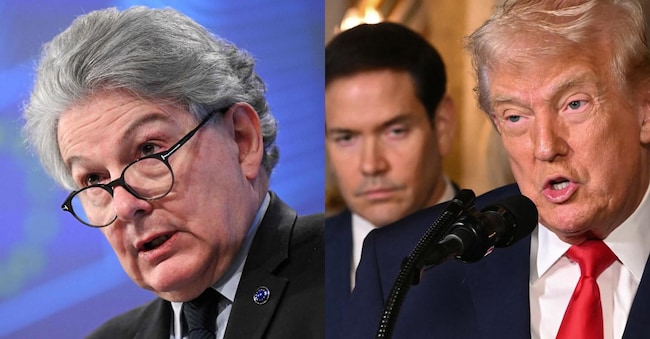
A sinistra, Thierry Breton, ex Commissario europeo per il Mercato interno; a destra, Marco Rubio, Segretario di Stato Usa, e Donald Trump, presidente Usa

4' min read

Translated by AI
Versione italiana

4' min read

Translated by AI
Versione italiana

A 'ban' instead of diplomacy. Washington puts Thierry Breton and four other Europeans on the list of undesirables and does so in public, linking their names to an alleged "global industrial censorship complex". It is the final scene in a story that has become, step by step, a tug-of-war between allies.

What happened

On 23 December 2025, the US State Department announced that it had imposed visa restrictions on five individuals who, according to the US, allegedly led or fuelled an alleged 'global industrial censorship complex'. In essence, a network of public decision-makers and civic organisations accused of pressurising American platforms and companies to restrict content and opinion protected by the First Amendment.

Loading...

The group includes Thierry Breton, former European Commissioner for the Internal Market, and four figures related to countering hatred and disinformation: Imran Ahmed (Centre for Countering Digital Hate), Josephine Ballon and Anna-Lena von Hodenberg (HateAid), Clare Melford (Global Disinformation Index).

The Dsa and the perceived 'spillover' effect in Washington

The friction stems from the heart of the Digital Services Act (Dsa), the European Union (EU) law that from 2024 imposes on online platforms - especially the largest ones - stricter rules on moderation and responsibility: transparency obligations on content and advertising, risk assessment and management, mitigation of illegal phenomena and 'systemic risks', independent audits and powers of supervision and sanction entrusted mostly to the European Commission. If for Brussels it is a package of guarantees and responsibilities for a safer digital market, for a part of the American establishment (in particular conservatives) it is a framework that, even if formally limited to the EU, induces global platforms to conform everywhere to reduce costs and legal risks, with the result of de facto conditioning also the US 'public square'.

Costa: "Sanzioni contro europei inaccettabili tra alleati e partner"

August-September 2024: the clash on X

A crucial juncture is the summer of 2024, when Breton becomes the recognisable face of the European 'hard line' on platforms in the United States. The House Judiciary Committee, led by Jim Jordan, opens direct political pressure on the Frenchman by accusing the Commission of threatening X (thus an American company) and of wanting to use European law to push content moderation that would end up touching political discourse in the United States as well. The letter of 15 August 2024 and the subsequent communiqué/letter of September formalise the rhetorical framework: Dsa equals content regulation, content regulation equals risk of censorship, risk of censorship equals American constitutional freedom problem.

In parallel, Breton's own public communication is also criticised by pro-digital rights actors: Eff, Access Now and ARTICLE 19 ask him to avoid an enforcement perceived as politicised and to clarify the interpretation of 'systemic risks', precisely so as not to hand over the argument that the DSA is used as political leverage to his opponents.

May 2025: Washington creates instrument

The quantum leap occurred on 28 May 2025, when US Secretary of State Marco Rubio announced a new 'visa restriction policy' aimed at 'foreign nationals' deemed responsible for restricting/censoring protected freedom of expression in the US.

The rationale is: if a foreign authority or its supporters push American platforms to remove or restrict content that would be protected in America, Washington can respond by preventing it from entering the country. Deterrence is not only aimed at governments, but also at "ecosystems" that - in US reading - influence the moderation, advertising and reputation of platforms.

August 2025: the diplomatic campaign against Dsa

In the summer of 2025, the US posture becomes operational: Reuters reveals an internal dispatch dated 4 August and signed by Rubio thatinvites US diplomats in Europe to engage governments and relevant authorities to promote opposition to the DSA, collect examples of alleged censorship affecting US Americans or companies, and push substantial changes to the law. Once the diplomatic machine is set up, therefore, the visa measure becomes the final part of the strategy.

September 2025: the clash intensifies

The debate soon entered political and research circles. A letter from scholars (circulated in the run-up to hearings and political clashes in the United States) contests 'maximalist' readings of the DSA as a instrument of global censorship and insists on the idea that the law, rather, introduces procedures and obligations that strengthen users' rights and the transparency of platforms.

5 December 2025: the fine at X and the accelerator effect

On 4-5 December 2025 the European Commission fines X EUR 120 million for violations of transparency obligations under Dsa, naming among the problems the design of the 'blue tick', the advertising archive, and access to data for researchers. It is the first major Dsa sanction of its kind and has a highly symbolic value because it hits the platform of Elon Musk, a central figure in the American debate on free speech and a political ally (now somewhat less so) of Trump.

18 December 2025: the Senate push

Within days of the State Department's announcement comes domestic pressure: Senator Eric Schmitt writes to Sarah B. Rogers openly calling for "sanctions and visa restrictions" against foreign individuals and entities linked to an alleged "international censorship regime", explicitly citing the multa a X and the European framework.

23 December 2025: towards the selection of the five targets

When the State Department announces 'actions to counter the global complex of industrial censorship', the framework is complete. There is the policy (May), there is the diplomatic campaign (August), there is the symbolic event (fine to X) and there is a domestic political push (Schmitt). The novelty of December is personalisation, with the measure being taken not against an institution or a government, but against individuals.

Breton, although no longer a commissioner, is the perfect target because he embodies the most media-driven phase of the confrontation with X and, for Washington, the very essence of the regulatory system. The other four names serve to target what the administration describes as the 'civic-operational' arm of the pressure, organisations that - in the American reading - influence moderation and the advertising market.

A years-long dispute thus ends not on a technical table, but in a gate at the airport. Five names become a passport stamp, and the word 'rules' slips into 'retaliation'. In the background the same questions remain - who decides what stays online, who pays when it goes wrong, who dictates global standards - but now they have a different noise: the dry one of a door closing between allies.

Copyright reserved ©

Brand connect

Loading...

Newsletter

Notizie e approfondimenti sugli avvenimenti politici, economici e finanziari.

Iscriviti