Locomotive in crisis

Germany, against recession more debt without touching the constitutional brake

Finance Minister and hawk Lindner is ready for more debt by 2025, thanks to the flexibility provided by the rules, when the economy is doing worse than expected. And in the country, the debate on whether budget constraints should be reformed is reopened

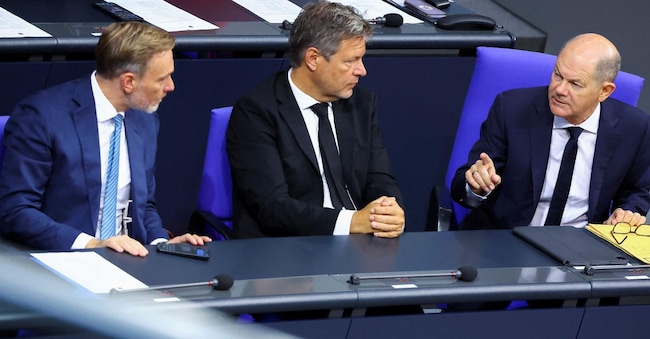
Il cancelliere tedesco Olaf Scholz (primo da destra), il ministro dell’Economia, Robert Habeck, e il ministro delle Finanze, Christian Lindner (primo da sinistra)

3' min read

3' min read

Make more debt, without reforming the debt brake. This is the idea of the German Finance Minister, Christian Lindner, the leader of the Liberals who rigidly opposes the questioning of budget constraints in Germany, as well as common European debt.

Less growth, more debt

.

According to his ministry's plans, revealed by Spiegel on 11 October, Germany's net borrowing will amount to EUR 56.5 billion next year, 5.2 billion more than estimated in the summer in the government's draft budget.

Loading...

A greater recourse to loans is made possible by the slowdown of the economy, which is probably already in technical recession (two consecutive quarters of contraction) and which is set to close 2024 with a GDP decline of 0.2%, according to the new estimates just released by the Executive. A weaker trend than assumed in the draft budget, therefore, which opens up room for manoeuvre.

The new debt would be intended to compensate for the drop in tax revenues caused by the economic slowdown and the increased spending due to rising unemployment, but it will not (at least not entirely) solve the issue of the 12 billion hole in next year's financial manoeuvre, adopted by the coalition led by Olaf Scholz after weeks of clashes.

Lindner reiterates 'no' to Draghi: risks for common debt too high

Scheduled cuts

.

On the basis of the mid-May estimates, experts had predicted that the governments, federal, state and local, would have to dispense with a total of EUR 80.7 billion between 2024 and 2028, compared to the autumn 2023 estimates. The new estimates of the Executive are expected on 24 October.

Government spokesman Wolfgang Büchner said they would wait until the end of October before deciding whether to fully utilise the additional debt margin allowed by the debt brake rules.

Max 2025 in France: cuts and higher taxes without assets

Braking or not braking

.

In Germany, the federal government and the 16 states are obliged to maintain 'in principle' a balanced budget. No other G7 country has such strict limits. The rules were included in the German Constitution in 2009 (this was in the middle of the global financial crisis).

The debate has always been open, and now, with the economy in the doldrums and strategic industrial groups in crisis, many are wondering how strict adherence to constraints, which although not absolute, limit the structural deficit at federal level to 0.35% of GDP, is appropriate. A very narrow margin for manoeuvre.

On Wednesday 9 October, the Minister of Economic Affairs, the Green Robert Habeck, outlining the government's dark economic forecasts, said that a revision of these rules could help get out of the crisis.

For economist Achim Truger, one of the members of the committee of wise men advising the government, the executive should 'declare an emergency and suspend the debt brake'. The president of the Bundesbank, Joachim Nagel, has also repeatedly spoken out in favour of some revision of the rules.

On the opposite side, there is precisely Lindner: 'The state cannot buy growth with debt,' he said after the cut of the forecast for the German economy. And on 11 October he stated that the automatic debt adjustment shows the flexibility of German debt rules.

The debt brake was suspended in the past to cope with the consequences of the Covid-19 pandemic and the energy crisis, and in 2023, for the war in Ukraine.


Copyright reserved ©

Brand connect

Loading...

Newsletter

Notizie e approfondimenti sugli avvenimenti politici, economici e finanziari.

Iscriviti