Test drive preview

Omoda 4: a sneak preview (in China) of the Shs-h full-hybrid version

More crossover than SUV, the new model boasts an unconventional style, a powertrain that prioritises electric motor power and European-style dynamism

5' min read

Translated by AI
Versione italiana

5' min read

Translated by AI
Versione italiana

Originally named Omoda 3 when it was a concept car, it became the Omoda 4 once production was approved – a move intended to convey that the final result had exceeded expectations, no doubt thanks to the vision of some marketing ‘deus ex machina’ – and marks a new chapter for the Chery Group’s brand. We had a sneak preview of the Omoda 4 in the vicinity of Wuhu, where the Chinese group is based, albeit briefly, as we had to take turns at the wheel of the only test car available with many other Italian colleagues. All in all, it was a useful taster nonetheless for understanding the character of this model, which takes the very young brand (launched in 2022 with the mission of targeting markets outside China) away from the over-exploited realm of classic SUVs.

Motori24 videos

Loading...

Omoda 4, le foto del test in Cina

Photogallery9 foto

Omoda 4: the revolutionary model in the

range

The concept car that had heralded its arrival had made it clear right from the start: the Omoda 4 would be a trailblazer. Indeed, it was the inspiration behind the conceptual and stylistic evolution of the brand’s range, as it would open up a new line-up to complement that of the classic SUVs. This feeling was confirmed by the Omoda 5, which now, two years on, incorporates the brand’s family styling into its design, which was already heavily influenced by that of the Omoda 4. In Wuhu, over the past few days during the International User Summer 2026, that feeling turned into certainty upon seeing the Omoda X concept, which previews a highly original model set to go into production at the end of next year.

Omoda 4: two options – the Gen Super full hybrid and the full electric

Based on the T1X multi-energy modular architecture – the same as that used in its sister models, the Jaecoo 5 and Omoda 5 – the Omoda 4 range, due to go on sale from early 2027, comprises the Shs-H full-hybrid front-wheel-drive and all-electric versions. Prices are expected to start at 25,000 and 28,000 euros respectively.

The electric model is powered by a powertrain delivering 204 cavalli and 288 Nm of torque, fuelled by a 61 kWh LFP battery, which promises a range of up to 470 kilometres. In the Shs-h’s powertrain, this same electric motor is combined with a 1.5-litre turbocharged petrol engine producing 144 cavalli of torque, resulting in a total power output of 224 cavalli and 295 Nm of torque, as the hybrid system can operate in both series and parallel modes. In addition to the electric motor, there is another motor that acts as a generator to charge the 1.83 kWh battery.
Omoda 4 has an outfit that really stands out

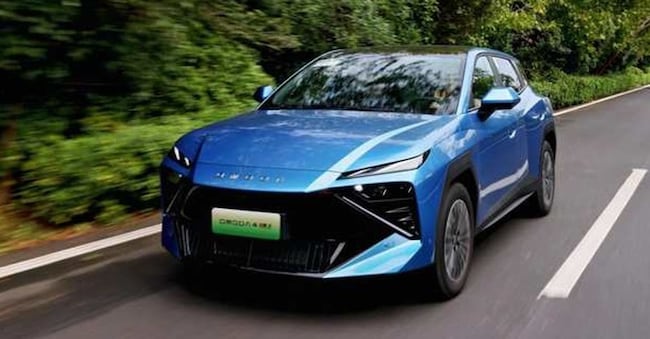
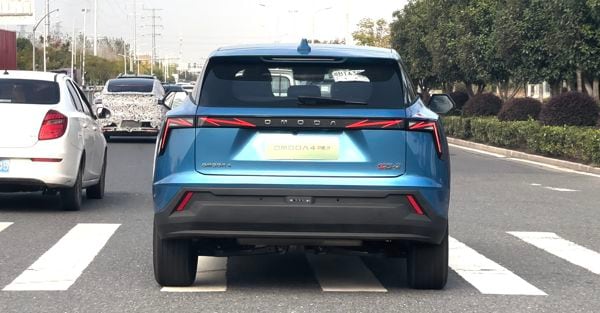
The new model has a highly distinctive character. Its design is defined by a stylistic language that combines clean, geometric lines, sporty touches and a hi-tech feel, drawing inspiration from the world of Japanese Mecha transformers. The front end, which is aggressive and given a muscular look by the interplay of sharp lines, incorporates a two-tier lighting signature, with the lower tier almost camouflaged by the oversized grille of the full-hybrid model we tested. Viewed from the side, the prominent creases cutting across the flanks, the sculpted wheel arches and the waistline that rises towards the rear stand out; together with the raked rear end, topped by a large spoiler, they help to create a sporty silhouette.

Omoda 4, a hi-tech space

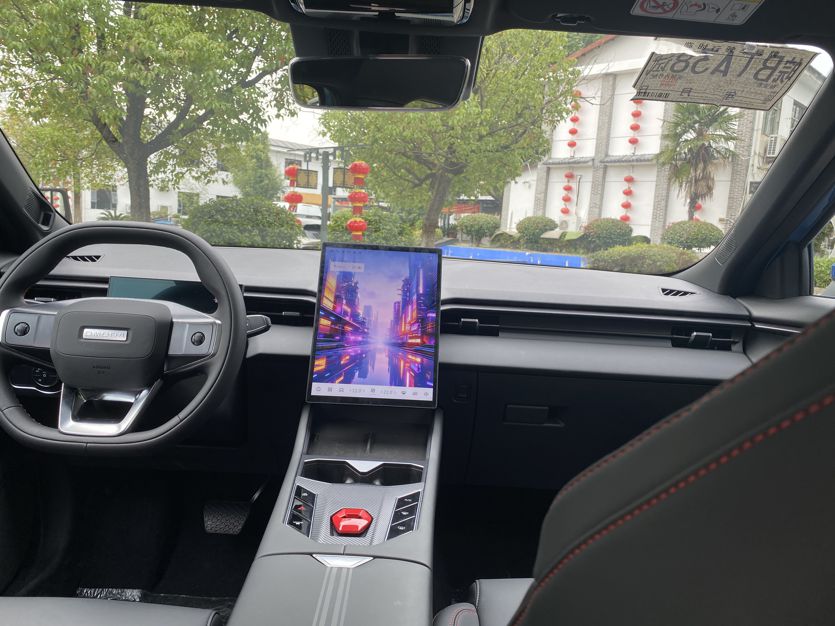
Measuring 4.42 metres long, 1.87 metres wide, 1.57 metres high and with a wheelbase of 2.70 metres, the Omoda 4’s dimensions place it straddling the line between the mid-size and compact car segments, yet its interior offers a level of space on a par with that of the former, despite its wheelbase not being among the longest in the sector. This is due, in particular, to both its width – which is almost record-breaking for a compact car – and its unobtrusive dashboard. The interior, dotted with storage compartments and characterised by a futuristic style, is both striking and high-tech. The dashboard is interrupted by the centre console, which, being very wide, divides the front of the cabin into two zones. At the bottom, it houses the buttons for the driving modes, the climate control and heated rear window controls, and the ignition switch – protected by a red flap, much like on a Lamborghini or, if you prefer, like on military fighter jets to safeguard critical controls. At the base of the infotainment display there are a few shortcuts, but you then need to navigate through the menus to select the desired functions, such as deactivating speed warnings. On the centre console is the 12.3-inch vertical infotainment display, which incorporates both the AI – set to Chinese, so who knows how responsive it is – and wireless connectivity for smartphones. The cockpit features a small, 8.8-inch display with limited customisation options, though the text is clearly legible. The Shs-h we tested was a pre-production model, as suggested by the cables from the additional instruments dangling beneath the dashboard on the passenger side and the absence of some of the finer interior details. In any case, at first glance, the overall presentation seemed good by industry standards and, above all, in line with the Omoda 4’s estimated prices for Italia.

Omoda 4, a zippy and agile full hybrid

As mentioned, our preview test drive in the Omoda Shs-h was rather brief. Setting off from the centre of Wuhu, our route took us along fast national roads and a stretch of motorway, all with well-surfaced roads. First impressions confirm that this model was not designed for China – where it is not even due to go on sale – but for the Chery Group’s main export markets. First and foremost, Europe. Comfortably seated in the sports seats with integrated headrests – which are likely to be those found in the top-of-the-range Italian ‘Premium’ trim (the other being the ‘Pure’ trim) – the Omoda 4 feels responsive thanks to its firm suspension and fairly sharp, precise steering. Tests in our part of the world should confirm this impression, especially given that Chery’s R&D centre in Raunheim, Germany, also contributed to the chassis tuning of the cars for Europe, just as it did with the Omoda 5. This good dynamism is complemented by the powertrain’s operation, in which the electric motor always plays a predominant role; therefore, does not merely propel the car briefly with zero emissions but also plays a key role in ensuring a very responsive reaction to every press of the accelerator and in smoothing out power delivery, enhancing driveability and ride comfort. Of course, apart from fuel consumption – which has not yet been disclosed by the manufacturer, unlike the top speed of 180 per hour and the 0–100 time of 8.1 seconds – and which, frankly, it would not be fair to assess in a test covering just a few dozen kilometres. Finally, when the petrol engine kicks in to support the unit that generates electricity for the battery, or at motorway speeds, it does so quietly and without causing any jolts, thus without affecting comfort.

Copyright reserved ©
Loading...

Brand connect

Loading...

Newsletter

Notizie e approfondimenti sugli avvenimenti politici, economici e finanziari.

Iscriviti