

‘In Europe, consumption is rising whilst production is falling. Ports will have to manage the reversed flow of imports and exports’
Tensions and wars, changes to shipping routes. All of this has an impact on the future of Mediterranean ports. The chairman of the Western Liguria Port Authority is ready to publish the Master Plan. ‘The meeting with Aponte has reinforced the view that, as a result of the single currency being overvalued against the dollar and high production costs, the European continent is losing competitiveness and is shifting from being an exporter to a net importer.’

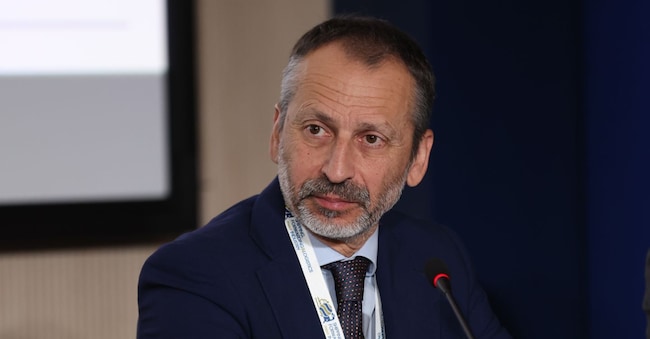
Tensions and wars, changes to shipping routes, and the transformation of Europe into an increasingly consumer-driven market rather than a manufacturing continent. All of this has an impact on the future of Mediterranean ports and, of course, Italian ports. We therefore began with the ports managed by the Western Ligurian Sea Port Authority to outline the current challenges and future developments. Chairman Matteo Paroli has, in fact, just completed 65 meetings with stakeholders to draw up the Port Master Plan. The most recent meeting, which took place ten days ago with Gianluigi Aponte, chairman of MSC, proved to be arguably the most interesting in terms of geo-economic aspects.
Port Master Plan
“First of all,” explains Paroli, “let me remind you that, adopting an innovative approach, we chose to accompany the drafting of the new Master Plan with a wide-ranging consultation process, which over two months involved more than 120 stakeholders across all economic and social sectors in the Genoa and Savona areas, including, for the very first time, citizens’ committees. Given that a Master Plan is projected to cover a period of over twenty years, we have decided to base our document on flexibility, economic and environmental sustainability, and strong connectivity with the European continent. The meeting with Gianluigi Aponte has reinforced our vision’. That is, a European continent which, as a result of the single currency being overvalued against the dollar and high production costs, is losing competitiveness and transforming from an exporter into a net importer. This is a scenario which, from an industrial perspective, must be addressed with strategic seriousness and concern, and which, from a logistical perspective, will alter the management of peak and off-peak periods and thus the overall efficiency of the value chain. “A trend already evident today in the ports of Genoa and Savona,” continues Paroli. “All this translates into the need to increase terminal capacity, efficiency and intermodality.”
A scenario that is not too far off, given the growing importance of the Indian and African economies. These two regions are set to become increasingly important trading partners for the EU. These developments are further complemented by the evolution of trade relations with other regions, including North Africa, the Middle East and South America, which may help to reshape the geography of trade.
Security and logistics
“The evolution of import and export trade will give rise to new requirements in container management, with potential imbalances between incoming and outgoing units and consequences for the organisation of logistics chains and the necessary port capacity,” explains Paroli, who highlights the issue of security. “Together with Fincantieri, we have embarked on a programme to enhance the deployment of advanced water monitoring and protection systems at the ports of Genoa, Savona and Vado, using technologies that include acoustic sensors, sonar and underwater drones, capable of detecting any intrusions or anomalous situations’. Liguria is also home to the National Diving Centre, ‘which’, adds Paroli, ‘can harness industrial and technological expertise to meet the new requirements of maritime infrastructure’. For its part, the port authority has allocated over 3 million for smart logistics in its 2027 budget, nearly 2 million for port security and a further 2 million for compliance with the European NIS2 directives. However, what emerges from the interview with Paroli is that port security today is not limited to the physical protection of ports. Today, it means safeguarding digital systems, communication networks, logistics hubs and terminals along the European TEN-T corridors, as well as energy infrastructure and increasingly interconnected waterways. The port must therefore be seen as an active hub connecting energy flows, communications, maritime and rail networks, and physical access to new technologies. For these various factors to materialise, it is clearly necessary for ports to continue to handle volumes sufficient to ensure the economic stability of their business model and of the industrial areas they serve.
The near future of airports
“Tensions in the Middle East and the instability of the routes through the Red Sea and the Suez Canal have necessitated a reorganisation of maritime links, involving a round-the-world route via Africa,” concludes Paroli. “Today we are seeing encouraging signs of a gradual return by shipping companies to traditional routes, but to prevent the western Mediterranean from losing its central role to the north, we must be prepared not only to intercept these flows but also to understand the dynamics they entail.” In this sense, the reversal of the balance between imports and exports becomes the path to follow in the coming years – around which the efficiency of logistics must be structured.


