

Initial steps taken at European and Italian level (in collaboration with the Asas agency) to promote diving safety
The Commission has launched a new phase of action through the Cable Security Toolbox and the Connecting Europe Facility (CEF) programme, mobilising €347 million to strengthen response capabilities for the protection of cables. Rome is taking action through a dedicated body to establish standards for rapid response in the event of damage or sabotage.

Key points
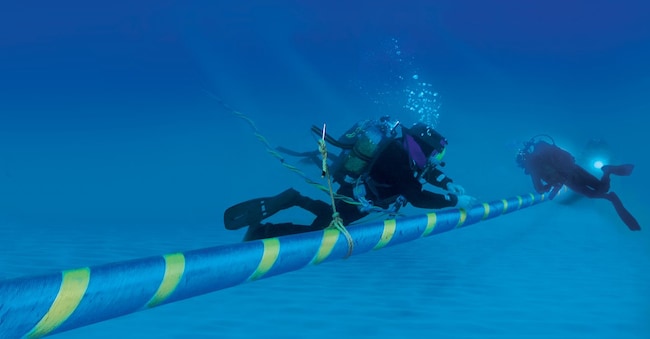
It has been over 150 years since the first undersea telecommunications cable was laid on the Atlantic seabed between Newfoundland and Ireland in 1857. It was used for telegraph communications, but since then that technology has never stopped evolving. The first telephone cable was laid in 1956 and the first internet cable in 1988. Currently, the total length of cables on the ocean floor exceeds one million kilometres. It is easy to see how vital the security of such infrastructure is for protecting the data travelling through the cables, given that 95–99 per cent of global internet traffic, as well as electricity flows, travels along these undersea routes. The problem facing the European Union is the one that makes it most critically vulnerable, namely the sovereignty to carry out repairs in the event of a cut, accident or sabotage, since ensuring data continuity and security means not only preventing an attack, but also having the operational, legal and logistical power to repair a severed cable before a fault escalates into a systemic crisis.
Europe’s underwater operations
In this regard, the European underwater safety framework is undergoing a fundamental transformation. On 5 February this year, the European Commission launched a new phase of initiatives through the Cable Security Toolbox and the Connecting Europe Facility (CEF) programme, mobilising €347 million to strengthen response capabilities. According to a study conducted by Francesco Paolo Bello (managing partner at Deloitte Legal), Brussels has provided €5.8 million in funding for the establishment of the first Regional Security Hubs, designed to serve as the first permanent platforms for the exchange of real-time information and the coordination of responses to threats. The first, to which €2.5 million has been allocated, concerns the Baltic Sea: the project is coordinated by Finland, with contributions from Estonia, Latvia, Sweden, Denmark and Germany. The second project, meanwhile, concerns the Mediterranean hub, led by Italia in collaboration with Greece, Cyprus and Malta. The aim, through calls for proposals managed by the agency HaDEA (the European Executive Agency for Health and Digital), is to fund adaptable repair modules that can be installed on designated vessels within 72 hours of arrival in port, with a view to creating a strategic reserve capable of covering critical areas across the European continent.
The fragmentation of competences in the Mediterranean
Let us now turn to the Mediterranean landscape, which is of great relevance to Italy. From a regulatory perspective, the main challenge lies in overcoming the fragmentation of legislative powers and in harmonising the synergy between public and private actors. Given that in the Mediterranean alone there are 850 critical infrastructure assets, comprising 65 telecoms backbones, 47 military cables, seven electricity interconnections, nine gas pipelines and five oil pipelines – with a further 235 new cross-border projects planned by 2030 – the Italian government has responded to European directives by establishing the ASAS, namely the Agency for the Safety of Underwater Activities, through Law No. 9/2026. The agency was set up to centralise powers previously scattered across numerous administrative bodies, with the aim of establishing technical standards, speeding up authorisations and coordinating regulatory aspects, particularly for dual-use (civil and military) infrastructure. Paradoxically, in fact, Italia possesses an extraordinary combination of assets: first and foremost, its geographical position; then there are players such as Fincantieri, Sparkle and Prysmian, as well as its naval expertise.
Asas’s diagram
There is also one factor to bear in mind: the physical maintenance capacity in the area – represented by Elettra and the cable-laying vessel Antonio Meucci, based in Catania – is managed by the French group Orange. In the event of a simultaneous crisis in the Mediterranean, who has the contractual and political authority to dispatch the vessel, and which fault should it be directed to first? Beyond individual owners… Catania should become the hub of a permanent Mediterranean reserve comprising pre-qualified vessels. In the event of a cable fault, the first misconception is to think that insurance alone is sufficient to guarantee a country’s continuity. A cable can be protected by policies covering property damage, third-party liability, hull and machinery, business interruption, and even the risks of terrorism and war. But an insurance policy compensates for a financial loss: it does not manufacture a replacement repeater, train a specialist splicer or compel a civilian crew to sail through mined waters or areas subject to electronic warfare. Furthermore, the crucial issue is the attribution of blame. An anchor dragged across the seabed may appear to be a random accident, turn out to be an act of sabotage, and ultimately be linked to hostile action by a state. Not to mention that repairing a broken cable is not an instantaneous operation. A cable-laying vessel must remain at the point of failure for days, moving at very low speed to retrieve the cable ends from the seabed, make the splices and reposition the line. It goes without saying that, in a potential crisis or war scenario, a stationary vessel becomes a vulnerable target. To circumvent this danger, one solution would be a coordinated operation: the vessel remains a civilian vessel, led by the maritime captain for navigation and the cable superintendent for technical operations, but is escorted by military frigates, patrol aircraft, surface drones and mine-countermeasure systems provided by the Navy and NATO.
Public guarantees thus become an essential legal prerequisite. The question is: without state coverage of risks and crews, shipowners and insurers would refuse to authorise the entry of civilian vessels into the area of operations. In this regard, the European call for proposals managed by HaDEA is offering €40 million (deadline 8 October 2026) to fund rapid repair modules that can be installed within 72 hours, alongside the 347 million already mobilised by the Connecting Europe Facility via the Cable Security Toolbox. The aim over the coming years is to establish a structured capability: to fund an emergency mission, define the political priority, mobilise the vessel and crew, and complete the installation of the technical modules. All within a matter of days.

