North Africa

Italia–Libya: two agreements signed in Misrata – ports and food supply chains at the heart of the cooperation

Agreement between ports in western Sicily and the Libyan Free Zone. The Italian-Libyan Chamber of Commerce has also signed a memorandum with Izsum covering laboratories, training and food safety. Around sixty Italian companies are taking part in the mission

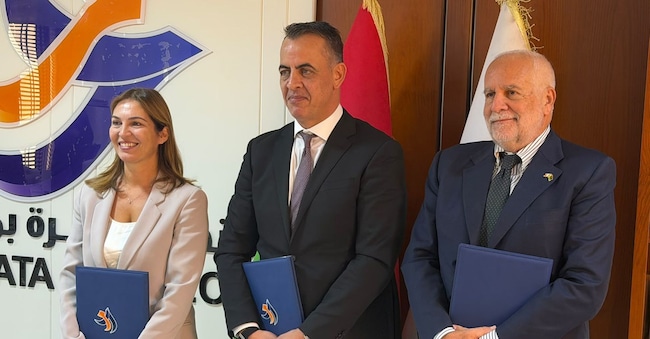
Da sinistra, Annalisa Tardino (presidente dell’AdSP del Mare di Sicilia occidentale), Mohsen Al-Sagoutri (presidente della Misurata Free Zone) e Nicola Colicchi (presidente della Camera di Commercio Italo-Libica) a Misurata per la firma dell’accordo di cooperazione tra i due enti portuali

5' min read

Translated by AI
Versione italiana

5' min read

Translated by AI
Versione italiana

Port logistics, access to African markets and services for the agri-food supply chains. Economic cooperation between Italia and Libya is expanding with two agreements signed in Misurata as part of the business mission organised by the Italian-Libyan Chamber of Commerce. The first links the port system of western Sicily with the free zone in the Libyan city. The second aims to strengthen animal health and food safety, complementing scientific collaboration with opportunities for technology transfer and business-to-business meetings.

The agreements form part of the programme for the delegation of around sixty Italian companies, in Libya from 31 October to 4 November. The initiative is organised by the Italian-Libyan Chamber of Commerce in collaboration with the Italian Embassy in Tripoli and Unioncamere, with the support of the Misurata Free Zone.

Loading...

The agreement between the ports

The port agreement was signed by Annalisa Tardino, chair of the Western Sicilian Sea Port Authority, and Mohsen al-Suqutri, chair of the board of directors of the Misurata Free Zone. The signing was attended by Nicola Colicchi, President of the Italian-Libyan Chamber of Commerce.

The aim is to develop cooperation between the infrastructure networks on both sides of the Mediterranean, creating the conditions for new trade and logistics links. For the western Sicily network, which includes, amongst others, Palermo, Termini Imerese and Trapani, the focus is on the potential to tap into new traffic flows and strengthen integration with North African transport networks.

“The agreement signed between the Misurata Free Zone and the Port System Authority of the Western Sicilian Sea, with the support of the Italian-Libyan Chamber of Commerce, represents a tangible opportunity for collaboration that we intend to bring to life, transforming institutional relations into projects, investments and new opportunities for development for Sicily, Libya and Italia,” said Tardino.

The president proposed hosting a Libyan delegation in Palermo to identify the activities to be carried out. The memorandum of understanding thus marks the start of a phase of practical consultation: the launch of any new services and connections remains an objective to be developed, not a result already achieved by the signing.

For al-Suqutri, Italia is a key partner both in terms of trade volumes and the prospects for further collaboration. Colicchi highlighted the mission’s contribution to raising awareness amongst European operators of the opportunities offered by Misrata and its free trade zone.

Investment and the African market

Among the elements of greatest interest to operators is the $2.7 billion investment programme for the expansion of the port terminals in Misurata, spearheaded by a consortium led by MSC. According to Tardino, this expansion could open up opportunities for collaboration with Sicilian ports, which are also undergoing infrastructure development.

The aim is to link the expansion of port capacity to the growth in trade, promoting Misurata as an industrial and logistics hub for African markets. In his address to the Libyan-Italian Business and Investment Forum, the Italian Ambassador to Libya, Gianluca Alberini, highlighted the city’s potential as a hub between Europe and Africa, within the framework of the Mattei Plan.

The composition of the Italian delegation reflects the breadth of the sectors involved: construction, infrastructure, agri-food, energy, logistics, transport, mechanical engineering and healthcare. Participants include Fincantieri and the Grimaldi shipping group. The programme combines institutional meetings with bilateral discussions and visits to local manufacturing facilities.

Loading...

The memorandum on food supply chains

A second area concerns scientific and technological services for animal husbandry and the agri-food sector. At the headquarters of the Italian-Libyan Chamber of Commerce in Misrata, Colicchi signed a memorandum with Stefano Petrini, the delegate of Vincenzo Caputo, Director-General of the ‘Togo Rosati’ Experimental Zooprophylactic Institute of Umbria and the Marche.

The agreement covers epidemiological surveillance, the strengthening of Libyan veterinary laboratories, staff training and the monitoring of food of animal origin. The programme includes activities relating to the main infectious diseases affecting livestock, the exchange of epidemiological information and support for the development of prevention and biosecurity plans.

For the laboratories, the collaboration covers molecular and serological diagnostics, quality management and the validation of methods in accordance with international standards. Activities relating to autogenous vaccines and diagnostic reagents are also included, as well as potential initiatives involving technology transfer and local production.

With regard to food, the memorandum provides for microbiological and chemical testing of products of animal origin and fish, monitoring of veterinary drug residues and contaminants, traceability and risk management. This includes studies and interventions on farms rearing dromedaries, cattle, sheep and goats, with a focus on the hygiene and health standards of milk and meat.

Implementation linked to projects and resources

Alongside the scientific component, there is a programme of meetings between Italian companies and Libyan operators, business missions, technical visits and the search for partners for investments, joint projects and participation in national and international calls for proposals.

The memorandum is valid for five years from the date of the last signature and is renewable with the consent of the parties. However, it does not set out an immediately enforceable expenditure programme: individual activities must be governed by specific agreements and an annual work plan. Their implementation remains subject to the availability of financial resources and the approval of the governing bodies of the two institutions.

For both agreements, the decisive step will therefore be the definition of operational projects. In the port sector, this will involve identifying sustainable services and traffic opportunities for operators. In the food supply chains, the aim will be to translate training and technical assistance into diagnostic capabilities, monitoring and potential production partnerships. It is against these outcomes that the economic impact of the mission will be measured.

Sicilian ports: cooperation with North Africa as a driver for trade and logistics

The cooperation agreement forms part of the organisation’s internationalisation strategy and aims to strengthen relations with North African countries, with a view to promoting the development of trade and logistics. The scope of the agreement is outlined by the chairman of the Port System Authority, who links the agreement to the opportunities arising from the shifting geopolitical balance in the Mediterranean.

“I am a firm believer in international cooperation between Italia – Sicily in particular – and the countries of North Africa,” emphasises the president. In his view, the new dynamics brought about by international events may represent “an opportunity for our country and, above all, for our regions”.

The aim is to capitalise on the geographical location of Sicily’s ports and their historical, cultural and economic ties with the southern shore of the Mediterranean. The president highlights the development of the port of Palermo, which he describes as having experienced strong growth and significant infrastructure upgrades in recent years, alongside the role of the other ports managed by the organisation. Among these, the ports on the south-western coast can offer a direct link to North Africa.

The agreement is therefore presented as a means of translating institutional cooperation into economic opportunities for the regions. “I think there could be no better opportunity to try to boost trade and develop logistics by working with North African countries,” concludes the president.

Sign up to the NextMed newsletter so you don’t miss out on previews and in-depth articles

Copyright reserved ©
Loading...

Brand connect

Loading...

Newsletter

Notizie e approfondimenti sugli avvenimenti politici, economici e finanziari.

Iscriviti