Sports holidays

Get back in shape with Jannik Sinner, sailing on the high seas

Mobility exercises and running on the bridge. Mindfulness and Mental Economy Training. Tips from the world number one tennis player on training on the water.

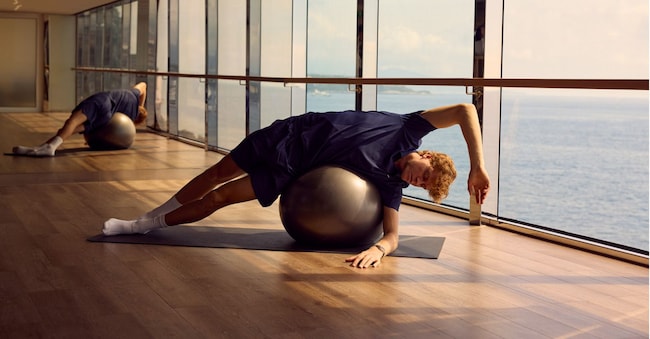
Jannik Sinner si allena a bordo della Explora III. ©Toby Mitchell

3' min read

Translated by AI
Versione italiana

3' min read

Translated by AI
Versione italiana

The cornerstones of his method are targeted technical sessions and mental preparation, designed to help players cope with the pressure of competitive tennis.

Jannik Sinner, world number one in the ATP rankings and also one of the 100 most influential athletes of 2026, often says that “without sacrifice, you cannot build dreams”.

Loading...

Tennis is a sport that combines physical and mental training, and develops endurance, agility, coordination and strength, as well as a strong ability to manage stress.

That’s why it might be worth trying out a training programme tailored by the champion for Explora Journeys, to be carried out whilst sailing.

In Balance: a Jannik Sinner Ocean Wellness brings together the routines and methods I use to strike a balance between physical performance and mental clarity, in a realistic and accessible way,” explains the world number one tennis player.
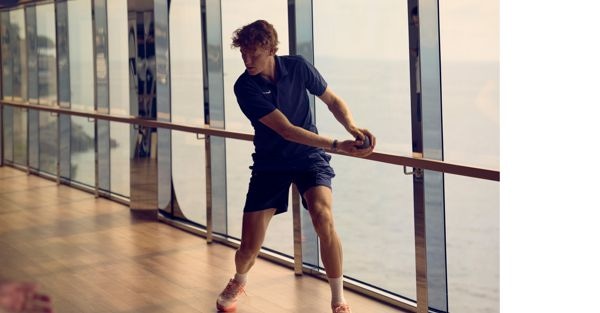
“Together with my team, we’ve turned part of my daily workout into something useful for others, something they can apply to their everyday lives, but with discipline – which is the most important part – because it’s consistency over time that makes the difference. It’s not just about training, but about finding your own balance, paying attention to recovery and staying mentally sharp.”

Sinner was on board during the prelude journey of the new Explora III, from 24 to 29 July, to put the philosophy behind his approach to the test.

The programme is structured around four pillars – Train, Re-centre, Restore and Renew. “We always start with a proper warm-up, which is often underestimated, as is recovery, both in the gym and on the tennis courts: light strength and mobility exercises, a bit of mindful breathing to stay focused and then hot-and-cold contrast therapies, whether swimming or playing pickleball on the ship’s decks”. You can start training whilst on holiday and then continue with the exercises and good habits consistently even once you’re back on dry land.

©Toby Mitchell

For Sinner, his mental attitude is crucial. Once, during a press conference, he said, in an unflappable tone: “I like to dance in the storm of pressure; you have to take it in a positive light, you have to make friends with it”.

His training method focuses on building muscle using kettlebells, weights, gym machines and resistance bands for shoulder strength exercises, as well as workouts with a medicine ball and foam rollers to relieve tension and, for aerobic exercise, outdoor running and indoor sessions on treadmills and exercise bikes.

Loading...

Also important is the eye training he undergoes, using visualisation techniques such as focusing intently on a small ball to stimulate reflexes, speed up reaction times and improve tactical processing during rallies.

‘If I were to describe the stages of my physical preparation, it always begins during the off-season, in December. It starts with a lot of physical work in the gym, followed by intense tennis sessions, during which there’s time to work on the finer points, both technical and tactical. During tournaments, however, training changes: sessions become shorter and the physical workload is lighter too, because I need to conserve energy for the matches,” he explains.

Technology also helps both to track movements and to strengthen muscles, without putting too much strain on the joints: GPS is used to monitor the distance covered during matches, whilst a heart rate monitor is used to keep an eye on the heart rate.

But training involves much more than that: neuroscience, sports medicine and the psychology of performance.

Sinner uses Mental Economy Training, a programme developed by Riccardo Ceccarelli, who has brought to tennis the techniques of mental training that have been used for over thirty years in the world of Formula 1.

A real workout for the brain, where you learn how to improve your mental efficiency, strategic skills and emotional regulation following a mistake.

Sitting in front of a screen displaying race simulators, participants put their cognitive processing, memory and reaction times to the test, whilst wearing a headband fitted with neurological sensors capable of monitoring and assessing their reactions. After all, the best training is the kind that helps clear your mind of distractions and build self-confidence.

That is why Sinner recommends combining physical training with cognitive training and some mindfulness to stay focused on the present moment.

Copyright reserved ©
Loading...
Loading...

Newsletter

Notizie e approfondimenti sugli avvenimenti politici, economici e finanziari.

Iscriviti