Mediterranean

Kallas criticises Turkey: ‘The memorandum with Libya infringes the sovereign rights of third countries.’ What does the treaty say?

The Libyan House of Representatives has ratified the memorandum with Turkey, overturning all previous decisions and paving the way for new agreements with Ankara. Cyprus, Greece, Egypt and Israel are furious.

3' min read

Translated by AI
Versione italiana

3' min read

Translated by AI
Versione italiana

The European Union, Egypt and Israel have condemned the amendment to the agreement between Libya and Turkey. The EU’s High Representative, Kaja Kallas, meeting with Turkish Foreign Minister Hakan Fidan today, ‘raised the issue of yesterday’s vote in Libya on a maritime memorandum of understanding with Turkey, emphasising that it violates the sovereign rights of third states’.

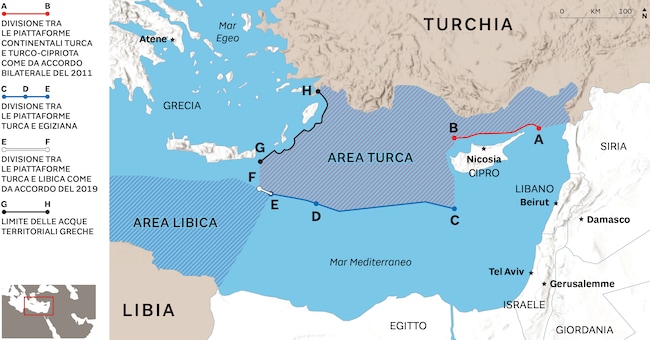
This was reported by the Vice-President of the European Commission herself, via social media, following the ratification by the House of Representatives in Tobruk/Benghazi (Eastern Libya) of an agreement delimiting their respective maritime boundaries – boundaries which disregard the claims of Cyprus and Greece.

Loading...

Kaja Kallas

epa13289233 Kaja Kallas, alta rappresentante dell’Unione europea per gli affari esteri e la politica di sicurezza, EPA/WAEL HAMZEH

“Good neighbourly relations and progress in resolving the Cyprus issue,” he adds, “are of great importance. With regard to Russia’s dangerous escalation in the Black Sea, I reiterated the need to step up pressure on Moscow to bring the war to an end. Both the EU and Turkey support an agreement that guarantees freedom of navigation in the Black Sea.”

‘We also discussed developments in the South Caucasus and across the Middle East. The Houthis’ attacks against Saudi Arabia and Yemen are textbook examples of terrorist tactics and must stop. In the Strait of Hormuz, Iran is making navigation dangerous and costly. Freedom of navigation must be restored, without the imposition of tolls or charges,” he concludes.

What does the memorandum say?

 Signed in November 2019 by the Turkish government and the Libyan Government of National Accord, the memorandum defines the respective areas of maritime jurisdiction in the Mediterranean. The agreement establishes a boundary that Ankara considers useful for safeguarding its maritime interests and the prospects for exploiting offshore energy resources.

The agreement is contested primarily by Greece, Cyprus and Egypt because, according to these countries, it completely disregards the maritime rights of other states and of the Greek islands, creating a boundary line that does not comply with the principles of international law of the sea.

The vote in the House of Representatives marks a shift in relations between eastern Libya and Turkey. In 2020, the Eastern Parliament had rejected the two memoranda of understanding signed with Ankara, concerning the delimitation of maritime zones and cooperation on security and defence. It had also passed a resolution to sever political ties with the Turkish government.

The new decision therefore marks a shift from the approach previously adopted by the authorities in eastern Libya. The rapprochement with Ankara forms part of a process of gradual redefinition of regional alliances, in which agreements on security and the control of maritime areas are taking on strategic importance.

The Parliament’s decision could mark the start of a new phase in bilateral relations, with possible repercussions for the political and diplomatic balance in Libya and for relations with other actors in the Mediterranean.

Reactions

In particular, Greece rejects the decision by the Libyan House of Representatives to approve the amendments to the agreement. A statement from the Foreign Ministry in Athens states that ‘this decision does not alter the illegal, null and void, and legally non-existent nature of the memorandum, which contravenes international maritime law and infringes upon the sovereign rights of the states in the region’.

Loading...

‘Geography and international law of the sea are not altered by unilateral and legally unfounded parliamentary decisions. Turkey and Libya do not have coastlines that face each other or are adjacent in such a way as to provide a legal basis for the delimitation of the maritime zones that are intended to be established.’

‘Furthermore, the memorandum disregards the Greek islands and their rights over maritime zones under the United Nations Convention on the Law of the Sea (UNCLOS) and customary international law,’ the statement notes. ‘Having already concluded agreements on the delimitation of maritime zones with Egypt and Italia, in accordance with international maritime law, Greece has demonstrated its respect for international law and the sovereign rights of neighbouring states. We call on the Libyan side to refrain from any action contrary to international law and which undermines stability in the eastern Mediterranean. Greece has already informed its partners and allies and will take all appropriate measures to safeguard its sovereign rights.”

“Israel strongly condemns the decision by the Libyan House of Representatives to ratify the memorandum on maritime jurisdiction between Turkey and Libya. This agreement infringes upon the sovereign rights of our close allies in the region.” This was the statement issued by the Israeli Foreign Ministry on X after the Libyan authorities in Benghazi ratified the 2019 agreement between Ankara and Tripoli on the delimitation of maritime zones.

Israeli diplomatic sources add: “Unfortunately, we are once again witnessing Turkey’s efforts to destabilise the eastern Mediterranean region.”

Copyright reserved ©
Loading...

Brand connect

Loading...

Newsletter

Notizie e approfondimenti sugli avvenimenti politici, economici e finanziari.

Iscriviti