
Lavinia Biagiotti: 'For our 60th anniversary an ecosystem of fashion, sport and art'
Meeting with the entrepreneur and fashion designer who heads the company founded by her mother Laura and grandmother Delia in 1965: 'I have many projects, from hospitality to patronage. And I want to preserve our capital and values'.

4' min read
4' min read
On 30 July 1965, in the very hot summer in which the Beatles had first played in the city, 22-year-old Laura Biagiotti founded the company Biagiotti Export in Rome with her mother Delia, to produce and distribute the great names of Roman haute couture, from Schuberth to Capucci, throughout the world. After having made the Alitalia uniforms and created a collection for the US market, the young company thus followed and interpreted the evolution of Italian fashion towards its peculiar pret-à-porter, made of innovative design and nourished by the country's textile heritage.
Sixty years later, from the medieval castle of Marco Simone di Guidonia, the family home and creative and administrative headquarters on the outskirts of Rome, Lavinia Biagiotti Cigna celebrates the milestone, seated at the desk that was her mother's, in the studio inhabited by memories, photos, affectionate cards and awards, inherited (together with the company, which in 2024 had a turnover of 100 million and sells 55% abroad) in 2017, when Laura Biagiotti suddenly passed away. "Our history has accompanied Italian fashion in all its stages," she explains, "from the birth of Modit in Milan to the openings to foreign markets, of which my mother was a pioneer with the first fashion shows by an Italian designer in China and Russia. Today I have another project: to bring the world here to us'.
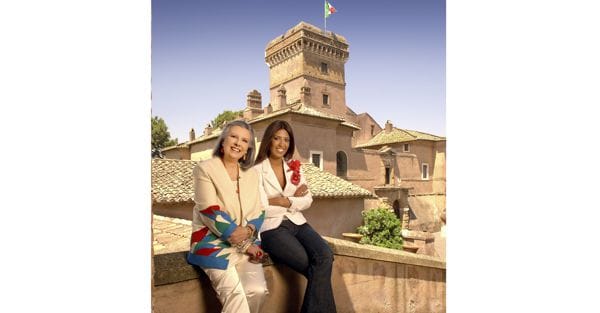
In a certain sense you have already succeeded, with the 270,000 people who came two years ago from all over the world for the Ryder Cup at the Marco Simone Golf & Country Club, the facility adjacent to and belonging to your company.
"Of course, it was an enormous success. Now, however, I would like to go further, creating a sort of 'Biagiotti ecosystem': an atelier where I can regain proximity to my clients, the reality of golf, perhaps a hotel; give them the chance to visit the 2nd-century Roman villa that I am finishing restoring to the memory of my mother (who is passionate about archaeology, ndr) and our collection of the futurist artist Giacomo Balla. A 2,000-year journey with different souls in the same place. I would like it to be a model for a new Made in Italy tourism, also supported by companies'..

About ateliers, his grandmother started by opening one in Via Salaria. Who is Biagiotti's customer today?"My mother could not find clothes for herself, for a working woman. René Gruau's illustrations that still decorate our shopper bags remind us of her, a woman in perpetual motion. It is the same today, fashion must be an ally to living. For example, many girls choose our white blazers for graduation, they make them feel protected and at the same time luminous. When I create, I think that things must last and follow a woman's changes at the same time, even within the same day.
Biagiotti's passion for knitwear, those fabrics for which his mother was called 'the queen of cashmere' by the New York Times, helps a lot in this.
"I am very impressed when models wear our clothes and exclaim "it's so soft!". Too many times, fashion is exclusive, in the sense that it separates the dress from the wearer. Instead, it should be more inclusive, taking care of people. If it succeeds, it will be a turning point for the whole system.
-U03433117234rvU-600x313@IlSole24Ore-Web.JPG)


