Trade

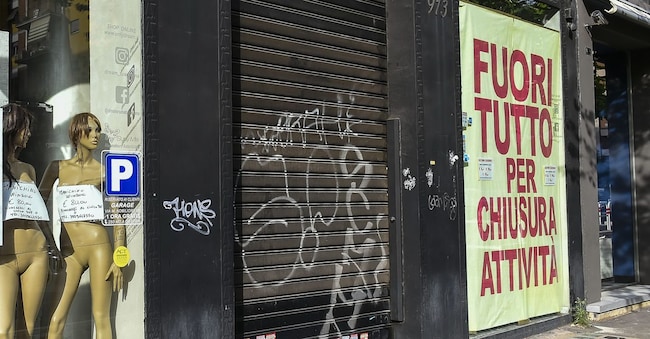
Neighbourhood shops have fallen by 11% over ten years: the Centre and North are hardest hit

More than half of municipalities have no IT or telecoms shops. The South is holding its own thanks to tourism. Ancona, Pesaro and Mantua top the list for closures

IMAGOECONOMICA

4' min read

Translated by AI
Versione italiana

4' min read

Translated by AI
Versione italiana

More than 5,000 Italian municipalities have no computer or mobile phone shops, and over 3,000 have nobookshops, stationers, toy shops or shops selling other cultural or leisure products. Hardware shops, furniture showrooms and shops selling household goods are absent from 2,163 localities. Taking it to the extreme: 329 municipalities do not even have a single retail outlet.

It is the crisis in local retail, which is affecting the central and northern regions in particular, where tourism has failed to stem the long-term trends driving this decline (from large-scale retail to e-commerce). This regional snapshot was compiled by Nomisma’s Observatory on Reciprocity and Local Trade, which shared the trends over the last ten years, province by province, with *Il Sole 24 Ore*.

Loading...

The territories

Since 2015, Italia has seen an overall decline of 11.2 per cent in the number of local shops. ‘This is a clear sign of urban centres becoming depopulated, of relationships weakening and of communities at risk of losing their traditional points of reference,’ comments Francesco Capobianco, head of the Public Policy division at Nomisma. Moreover, the decline in local retail does not merely affect the economy, but has a direct impact on quality of life and on social cohesion within local areas’.

At the bottom of the table are Ancona (-21.3%), Pesaro and Urbino (-20%) and Mantua (-19.9%). Below them, a further 27 provinces recorded declines greater than the national average. Of these, only two (Bari and Sassari) are in the South. Southern Italy has in fact held up better, not only with all its provinces below the national average, but even showing, in 11 cases, a positive change compared with ten years ago (led by Trapani, Crotone and Naples).

APERTURE E CHIUSURE

Le Province italiane per variazione percentuale del numero di negozi di vicinato tra 2015 e 2026

Loading...

The Mezzogiorno Estate

This trend is now clearly evident from Nomisma’s analysis – which takes into account only local shops, excluding tourist accommodation and petrol stations – but it had already been hinted at by the data released in March by Confcommercio, which had recorded a decline in business numbers from 2012 to 2025 across 122 municipalities. In that instance too, the South had dominated the bottom of the rankings, showing a less severe decline in business activity. ‘The resilience holds up to a certain extent, because the reduction in active businesses remains,’ notes Mariano Bella, director of Confcommercio’s Research Department. ‘However, it is more moderate.’ There are various contributing factors: ‘There are incentives – he continues – such as the ‘Resto al Sud’ scheme, which supports the launch of new businesses, or the single Special Economic Zone (ZES). We are unable to say exactly how much of an impact they have, but they certainly play a role’.

And then there is tourism, which, whilst representing a critical issue for some areas, becomes an important economic driver for others: ‘In cases of overtourism in large cities, there is a negative effect, because an excessively high influx of tourists tends to drive out residents and local shops. But in cases of undertourism, that is, when visitor numbers remain below the sustainable capacity threshold (which is the case in the vast majority of Italian destinations), tourism generates prosperity, supports local businesses and ensures residents’ incomes.”

Demographics and logistics also play a part: ageing populations and more remote locations help to maintain the importance of those local networks made up of small family-run businesses. It is no coincidence that the research published in February 2026 by Agata Maria Madia Carucci, Valeria Marzocca and Roberto Antonello Palumbo of Istat and Annamaria Fiore of Arti Puglia also showed that, during the period 2014–2022, it was inland areas—normally considered more vulnerable to depopulation—that demonstrated a greater capacity to sustain the commercial fabric.

Employment and sectors

As regards the number of employees, the national average calculated by Nomisma shows a 21.2 per cent increase over the last ten years. This figure appears to contradict the data for shops, but is in fact explained by sectors with high staffing requirements such ascatering, health and personal care, and building materials – the only sectors not to show a decline in the surveys between 2015 and 2025. The boost to employment provided by these sectors is significant, to the extent that no Italian province has recorded a decline in the number of employees. On the contrary, overall growth has reached peaks of 37.2% in Matera, 36.8% in Sassari and 35.9% in Syracuse.

Overall, the local retail sector in Italia comprises 1.196 million local units and nearly 2.85 million employees. These account for 18.7 per cent of units and 14.4 per cent of employees, respectively, of all economic activities across the country. Of the 1.196 million local business units, neighbourhood shops account for around two-thirds (760,000), whilst the catering sector accounts for the remaining 436,000. The latter sector, however, employs a large number of staff: 1.5 million employees, compared with 1.35 million in the retail sector.

IL COMPARTO

Loading...

The trend is not the same across all sectors. Between 2015 and 2025, the catering sector grew by 26.2 per cent, whilst health and personal care (+0.4 per cent) and building materials (-2.3 per cent) remained largely stable. The sharpest declines, however, were seen in culture and leisure (-28%), textiles, clothing and accessories (-21.4%), hardware (-17.8%) and jewellery (-15.4%).

Copyright reserved ©

Brand connect

Loading...

Newsletter

Notizie e approfondimenti sugli avvenimenti politici, economici e finanziari.

Iscriviti