
Marco Pannella, ten years without his liberal and non-violent madness
Ten years after his death, the memory of a radical leader who left his mark on Italian politics with his battles for civil rights, his fight against the partyocracy and his commitment to a freer economy: a podcast to recount a man who knew how to unite apparently opposing positions, with alliances of all kinds, and who left a legacy that is still difficult to overcome

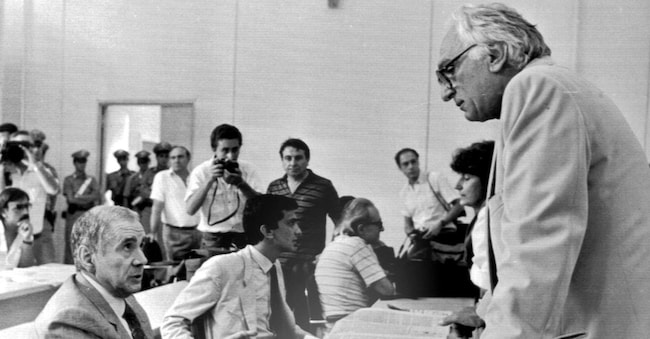
Ten years ago today - 19 May - Marco Pannella, radical leader, died, and with him died many things in Italian politics, and especially in the radical world. Because Pannella was indeed many things in Italian politics and all in the radical world. He was to the left on rights and to the right on the economy. So with his death he left behind him, in our country, a void yet to be filled in this sense, that is, a strong lack in the capacity for an effective and lasting synthesis, winning or at least convincing, of a leader or a modern political force with a similar liberal vocation - civil rights plus free market - and a lively predisposition to the non-violent method.
He was precisely the leader of the civil rights battles, the inventor of showbiz politics: do you remember him duetting with a fake Giovanni Spadolini (Gianfranco D'Angelo) on Drive in? And the ghosts at Tribuna politica? They were sheets, underneath were they, the three or four of the Pannella patrol. Because Pannella, for many, was the madman that Mario Ferrara sought for the liberals by writing in Mario Pannunzio's World, he was the dragger of referendum masses and the picker of little and comma in political elections. He was Oscar Luigi Scalfaro's great voter in the Quirinal and then his great accuser. An anti-fascist, he went to the RAI debate with the leader of the Social Movement, Giorgio Almirante. In splendid solitude. An anti-communist, he would go to the PCI Congress, under insults and spitting we have never understood how only metaphorical. In splendid solitude, given the high neck and black coat of that day.
An anticlerical, he went to see Karol Wojtyla to share the battle against world hunger, also in prophetic function of managing global economic-financial imbalances. Non-violent, he went in camouflage to the front among Croatian soldiers. Anti-prohibitionist, he went to get arrested everywhere distributing stuff he didn't smoke, while smoking everything else and all the time.
He was the great accuser of the partitocracy of the First Republic and then its great defender with the initiative of the 7 self-advocates to protect the 'Parliament of the Corrupt' and against the justicialist drifts. He was the pupil of Benedetto Croce and the historical right, the friend of Leonardo Sciascia and Vasco Rossi, the one who ran for Ilona Staller, Toni Negri and Enzo Tortora and the one who ran for (building) clean-up at Ostia City Hall.
He was a liberalist not by ideology, much less by application to theoretical study, but by a natural Ernestorossian conviction, from Ernesto Rossi (see The World above), that this was what Italia needed: a shake-up against corporations, against the excesses of the state (and above all the voracity of the partyocracy) in the economy. Simplifying for him was the least that could be done in favour of our businesses, which he always urged to free themselves from the excessive attraction of the false-friend State and with which he fought battles, battles to simplify and to liberalise, and not only business hours. Because it was right, perhaps not in absolute terms, but specifically for Italia: it was the right cure.


