
Meloni cracks down on schools: a cap on foreign pupils and a ban on the burqa are introduced
The Prime Minister: “We will soon pass the legislation introducing the term ‘liceo’ for technical and vocational schools as well.” Headteachers: the cap on foreign students is reasonable but difficult to implement

Key points
- Headteachers: cap on foreign pupils is a reasonable idea but difficult to implement
- ‘We go to school with our faces uncovered; gender equality is non-negotiable’
- ‘Italian children must not feel like a minority in the classroom’
- Technical and vocational schools will also be known as ‘licei’
- “Things are starting to change in the workplace, but it’s not enough; we need to keep young people here”
- “Car tax? It’s not true that the regions will pay”
- A dedicated account for those who still want to pay their road tax
- ‘Is the Left calling it an electoral ploy following the superbonus fiasco?’
- The dig at Schlein: ‘Find something true to say, and I’ll slip it to you under the table’
- ‘As we head towards the election, beware of those around the world who do not want Italia to be strong and a free leader’
- “Platforms must take responsibility for social media restrictions”
- ‘1968 was a failure; for decades, we were taught nothing but lies at school’
- Rejecting the so-called ‘success model’ that suggests there’s no need to study or ask questions
- ‘You’d rather belong than just fit in’
- “Tajani on women and skirts? It was a poorly worded remark; I wouldn’t make a big deal of it”
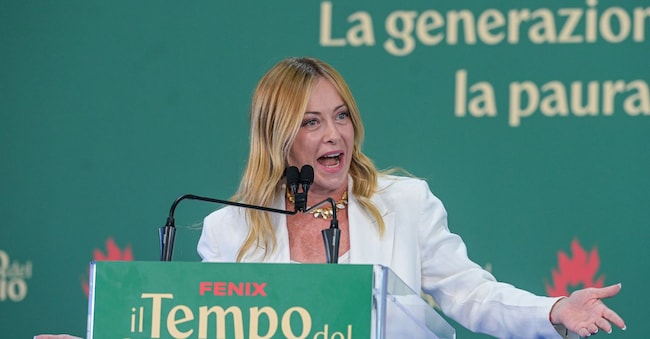
A cap on the number of foreign students per class, a requirement for the parents of pupils with serious difficulties integrating into school to learn Italian, and a ban on burqas and niqabs at school: on the Sunday of the Pontida, a stronghold of the Lega and the sovereignist rally organised by Futuro Nazionale, almost as if to reignite the challenge from the right on security and identity issues, Giorgia Meloni announced an imminent measure to be brought before the Council of Ministers to tackle ‘a matter of civilisation’. She did so by rousing the crowd of Gioventù Nazionale, the youth wing of her party.
Headteachers: cap on foreign pupils is a reasonable idea but difficult to implement
According to Antonello Giannelli, president of the National Association of Headteachers (ANP), ‘from an educational perspective, the issue is well-founded and worthy of support, but it is difficult to find a practical solution’. ‘Schools must accept enrolments from local children, especially for nursery and primary schools’ and ‘if the majority of pupils in that area are foreign nationals, what are we to do? Send them away?’ For this reason, the circular setting a 30 per cent cap ‘could not be implemented’.
‘We go to school with our faces uncovered; gender equality is non-negotiable’
The Prime Minister emphasised that ‘at school, you go with your face uncovered, and in Italia no one, in the name of a real or supposed tradition, can decide that a young woman should cover herself up. Equality between men and women is non-negotiable. It is non-negotiable on our streets, and it is non-negotiable in our schools’.
‘Italian children must not feel like a minority in the classroom’
“It’s unthinkable, simply unthinkable, that in an Italian classroom there should be Italian children feeling left out in a corner simply because they’ve become the minority. That cannot be allowed to happen,” Meloni emphasised from the stage at Fenix. A child, she added, “must learn our language, get to know our culture and respect our rules. It is the only proper way to welcome them.”
That is why the Prime Minister has announced the introduction of a rule setting a maximum number of foreign pupils per class: ‘If there is just one child in a class who does not understand Italian, that child will probably manage, with the help of their classmates and teachers, to learn the language and integrate quickly. However, if the number of children who do not understand the language of instruction becomes large, or even forms the majority, that is no longer integration; that is neglect. And the only thing those children are likely to learn is marginalisation.’

