
Mercedes C-Class petrol: the test drive: what it’s like and how it drives
The fifth-generation update makes only minor changes to the exterior and interior, but thanks to extensive use of AI, it redefines the efficiency, digitalisation and driving dynamics of this Mercedes range

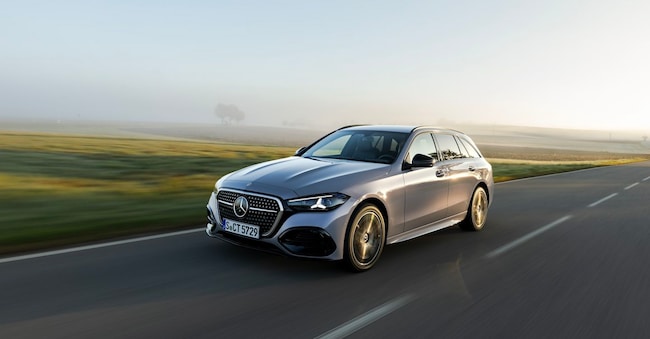
Mercedes’ new technological direction, launched with the electric GLC – which makes extensive use of a supercomputer and regenerative AI – extends not only to all-new models, but also to those undergoing a facelift. Now it is the turn of the C-Class range with internal combustion engines, which joins the electric line-up. The new series of the more traditional ‘baby-Benz’ – the model that has always been part of Mercedes’ range of naturally rear-wheel-drive cars – reveals its evolution, which raises the bar for efficiency, dynamism and human-machine interaction, through just a few new aesthetic details.
Mercedes C-Class: hybrid engines only and MB.OS with AI
The new range features updated engines for both the saloon and the estate, all of which are Euro 7-compliant. The petrol engines redefine the range as they are all 2-litre turbocharged units with 48-volt mild hybrid technology; however, they differ from those in the Hybrid versions of the smaller CLA and GLC models because the system does not power the cars solely on electric traction. The starter-generator is a second-generation unit, integrated into the nine-speed automatic gearbox, and adds an extra 23 cavalli to the 177 cavalli of the 200 version, the 218 cavalli of the 250 and the 258 cavalli of the 300, to optimise acceleration and cruising performance. These engines also feature an electric supercharger powered by the 48-volt system, which pre-charges the supercharging system to eliminate annoying turbo lag and ensure prompt responses to the accelerator at low revs. In addition to these versions, there are the 300 and 400 variants of the ‘e’ series, which are plug-in hybrids with total power outputs of 313 and 381 cavalli respectively. They feature batteries with a usable capacity of 19.53 kWh, promising ranges exceeding 100 kilometres. Furthermore, they feature an on-board charger that supports recharging not only with 11 kW alternating current but also with direct current up to 55 kW, enabling a charge from 20 per cent to 80 per cent in twenty minutes. The new range also features updated turbo-diesel engines capable of running on HVO, B10 and B20 biodiesel, both with a 2-litre capacity: the 200d delivers 163 cavalli and the 250d 200 cavalli.
The new C-Class range also features the MB.OS digital platform with AI, which manages all the car’s systems and functions whilst enabling them to interact with one another to optimise efficiency, dynamism, comfort, digitalisation and human-machine interaction. This technological revamp is complemented by enhanced ADAS features for advanced Level 2 semi-autonomous driving, thanks to a suite of equipment that may include ten cameras, five radar units and twelve ultrasonic sensors, all connected to a control unit capable of performing up to 254 trillion operations. Finally, the new C-Class models also benefit from a revised suspension setup to better balance dynamism with comfort.
Mercedes C-Class: not much has changed on the outside at the front, nothing at all on the inside, but it’s more user-friendly
The design of the saloon and estate essentially remains that of the fifth generation, as the only real change to their styling is the adoption of a grille in line with that of the latest Mercedes models, which can also feature an illuminated surround. Its inclusion also slightly redefines the design of the front bumper, which is accompanied by a new lighting signature, just like the one at the rear. The update has only a slight impact on the dimensions of the two C-Class variants, with the length standing at 4.77 metres, the width at 1.82 metres, the height at 1.44 metres and the wheelbase at 2.86 metres.
The interior design remains unchanged from the familiar layout, but new materials, upholstery and colour schemes lend the cabin a more refined feel. The digitalisation is clearly evident in the 12.3-inch configurable cockpit and the 11.9-inch vertical infotainment display mounted on the centre console. However, appearances can be deceiving. In fact, as well as a simplified and clearer interface, it utilises the MB.OS platform, which supports ChatGPT, Microsoft Bing and Google Gemini to respond very promptly to queries. It also integrates Google Maps navigation, which, however, proved to be somewhat inaccurate on several occasions during the test drive.

