Use

Microsoft sides with Anthropic against the Pentagon

Redmond company takes Anthropic to court against Pentagon designation as supply chain risk

by Angelica Migliorisi

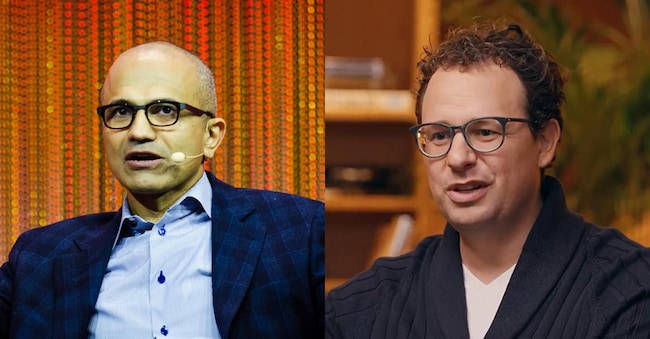
Da sinistra, l’amministratore delegato di Microsoft, Satya Nadella, e il fondatore e amministratore delegato di Anthropic, Dario Amodei

3' min read

Translated by AI
Versione italiana

3' min read

Translated by AI
Versione italiana

Microsoft also challenges the Pentagon. And it does so to defend Anthropic, the artificial intelligence company founded by Dario Amodei that ended up in the crosshairs of the US Department of Defence after refusing to relax two limits deemed non-negotiable:no mass domestic surveillance and no use of its models in fully autonomous weapons.

The Redmond group filed an amicus brief in a San Francisco federal court in support of Anthropic's request for a temporary stay of the company's classification, imposed by the Pentagon, as a "supply-chain risk". For Microsoft, that decision would also directly affect it, as it incorporates Anthropic's technologies into its supply to the US military.

Loading...

The supply-chain risk label prevents government contractors from using Anthropic's technology in their work for the US military. It does not, however, automatically equate to an indiscriminate ban on every business relationship of the company in every market. Hence, the reason why Amodei's company speaks of abuse of power and why Microsoft considers the measure serious enough to justify direct intervention in court.

How we got to today

In February, after months of failed negotiations,President Donald Trump had ordered federal agencies to stop using Anthropic technology, while the Department of Defence announced the designation of the company as a supply chain risk. The clash was sparked by negotiations over the terms of use of Claude, the company's flagship model: Anthropic wanted to maintain two clear exceptions, namely the exclusion of use for domestic mass surveillance of Americans and the exclusion of use in fully autonomous weapons, while the Pentagon argued that limits on lawful military uses could not be defined unilaterally by a private company, but by the government.

Anthropic did not reject cooperation with national security outright. On the contrary, it recalled in its official communiqués that it has been supporting US soldiers since June 2024 and that it was the first leading company in advanced artificial intelligence to deploy models in the US government's classified networks. But it also called "unprecedented" the choice to be labelled as a "supply-chain risk", arguing that historically this type of tool has been used against subjects considered adversaries of the United States and not against an American company.

Imbarazzo al vertice Ai: Altman e Amodei non si stringono la mano

Thelawsuit filed on 9 March therefore alleges that the designation is unlawful and retaliatory. The company invokes the First Amendment, the Fifth Amendment, and the Administrative Procedure Act, and accuses the government of reacting to the company's refusal to relax its rules of use on Claude and not to a technical risk related to supply chain security.

In fact, 10 U.S.C. § 3252, the regulation cited by the Pentagon, defines 'supply chain risk' as the risk that a competitor may sabotage, alter, or otherwise compromise the design, integrity, or operation of a covered system. For Anthropic, the Department of Defence has used a regulatory basis designed to protect covered systems against adversary threats in a completely different context, i.e. against a US company that continues to present itself as a national security partner.

And that is precisely where Microsoft comes in. In the brief filed in San Francisco, Satya Nadella's company argues that the Pentagon's classification affects not only Anthropic, but also contractors and integrators who use the technology as part of broader solutions provided to the government. In particular, Redmond objects to the fact that the Pentagon has set aside six months for itself to phase out Anthropic from systems already in use, without offering contractors a similar transition period. This would force government contractors to hastily redesign components already incorporated into operational or deployed technologies, introducing new commercial risks and potential discontinuities in government mission support.

The Strategic Partnership

Last November Microsoft, Nvidia and Anthropic announced a strategic partnership that brought Claude to Azure and strengthened the industrial alignment between Microsoft's cloud and Anthropic models. Microsoft would invest up to USD 5 billion in the company, while Nvidia would invest up to USD 10 billion. In the months that followed, Redmond also publicly reaffirmed a 'multi-model' strategy for its artificial intelligence products, with Anthropic providing technologies later incorporated into platforms, services, and enterprise environments of one of the US government's largest technology contractors.

The Department of Defence's action, however, did not only turn Microsoft's nose up at it. Thirty-seven researchers and engineers from OpenAI and Google also submitted their own amicus brief in support of Anthropic. A sign that for a part of the industry, the possibility for a private company to publicly claim that there are uses of its artificial intelligence that it does not want to authorise - without thereby being hit with a measure that compromises its access to the government market - is an unbreakable principle.

Copyright reserved ©

Brand connect

Loading...

Newsletter

Notizie e approfondimenti sugli avvenimenti politici, economici e finanziari.

Iscriviti