Sam’s analysis

The Middle East: airports under attack. But it is the civilian economy that bears the brunt of the war

The Houthi attacks on airports in Yemen and Saudi Arabia are jeopardising the continuity of air services. The consequences affect citizens’ mobility, healthcare, commercial activities and the ability to maintain links with other countries

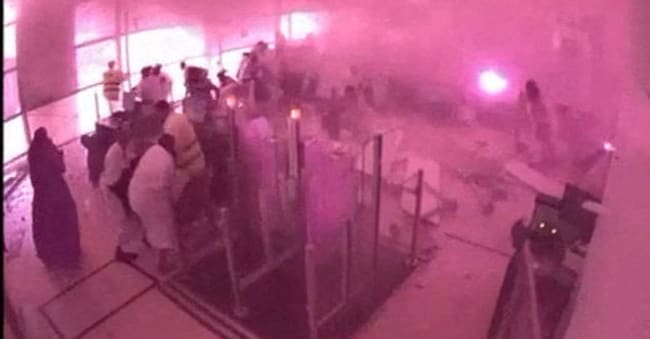
Le immagini delle telecamere dell’attacco all’Aeroporto Internazionale Re Khalid di Riad, in Arabia Saudita, il 10 ottobre 2026 Reuters

4' min read

Translated by AI
Versione italiana

4' min read

Translated by AI
Versione italiana

The cost of an attack on an airport is not measured solely in terms of damage to the runway or terminal facilities. It includes disrupted journeys, cancelled connections, postponed medical treatment and lost working hours. When the continuity of air transport is under threat, the physical target is infrastructure, but the consequences affect a whole system of economic and social relations.

It is from this perspective that we should read the fourth issue of the series Witness and Impact , published by Sam on 15 November under the title Civilian Airports Under Fire. The report documents attacks attributed to the Houthi group against civilian airports in Yemen and Saudi Arabia, with a particular focus on the incidents of October 2026. The investigation centres on the safety of passengers and staff, and flight disruptions. But an economic issue also emerges from its pages: how long can civil aviation sustain itself when every connection is exposed to the risk of sudden suspension?

Loading...

The Cost of Uncertainty

According to Sam’s account, the escalation that began in July affected the Saudi airports of Riyadh, Abha, Dammam, Jazan and Najran, as well as the Yemeni airports of Aden and Riyan. The sequence of events illustrates that the pressure on air links did not end at the moment of impact.

An airport relies on predictability. Airlines, crews, ground staff and passengers must be able to rely on timetables, procedures and safety conditions. When this predictability breaks down, a diversion is not merely a change of route: it can lead to the rescheduling of aircraft, additional ground handling requirements and missed connections. The disruption thus tends to spread beyond the airport directly affected.

The report does not provide an overall monetary estimate of these consequences. It would therefore be inappropriate to attribute an unproven aggregate economic cost to the attacks. The lack of an estimate, however, does not render the issue irrelevant: rather, it highlights the need to measure it using verifiable data, distinguishing between material damage, operational costs and the impact on passengers.

Aden: the fragility of a vital link

The incidents reported at Aden show how a military threat can immediately lead to the disruption of a civilian service.

According to Sam, on 7 October, a shell landing near the runway forced a flight from Cairo to be diverted. On 16 October, a Yemenia aircraft was evacuated whilst preparing for take-off, whilst another flight from Cairo was already in the air. On 28 October, according to the Yemeni authorities cited in the report, two attacks struck the airport, causing flights bound for Aden to be diverted to Djibouti.

Behind these operational changes are people who need to reach their families, their places of work or healthcare facilities. The report highlights the difficulties faced by patients and those travelling for humanitarian reasons: this is a crucial point, because the economic and social value of a route is not limited to the commercial value of the tickets sold. From this perspective, the continuity of the service forms part of protecting the population. The disruption of a medical journey cannot be assessed using the same criteria as a normal instance of airport inefficiency.

Security and business continuity in Saudi Arabia

The report also describes incidents at Saudi airports where passengers, families and civil aircraft were reportedly present during the attacks. For Dammam, Sam reports a toll of two dead and eight injured in the 21 October attack on King Fahd International Airport.

The document also refers to cancellations of flights departing from Riyadh between 8 and 25 October. On this point, it is essential to draw a distinction: the report itself warns that not all cancellations can be attributed to a single attack. Turning a temporal coincidence into a definite causal link would weaken the analysis rather than strengthen it.

Loading...

To assess the economic impact, therefore, detailed analyses are required: which flights have been suspended for safety reasons, for how long, and what the consequences have been for flight rotations and passenger services.

Legal protection is also a financial safeguard

Sam’s position is clear: attacks on civilian airports must cease. The report refers to the principles of distinction, proportionality and precaution, and challenges the notion that the presence of military activities in one part of a facility automatically makes the entire airport complex a legitimate target.

This is a development that has practical consequences. The protection of civilian infrastructure is not merely a restriction on the conduct of hostilities: it also safeguards the minimum conditions under which a society can continue to function and carry out economic activities.

Similarly, according to the report’s legal analysis, advance warning does not remove the obligation to protect civilians. For those managing an airport, this is not an abstract issue: what matters are the minutes available, the aircraft already on approach, the passengers on board and the practical possibility of evacuating without exposing other people to danger.

Sam argues that some of the documented incidents raise serious questions precisely about the effectiveness of the warnings and the precautions taken. However, determining whether any individuals bear criminal liability requires specific investigations into the targets, the weapons, the orders and the chain of command. Condemning the attacks must not take the place of rigorous evidence.

Rebuilding trust, as well as infrastructure

The response cannot be limited to repairing a runway. We must preserve the control tower recordings, tracking data, images and bullet casings, as Sam has requested. These are essential elements for reconstructing the events and distinguishing between documented accountability and unsubstantiated claims or accusations.

The organisation also calls on the United Nations, the International Civil Aviation Organisation and the relevant bodies to support independent technical investigations and measures to protect civil and humanitarian flights.

The priority remains to stop the attacks and protect people. But the long-term perspective must also take into account what comes next: restoring reliable connections, ensuring transparency regarding the consequences of the disruptions, and guaranteeing victims access to the truth, justice and redress.

An airport can resume operations following technical work. Regaining the confidence of those who use it requires something more: the reasonable assurance that a routine journey will not turn into deliberate exposure to danger. It is on this assurance that the possibility of resuming planning, working and investing is also based.

Tawfik al-Hamidi, a Yemeni lawyer and president of the SAM Organisation for Rights and Freedoms

Brand connect

Loading...

Newsletter

Notizie e approfondimenti sugli avvenimenti politici, economici e finanziari.

Iscriviti