
Batteries: Milan-based start-up set to begin production of synthetic graphite
It is a key component for lithium-ion batteries. The start-up, X-nano, was founded by the Italian Institute of Technology (IIT) and is funded by Mito Tech Ventures

Key points
A pilot plant for the sustainable production of synthetic graphite – the only one of its kind in Italia and one of just a few in Europe – is to be established across Lombardy, Abruzzo and Puglia, with the aim of becoming operational between late 2027 and the first half of 2028. Graphite is a highly valuable material because it is strategic for lithium-ion batteries used in electric vehicles and energy storage systems: at present, it is produced in China, but neither the United States nor Europe (with the exception of a few plants in France and Germany) are equipped to do so. Hence the idea behind X-nano, a start-up born from the Italian Institute of Technology (IIT), could lead the way in Italia: the start-up founded by Fabio Di Fonzo has closed a €3.7 million seed round. The round is led by Mito Tech Ventures, a venture capital fund managed by Mito Technology, alongside Pietro Fiorentini and a group of private investors: the funds raised will enable the construction of the pilot plant.
Specifically, the company has developed a proprietary, patented industrial process based on a non-catalytic pyrolysis reactor capable of converting gaseous hydrocarbons from any source – whether fossil-based or bio-derived – into high-purity graphite for lithium batteries and hard carbon for sodium batteries.
The geographical location of the plant
“Over 90% of global graphite production is controlled by China,” explains Di Fonzo. “Today, graphite is one of the critical materials whose exports are controlled by the Chinese government. At present, the main plant is in Casarile, in the province of Milan. For the pilot plant, we are working across Lombardy, Abruzzo and Puglia. Why these regions? It is linked to the availability of sites suitable for the specific requirements of this plant.”
Di Fonzo also outlines the timeline: ‘We expect to have it completed by the end of 2027, so that it will be fully operational between the end of 2027 and the first half of 2028.’
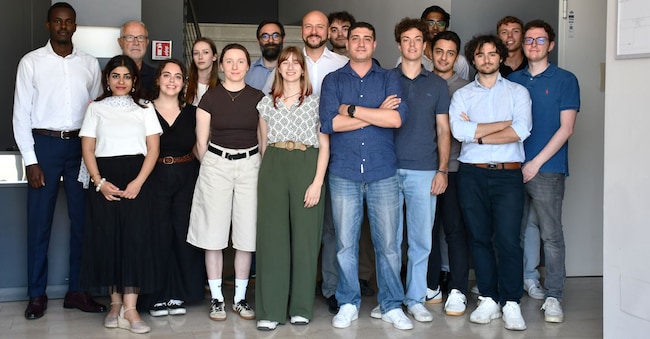
The start-up currently has 17 employees and four executives: it has three offices, two in Milan and one in Casarile. “Graphite,” he points out, “is used in batteries, as electrodes in steelworks, and as lubricants. In terms of graphite production in general, there is some in France and Germany, but when it comes to producing materials for batteries – which require the highest level of purity – I would say there is nothing available today. There are other start-ups trying to solve this problem using different methods, but in terms of production facilities, there is nothing.”

