Serbia

Mladic’s funeral: 8,000 people pay their respects to the ‘Srebrenica executioner’

State and military honours were paid to the general at the Church of St Luke in Belgrade. In Bosnia, 76,000 complaints have been lodged for glorifying a war criminal

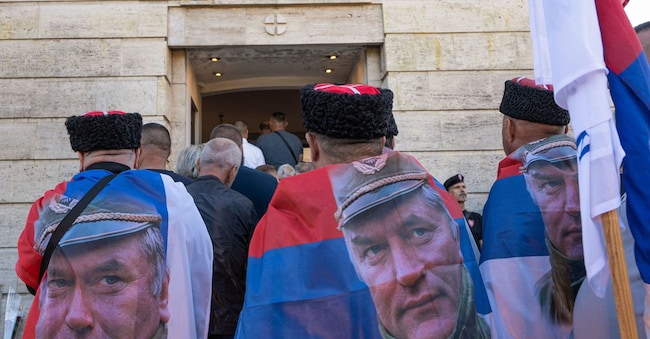
Uomini che indossano bandiere come mantelli, con l’effigie dell’ex generale serbo-bosniaco Ratko Mladic,  tra la folla radunata presso la chiesa di San Luca, in occasione dei funerali di stato (REUTERS)

4' min read

Translated by AI
Versione italiana

4' min read

Translated by AI
Versione italiana

Thousands of people – at least 8,000, according to police figures quoted by pro-government media – gathered in Belgrade for the funeral of Ratko Mladic, the Serbian general convicted of orchestrating the worst massacre in Europe since the Second World War, whose return to his homeland – where he was once regarded as a hero – has sparked international alarm. The funeral service was presided over by the head of the Serbian Orthodox Church, Patriarch Porfirije, but was shunned by the country’s leading political figures. Serbian President Aleksandar Vucic said he was tied up in an urgent meeting with Uzbek President Shavkat Mirziyoyev, who is currently visiting Belgrade.

The body of Mladic,, the Bosnian Serb commander convicted of war crimes and who has gone down in history as ‘executioner of Srebrenica”, who died whilst serving a life sentence in The Hague, was first laid in state, whilst Serbia defied the warnings from the European Union against public celebrations in honour of the man found guilty of the first genocide to have taken place in Europe since the Second World War.

Loading...

Thousands of people arrived early this morning at the small Serbian Orthodox church of St Luke, in Belgrade, to pay their respects to Mladic, who is still regarded as a hero by many Serbs. His officer’s cap and sabre lay on the coffin, flanked by men in military uniform. In front of it lay a row of medals. Outside the church, Serbian flags had been hung nearby, whilst a huge banner unfurled across the road read: ‘Welcome, General; thank you to your mother for giving birth to a hero’. Mladić, “an Orthodox Christian and a Serbian soldier”, “will remain deeply etched in the memory of the majority of the Serbian people”, said Porfirije during his funeral oration. “Beyond the judgements of human courts, the final verdict on his character and his actions rests with time, historical memory and, above all, divine judgement.”

In Bosnia and Herzegovina, where the glorification of war criminals is a criminal offence, in just seven days as many as 76,000 complaints were lodged, on the basis of which over 930 criminal proceedings were initiated against individuals who publicly glorified the general.

Mladic died aged 84 on 27 August in The Hague, in the Netherlands, whilst serving a life sentence for genocide, war crimes and crimes against humanity committed by his troops during the Bosnian War of 1992–95. Although the funeral arrangements were formally handled by Mladic’s family, the Serbian government sent a plane last week to bring the body back to Belgrade, and soldiers carried the coffin draped in the national flag.

On Saturday, a military memorial service was held at an official Serbian army facility. Serbia is a Pcountry applying for membership of the European Union and has been heavily criticised for the honours bestowed upon Mladic following his death. Marta Kos, the European Commissioner for Enlargement, cancelled a planned visit to Serbia in protest, arguing that ‘the glorification surrounding his death is incompatible with the values on which the path to the EU is founded’. Numerous other European politicians have voiced criticism, as have regional leaders and relatives of Mladic’s victims in the Bosnian War.

The President of the European Commission Ursula von der Leyen will be visiting the Western Balkans again this year, but it is not yet possible to confirm which countries will be included in the tour, according to the European Commission in response to a question about a possible stop in Serbia.

The conflict claimed over 100,000 lives and left more than a million people homeless before coming to an end in 1995 with a peace agreement brokered by the United States. The populist Serbian president Aleksandar Vucic, a former ultra-nationalist who supported Serbia’s expansionist policies during the war, has rejected the EU’s criticism, accusing Kos of ‘lying’. Vucic has stepped up his anti-Western rhetoric ahead of the snap parliamentary elections, scheduled for next month and considered to be of great importance.

Among those present in the church at the ceremony were at least three ministers from the Serbian government: Nenad Vujić, Minister of Justice, who in recent days personally escorted the body on the Serbian government’s state flight from The Hague and who, on 28 August – the day after Mladić’s death – was the first to announce the military and state honours; the Minister for Culture, Nikola Selaković, who was photographed shaking hands with people gathered outside the church and lighting votive candles; and the Minister for Transport and Infrastructure, Darko Glišić.

A Belgrado i funerali del criminale di guerra Mladic

Photogallery17 foto

Mladic was convicted in 2017 of orchestrating the massacre of over 8,000 Muslims in Srebrenica in 1995, the long siege of the Bosnian capital Sarajevo and other war crimes, including the establishment of concentration camps for non-Serb civilians and detained enemy soldiers. Serbia, which supported the Bosnian Serb forces during the war, continues to take a defiant stance on its role in the conflict and accuses the West of harbouring a hostile attitude towards Serbs. Since Mladić’s death, his nationalist supporters have organised vigils, painted a series of murals bearing his image in Belgrade and set off smoke bombs in his honour.

Loading...

Serbia has refused to acknowledge that genocide was committed in Srebrenica. Last year, Serbia buried another convicted war criminal, the former Chief of Staff of the Army, Nebojsa Pavkovic, with full military honours in a cemetery reserved for distinguished figures. Serbia’s path to EU accession is at a standstill due to the country’s democratic decline and Vucic’s refusal to comply with international sanctions against Russia over its invasion of Ukraine.

Srebrenica, designated by the United Nations as a ‘safe area’ for Bosniaks (Bosnian Muslims), ended up being overrun by Serbian forces, who forced men and boys to strip naked, killed them and then had their bodies removed by bulldozers to be buried in mass graves. The war began following the break-up of the former Yugoslavia, when Bosnian Serbs took control of large swathes of Bosnian territory with the aim of creating their own state and uniting it with Serbia.

Copyright reserved ©
Loading...

Brand connect

Loading...

Newsletter

Notizie e approfondimenti sugli avvenimenti politici, economici e finanziari.

Iscriviti