

Montenegro is working towards EU membership, and the port of Bar is aiming to compete in the Adriatic
Whilst Podgorica is negotiating the individual chapters of the talks, the government – having acquired a majority stake in the airport – is now turning its attention to the upstream rail infrastructure. A link with Serbia would guarantee Belgrade a preferential outlet at the expense of other options. With the port of Bari, on the other hand, there are numerous synergies
by 24Ore NextMed
 Aggiungi Il Sole 24 Ore
ai preferiti su Google
Key points
Montenegro is small enough to be underestimated, but sufficiently advanced on its path towards the EU to be able to reshape the trade landscape of the Adriatic. On 14 July 2026, the European Union provisionally closed negotiation chapters 8 (competition policy) and 29 (customs union) with Podgorica. With all 33 chapters open and 18 provisionally closed, the country remains the most advanced candidate. The immediate issue concerns accession. The strategic issue runs deeper: upon joining the Union, the port of Bar could become a gateway to the single market for goods from Asia, Turkey, North Africa and the eastern Mediterranean, shifting part of the European customs, tax and sanctions border to the Montenegrin coast. The closure of Chapter 29 does not yet make Bar a port of the Union. Agreements on individual chapters remain provisional until the negotiations are concluded in their entirety. The conference on 14 July was led, on behalf of the EU, by Thomas Byrne, Irish Minister of State for European Affairs and Defence, alongside the Commissioner for Enlargement, Marta Kos; the Montenegrin delegation was led by Prime Minister Milojko Spajić. Upon accession, Montenegro would be required to apply the Common Customs Tariff, EU procedures, anti-dumping measures, rules of origin, trade restrictions and European sanctions. But at that point, it would find itself directly within the EU framework.
Two harbours in the same harbour
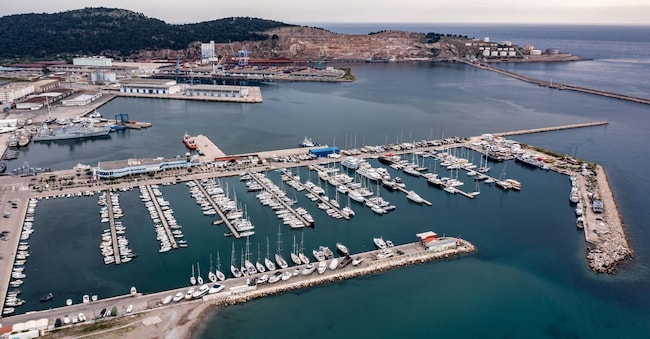
Bar is not a single corporate entity. Its operations are divided mainly between Luka Bar, a state-owned company, and Port of Adria, a private operator handling containers and general cargo. In December 2022, the Montenegrin government acquired an 18.42 per cent stake. The transaction, worth approximately €9.41 million, brought the state’s shareholding to 72.2 per cent, securing the state the qualified majority required for strategic decisions. Podgorica described the purchase as an investment of ‘vital national interest’, linking it to the transformation of Bar into a logistics hub for south-eastern Europe. Port of Adria, on the other hand, operates under a privatisation and concession model. Global Ports Holding acquired the operating rights in 2013 and holds a 62.09 per cent stake in the company. The operator reports nine berths, 1,440 metres of operational quay, an area of 518,790 square metres, a theoretical annual capacity of 750,000 TEU and 6 million tonnes of general cargo. The entire area falls within the free zone regime. Bar’s future depends not primarily on quay capacity, but on the continuity of the railway line to Podgorica, Vrbnica, Belgrade and Central Europe. The Montenegrin market is too small to sustain a major gateway port on its own. Serbia represents the crucial hinterland. The most important project is the reconstruction of the 39-kilometre Bar–Golubovci section, part of Rail Route 4 within the extended TEN-T core network. The funding package totals exactly 175,620,642 euros: an EIB loan of 63 million, signed on 22 December 2025, and a European grant of 112,620,642 euros, signed on 22 January 2026. The EIB states that the aim is to create a faster, safer and more reliable line, capable of handling 1.3 million passengers and 1.85 million tonnes of freight annually. The investment is significant given the scale of the Montenegrin economy, but it only concerns the southern section. The entire Bar–Belgrade line remains predominantly single-track and runs through mountainous terrain.
Serbia’s maritime choice
Serbia, for its part, has numerous alternatives: Bar, Trieste, Koper, Rijeka, Thessaloniki, Piraeus, Constanța and the Danube corridors. Geographical distance alone is not enough to determine the choice. Bar has a natural advantage for western and central Serbia, particularly in the sectors of bulk goods, cereals, metals, chemicals, energy and industrial cargo. For containers, the automotive sector and intermediate goods, however, reliability is the essential requirement. Serbian factories, however, cannot rely on a corridor where a missed train departure results in missing the ship. The link to Belgrade can also connect with the Serbian route to Novi Sad, Subotica and Hungary. This possibility theoretically extends Bar’s sphere of influence to Central Europe, but the infrastructure itself may favour Greek or North Adriatic ports.
Italia: between competition and integration
Trieste is the most formidable competitor for Bar. In 2025, the port of Trieste handled around 60 million tonnes, whilst the Trieste–Monfalcone system exceeded 64 million. The port and hinterland system handled 11,600 trains; Trieste recorded 7,939, with Germany accounting for 32 per cent of rail traffic, Austria for 19 per cent and Hungary for 13 per cent. Bar will not be able to replicate this network within five years, but it could take some Serbian cargo away from Trieste, particularly when the destination does not require access to the wider Central European network. Ravenna is primarily involved in cereals, fertilisers, metals and industrial bulk goods destined for the Serbian market. Ancona could face pressure in Ro-Ro traffic and general cargo from the Balkans, but could also develop feeder services and ferry routes. For Bari, however, the expansion of Bar represents an opportunity. In the first nine months of 2025, the Apulian port recorded 1,480 vessels, over 1.7 million tonnes of solid bulk, almost 4 million tonnes of general cargo and 75,000 TEU. Ferry passengers exceeded 840,000, whilst cruise passengers numbered around 430,000. A stable connection with Bar could support lorries, semi-trailers, agri-food, refrigerated goods, tourism and project cargo between southern Italia, Montenegro and Serbia. Gioia Tauro, on the other hand, is not Bar’s natural rival. In 2025, it handled 4,490,566 TEU, 14 per cent more than in 2024, confirming its status as Italia’s leading container port. Its role is predominantly one of transhipment; Bar could become one of the feeder ports served by the major Calabrian hub to reach the Serbian market by rail.
The risk of the free zone
The free zone regime is Bar’s greatest commercial advantage and, at the same time, its main vulnerability. Goods may be stored, redistributed, repackaged, transferred between owners or forwarded in transit with tariffs suspended. These operations reduce tied-up capital and facilitate regional distribution, but they can break the continuity between the original exporter, the beneficial owner, the declared consignee and the end-user. Then there is the issue of smuggling. Between 23 June and 16 September 2025, the authorities destroyed 130,003 cartons of cigarettes in the free zone, equivalent to 1,326,330,000 cigarettes. The operations took place under video surveillance, with the assistance of the British HM Revenue and Customs and European representatives. The operation has closed a long-standing vulnerability, but the next risk could involve sanctioned equipment, dual-use components, counterfeit goods, undervalued goods or corporate triangulation schemes. Bar remains a small port in a small country. However, economic borders are not defined by population: they are defined by the point at which goods, data, capital and controls enter a system. Montenegro’s future accession to the EU therefore represents more than just a new chapter in enlargement. It could have an impact on the Adriatic economy.

