
Deserts, wildlife and ancient sites: the whole of Africa in five thrilling journeys
Namibia. The elusive ostriches and the pink dunes of the desert

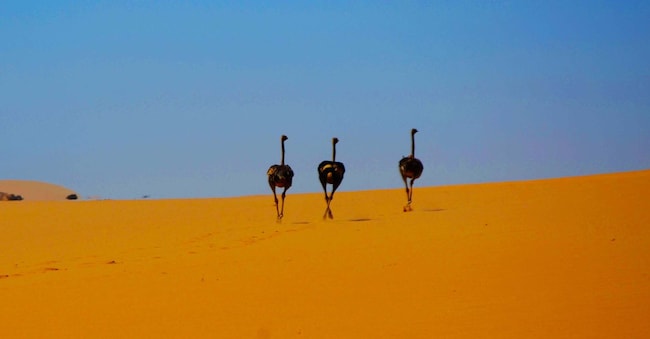
Those pink dunes of theirs are bewildering; they almost trick the eye. So much so that when the bizarre silhouettes of living creatures with their odd gait appear on the horizon, one initially struggles to recognise them as ostriches. Their appearance is particularly spectacular on the slopes of the sandy hills of Sossusvlei, some of which rise to over 300 metres: arriving here, at the most famous spot in the Namib Desert before sunset, means having the chance to climb these dunes when the light dances across their forms, colouring them pink, red and orange. Deadvlei, too – a depression of white clay dotted with now-blackened acacia trees – evokes a sense of time standing still, creating a landscape that Giorgio De Chirico might well have appreciated. The whole of the Namib-Naukluft National Park feels like an abstraction, something the wind could blow away at any moment into the waters of the Atlantic Ocean. Rainfall is minimal even near the Naukluft Mountains, which at a certain point abruptly interrupt the desert, displaying their rugged, rocky faces, often veiled by sudden mists. Yet this macrocosm is teeming with wildlife: for example, oryx, springbok, mountain zebras and bat-eared foxes move frequently and with ease amongst the dunes and gravelly plains. Even Swakopmund, a town originally settled by German colonists, seems almost unreal with its colonial cottages, the seals and flamingos that populate and bring colour to Walvis Bay, the old wooden jetties and piers which, as in the case of The Tug, have now been converted into restaurants (among Italian tour operators, Controvento is highly experienced and organises bespoke trips).

