
Nigerian Modernism from the Pompidou to the Tate Modern
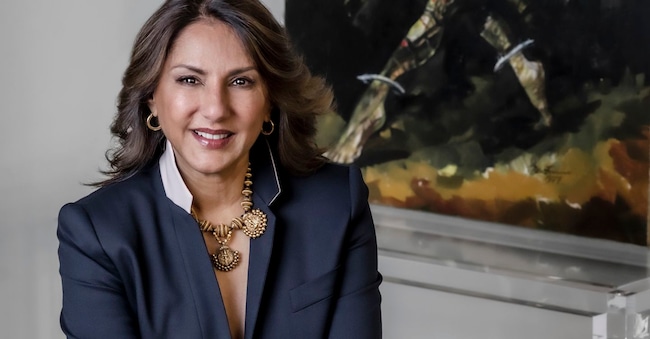
Kavita Chellaram tells how she went from being a collector to a gallery owner and opened Ko Art Space in Lagos. Today she collaborates with many museums

3' min read
3' min read
Modern Nigerian art is a segment to which the directors of numerous international museums are devoting more and more attention with a view to bridging a narrative gap and writing those pages of art history that are still partly to be written. Today, the works of modern Nigerian artists are featured in the group show "Paris Noir" at the Centre Pompidou (until 30 June) and will be the subject of the extensive exhibition "Nigerian Modernism" opening at the Tate Modern on 8 October until 10 May 2026 exploring a wide range of paintings, sculpture, textiles and poetry by over 50 artists, including Uzo Egonu, El Anatsui, Ladi Kwali and Ben Enwonwu MBE.
For just under 20 years, gallery owner Kavita Chellaram with Kò Art Space has been representing and exhibiting the work of modern Nigerian masters internationally and tells Arteconomy how this encounter came about.
Kavita, you started some time ago to present the work of modern Nigerian artists, do you remember in which year?
I started in 1977 as a collector to buy the works of modern Nigerian artists. I bought the works of Twins Seven-Seven and Jimoh Buraimoh, they were part of the Osogbo Art Schoo0l group, an academy where many Nigerian artists were trained in the 1960s. Professionally, however, it was in 2007 with the opening of the auction house ArtHouse. At that time, very few people dealt with Nigerian modernism, but it was an important job because it allowed us to price the works of these artists. Through the ArtHouse - The Space platform we organised in 2012 the Bruce Obobrakpeya exhibition, in 2015 that ofYosuf Grillo and in 2019 the group show Zaria Art Society (the collective founded in 1958 by students of the Nigerian College of Arts, including Yusuf Grillo, Bruce Onobrakpeya, Uche Okeke, Demas Nwoko in opposition to the strongly Western teaching of the College). After the success of this last exhibition I decided to open Kò Art Space and since 2020 with the gallery we present modern Nigerians at fairs, at Abu Dhabi Art and at Frieze Master.
Where did your interest in Nigerian modern art come from?
Modern art has always been of great interest to me, before the works of modern Nigerians, I used to collect the works of Indian modern artists. Nigerian modernism tells an important part of Nigeria's history, it took shape during the years of independence, it was a period of great hope for the country, there was an explosion of creativity, not only in the visual arts, but also in literature and music.
Different gallery owners operating in some African countries report the difficulty of creating the summer of artists because of the dispersion of their works, how was it for you?
Yes it was, but when I started several modern artists were still alive, so it was easier to acquire their works, then we worked with their families and later with private collectors and also auction houses.
Is there a museum in Lagos that houses the works of modern Nigerians? What about other museums?
Yes, in Lagos a few years ago theo Yemisi Shyllon Museum opened and in the permanent collection there is a section dedicated to Modern Nigeria. As a gallery, we have sold the works of modern Nigerians to MoMa, Guggenheim Abu Dhabi, Tate Modern, High Museum of Art, Princenton University Art Museum and Coker Museum. We lent the works of some of our modern artists to the Centre Pompidou for 'Paris Noir' (Bruce Onobrakpeya and Demas Nwoko) and are working on loans with Tate Modern for the 'Nigerian Modernism' exhibition.

