
Norway, right wing advances but Labour wins. Prime Minister Støre: Social Democrats can win
The results with 99% of the votes counted confirm the supremacy of the party of outgoing Prime Minister Støre and former NATO Secretary Stoltenberg, with 28% and the centre-left parties projected to win 87 out of 169 seats. But the populists of the Progress Party get almost 24%, doubling their support.
from our correspondent Michele Pignatelli
3' min read
3' min read
OSLO - Predictions fulfilled in Norway. With 99% of the votes counted, the Labour Party, already at the head of a minority government, is the most voted party, with 28.2% of the votes, and together with the other centre-left and left-wing parties should win 87 seats out of 169 in the Storting, the Norwegian Parliament. But behind them advances, even more than predicted, The Progress Party, the Norwegian declination of the right-wing populist wave sweeping Europe, even at 23.9%, with a jump of over 12 points on the previous elections. The Conservatives of former premier Erna Solberg, on the other hand, suffered one of their worst post-war defeats, as expected, with 14.6% of the vote. Together, therefore, despite the performance of the populists, the four centre-right parties stood at 82 seats.
The campaign was dominated by economic and fiscal issues, from the cost of living to public spending to the abolition of a controversial wealth tax, the last two workhorses of Sylvi Listhaug's populists. Given the support still guaranteed to Labour, however, the fears linked to geopolitical uncertainties, from the Russian threat to Trumpian protectionism, have certainly also weighed in, issues on which experienced figures such as the prime minister, Jonas Gahr Støre, and the finance minister and former NATO secretary Jens Stoltenberg offer undoubted guarantees. According to a survey by the Peace Research Institute Oslo, after all, 59% of Norwegians believe that a war will break out in Europe in the next decade (last year it was 55%).
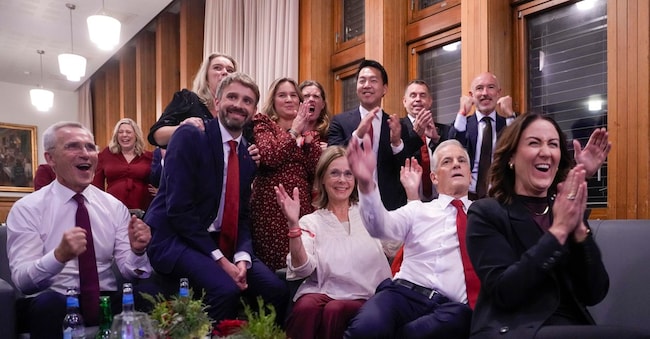
"In times of uncertainty, we have shown that we can cope with challenges," Støre told his supporters in the night after proclaiming victory. "What our friends in the world can see and say is that it is possible for the Social Democrats to win elections, even when the right-wing powers are strong.
So the outgoing premier and in pectore said he would immediately start consultations with all the other centre-left parties (Centre, Socialists, Greens and Rødt). Forming a coalition, however, will not be easy, especially on certain issues - from the exploration of new energy reserves to sovereign wealth fund investments, which came under the spotlight during the election campaign - on which the positions of the Greens and the groups further to the left (such as the Marxist party Rødt) diverge from those of the Social Democrats. One of the most likely options therefore appears to be an encore of a still Labour minority government, supported from outside by these parties.
"Relying on all four other parties could potentially be chaotic," comments Peter Egge Langsæther, political scientist at the University of Oslo, "I think Labour will have to make important concessions. They are parties that share core values and can agree on several points, even though they have different priorities; what is more complicated are the issues less closely related to how to distribute spending. For example, several of the smaller parties want to stop the exploration of new oil and gas fields, which Labour and the Centre want to continue (in the aftermath of the vote, Prime Minister Støre immediately declared that they would continue, to ensure that Norway remains a reliable supplier to the EU, ndr); then there could be conflicts with the Centre on the implementation of EU energy directives.


