Space

Electric nuclear propulsion for the Mars mission

After Artemis II, Nasa aims to go to the red planet in 2028 using for the first time a fission reactor, yet to be built
by Leopoldo Benacchio

4' min read

Translated by AI
Versione italiana

4' min read

Translated by AI
Versione italiana

Moon and Mars again, i.e. NASA changes its mind again. Artemis II went great, finally after so many problems and postponements, the four astronauts got into the Orion capsule, flew beyond the Moon, further than anyone else, and returned to Earth.

Orion came back rather battered, with many parts abraded or even missing; some commentators said that they took some good risks at Nasa. In many ways this is almost a compliment, since the skill of the decision-maker is also to understand when the risk is acceptable and when it is not, and lately at Nasa there has been little talk of risk.

Loading...

If you go to the Space Museum in Houston, where you can see the means of descent to the Moon of the 1970s Apollo mission, you realise just how much Werner von Braun, the father of US-made astronautics, knew just how much he could dare. It honestly makes an impression to see the millimetre-calculated fragility of Lem, the lunar module.

Now it is a matter of moving forward with a completely, or almost completely changed programme, with quite a few contradictions, as this American administration has accustomed us to by now, even for space.

Nasa's change of plans

During an event called Ignition, Nasa Administrator Jared Isaacman changed plans again for the return to the Moon, i.e. Project Artemis, and shocked the scientific community by announcing a mission to Mars, scheduled for December 2028.

Discarded as a goal only last month, not only by NASA but even by Elon Musk, who had long been the idea's greatest supporter, Mars is to be reached not by a conventional means: the planned spacecraft will carry a fission reactor, the first space nuclear propulsion test in over 60 years. All this when, at the same time, Trump is calling for a 3.8 billion reduction in the already reduced NASA budget, with Isaacman's assent.

What is nuclear propulsion?

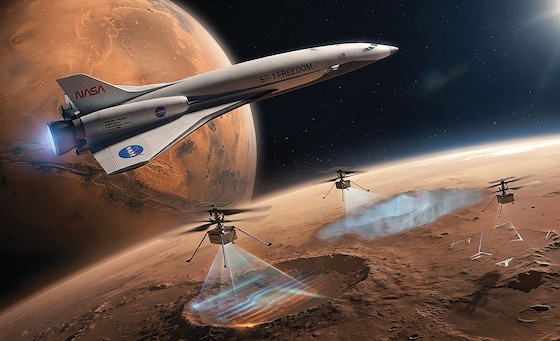
Be that as it may, the proposed Mars mission, the cost of which is unknown as yet, is interesting. It envisages bringing at least three small helicopters to the planet, similar to Ingenuity, the small drone brought in 2021 together with the large Perseverance rover. The small craft worked beyond all expectations and suggested that the experience be repeated, this time with more helicopter-drones, which are much more effective for exploring the ice and identifying potential landing sites for possible human missions.

The highlight of the planned new mission, however, is the spacecraft that will take them to Mars: Space Reactor-1 Freedom, which will use nuclear electric propulsion. This technology allows a different behaviour of the spacecraft and a higher speed, achieved in a progressive manner; fuel consumption is also lower than with traditional rockets. In essence, its use could be fundamental for the exploration of the outer Solar System. This is no small thing, so much so that one wonders why it has not been used before, but the answer is simple: the path to its realisation is full of technical, but also regulatory, obstacles.

It is indeed a matter of launching a, albeit small, nuclear reactor into space by 2028.

Conventional space missions are based on chemical rockets, which require huge amounts of heavy fuel; to take the example of Artemis II, we are talking about 3 million litres, about 3,000 tonnes.

Nuclear electric propulsion (Nep), on the other hand, relies on nuclear fission to generate heat, which is converted into electricity by a gas turbine that, in turn, ionises a propellant gas that is continuously ejected from the thrusters in the state of ionised plasma.

All it takes for such an engine is a few dozen kilos of uranium and a few thousand of propellant to go where we want on an interplanetary journey.

Vivere in una colonia su Marte, l'esperienza immersiva "Cast for Mars"

Technical and budget problems

The Nep, however, has a problem, which is easily solved: it is progressive but not very powerful to begin with, so we cannot use it, at the moment, to go into orbit from the earth's surface, we will have to use a conventional rocket for the initial thrust.

If the SR-1 Freedom fission reactor works properly, then much more powerful engines can be developed, one thinks of megawatts, which will get us to Mars in two to three months, as opposed to the nine needed today.

This is firstly an enormous benefit, because it would expose future astronauts to far less cosmic radiation, which is extremely harmful, and secondly because it would make a journey to the outer part of the Solar System, which could take as little as two years, credible. In addition to this, there would no longer be any need to worry about sunlight, which gets weaker and weaker as the distance increases, to create electricity with solar panels.

Being able to rely on fission is also very important for the establishment of activity on the Moon. Although it always shows us the same face, the Moon rotates on itself and has a two-week lunar night, in which no solar panel can ever provide energy.

To build SR-1 Freedom quickly, Isaacman explained that Nasa will use a 'frankenstein' approach, using uranium surrendered by the Department of Energy, and a fission reactor that was 'almost completely built', as well as the Power and Propulsion Element, an electric propulsion system already built for Gateway, the lunar space station that Nasa has now cancelled. And here, unfortunately, Italia, which was heavily involved in this fundamental element of the initial project, has lost several orders.

Copyright reserved ©
Loading...

Brand connect

Loading...

Newsletter

Notizie e approfondimenti sugli avvenimenti politici, economici e finanziari.

Iscriviti