
Nutri3d, foods with high nutritional value are 'custom-printed'
Project conducted by ENEA researchers with the companies Rigoni di Asiago and EltHub and the support of the Crea Research Centre

2' min read
2' min read
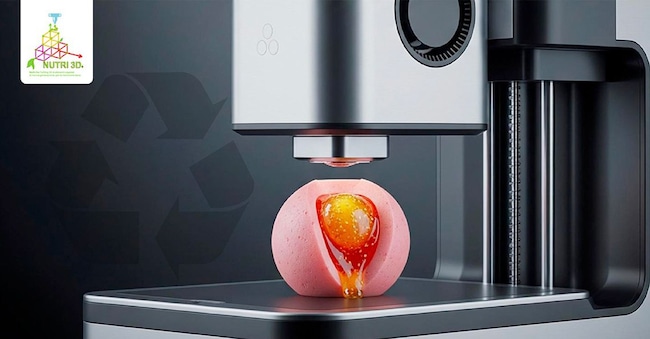
Sustainable food printed in 3D: technological innovation enters the food sector, ranging from multilayer bars to 'honey pearls'. The project, which aims to offer tailor-made food solutions with products of high nutritional value, is called Nutri3d and is led by researchers from ENEA with the companies Rigoni di Asiago and EltHub (coordinator) and the support of the Crea Research Centre - Food and Nutrition (and initially the company G&A Engineering collaborated)
In this area, researchers at ENEA have 'developed ingredients and actual recipes for bars, innovative snacks and small high value-added spheres, the "honey pearls", also obtained from cell cultures and agro-food residues, such as those resulting from fruit processing'.
A study (published in the journal Innovative Food Science & Emerging Technologies) was also carried out to assess the liking index among consumers, which, they point out at ENEA, 'showed a growing interest in these innovative products, confirming the potential of 3D printing in the future of food'.
"Our studies," says Simona Errico, researcher at the Circular Regenerative Bioeconomy Laboratory at the Trisaia Centre in Italy, "have revealed that 'pearls' with added plant cells have a better consistency and more juiciness, making them more palatable to consumers.
The study also revealed a growing interest. "The impact of climate change and the scarcity of new arable land will make it increasingly difficult to guarantee quality plant food," says Silvia Massa, scientific head of the Nutri3D project. In this scenario, the identification of innovative and alternative production and manufacturing systems (including 3D printing) emerges as a strategic approach to produce sustainable foods that are useful for the wellbeing of the population, even from agro-food residues, thus contributing to a healthy and safe diet. Such foods could also find customised application in space missions'. An important challenge, as the researchers point out, given that by 2025 "the food 3D printing market will reach a value of 360 million euros, a growth driven by the increasingly urgent need to feed a world population that, according to the United Nations, will exceed 12 billion by 2100, with an increasing impact on natural resources, air and water, especially in emerging countries".

