
One in five Italians have given up their holidays because of price rises
Izi survey: seaside resorts penalised, costs deemed prohibitive. Bocca (Federalberghi): 'Not an extraordinary summer like the one of 2024',

2' min read
2' min read
It is time for the first budgets for the summer of 2025, budgets that seem to be bordering on the red. On the one hand Bernabò Bocca, president of Federalberghi, says that "it is not an extraordinary summer like that of 2024. Although the balance will be taken at the end of the season with the final data on tourist flows. The drop in admissions, between 5 and 10 per cent, is especially noticeable in the seaside resorts, those usually most frequented. People are looking for different holiday solutions. The mountains, on the other hand, did well'. On the other hand, an Izi survey shows that 11 million Italians, more than a fifth, have given up a holiday or a trip because of price rises.
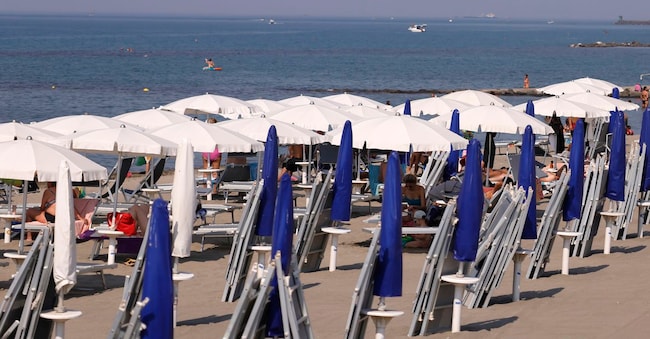
The most penalised were the seaside resorts, where one in four Italians gave up the beaches because of too high costs. And 70% of those who sought alternative destinations abroad did so because of too high costs in Italy. This is what emerges from a survey on the habits and impact of price increases for the 2025 season, carried out by Izi, a company for economic and political analysis and evaluation,
Generalised increases have kept millions of tourist customers away. According to the survey this summer, 57.4% of respondents said that the price rises of accommodation, 49% that of restaurants, and 42.5% considered the cost of beach services to be prohibitive. If the high cost of beach umbrellas can be remedied, 40% of the sample chose the free beach. There is also an important indication for the next season because if in the future the prices of services should remain at prohibitive levels, Italians will favour holidays in the low season, for 27.4%, or will take shorter, low-cost holidays, for 23.2%. . 70% of those who sought alternative destinations abroad did so because of the excessively high costs in Italy.
"Certainly the economic aspect is the most relevant in the change and reduction of holidays for this summer that is coming to an end," says Giacomo Spaini, president and ceo of Izi. "In the abandonment of long-term holidays, however, there is the consolidation of a trend that has been going in this direction for some time now. High prices do not help the progressive contraction of holidays into an ever-shorter timeframe, and all this means that even the offer of services, especially seaside ones, is concentrated in a single month. It is clear from our survey that we need to lengthen the season by offering services for a number of months commensurate with the potential of our beaches. Only in this way will it be possible to cut costs and increase tourist numbers'.

