
Open Arms, Salvini acquittal: 'It was not kidnapping, possible to go in another direction'
The grounds with which the Court of Cassation made the acquittal from the charges of kidnapping and refusal to perform official acts definitive have been filed

Key points
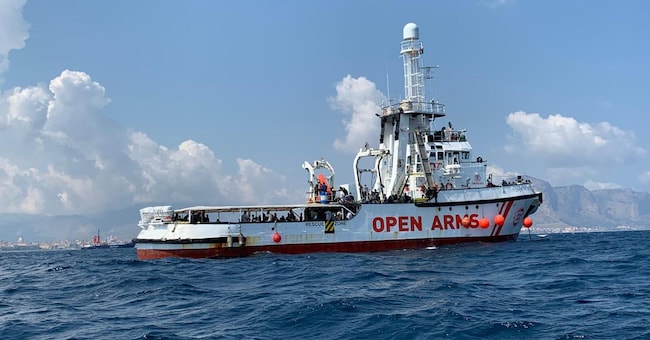
"The conduct alleged against Matteo Salvini, namely having, in his capacity as Minister of the Interior and abusing his powers, unjustifiably deprived 147 migrants of their personal liberty, failing without justified reason to positively review the Pos (place of safety) requests forwarded to his Cabinet Office, thus causing their unlawful deprivation of personal liberty, forcing them to remain on board the ship Open Arms, cannot fall within the scope of kidnapping". The Court of Cassation, filed the grounds, contained in 77 pages, with which on 17 December it rejected the Palermo prosecutor's appeal and made final the acquittal for deputy prime minister Matteo Salvini, accused of kidnapping and refusing to perform official acts for the Open Arms affair. The conduct alleged against Matteo Salvini, was, according to the public prosecution, in having, 'in his capacity as Minister of the Interior and abusing his powers, unduly deprived 147 migrants of their personal freedom, failing without justified reason to positively assess the Pos (place of safety) requests forwarded to his Cabinet Office, thus causing their unlawful deprivation of personal freedom, forcing them to remain on board the Open Arms ship'. Action that for the Supreme Court cannot, however, fall within the scope of kidnapping
The judges of the fifth criminal section wrote that the migrants were "prevented from entering the port of Lampedusa and disembarking, however, they were not prevented by the Italian authority, and specifically by Salvini - through his actions as Minister of the Interior - from heading in another direction.
Alternative routes
In particular, emphasise the supreme judges, "a port for disembarkation was indicated by the Kingdom of Spain (the ship's flag state, contacted immediately at the time of the rescues) (On 18 August 2019), modified (in the sense that a closer one was indicated in that of Palma de Mallorca) precisely to limit in time the stay on board of the migrants (compared to the one, more distant, first indicated in Ceuta), in adherence to the ship's captain's request". Moreover, "two other vessels were made available, one immediately available by the Italian Coast Guard, on which to tranship the migrants, some immediately, and through which to approach the Spanish coast escorting the Open Arms, reaching the Spanish military vessel that would also approach the Open Arms; and this was in accordance with the request of the ship's captain who, however, did not respond to the repeated invitations of the Italian Authority to indicate the necessary equipment for this purpose". "In other words", the supreme judges emphasise, "what was not allowed to the Open Arms ship, or rather to those who were still on board, was a determined conduct, represented by the disembarkation on Italia soil, but did not take place, according to the same accusatory prospect, a limitation of freedom of locomotion". Lastly, 'the charge of the crime of refusal to perform official acts,' the supreme judges write, 'assumed that the Pos request should have been positively examined, without delay, for reasons of public order and safety, hygiene and health. However, the appeal does not indicate in any way in what terms the refusal of the act had an impact on public order and safety, which, with respect to the powers and duties of the Italian authorities, cannot be correlated ex se to a ship flying the flag of the Kingdom of Spain, with respect to facts that have relevance only within the community travelling on it'.
Unaccompanied minors
The Supreme Court also ruled out crimes with regard to the landing operations of unaccompanied minors. The judges denied that actions "aimed at hindering or delaying beyond measure the disembarkation" can be attributed to Matteo Salvini. Already on 16 August 2019, and therefore the day after the arrival of the minors on Italia territory, the Department for Civil Liberties and Immigration, articulation of the Viminale, had, in coordination with the Garante per l'Infanzia, put in place the reception measures and had acquired the names of the unaccompanied under-18s for the appointment of guardians, and organised - with the necessary technical time - the disembarkation, on 17 August, of 27 people to be placed in ad hoc facilities.
ForGiulia Bongiorno, who defended Matteo Salvini, 'The Cassation Court's ruling, in full adherence to the acts, has clearly and unequivocally certified the correctness of the actions of the then Minister of the Interior, Matteo Salvini, in the Open Arms case. The migrants, to whom Italy has always provided care and assistance, writes the Court of Cassation, were never deprived of their personal freedom and the ship could have sailed to Spain where it had been assigned a safe disembarkation place".

