Big Tech

OpenAI launches SearchGPT and challenges Google on search

The Mountain View giant's shares are suffering. But undermining Big G's leadership will be a tough task

by Biagio Simonetta

OpenAI logo is seen in this illustration. REUTERS/Dado Ruvic/Illustration/File Photo

3' min read

3' min read

OpenAI announced that it is launching SearchGPT, a search engine based on its artificial intelligence (i.e. ChatGPT) with real-time access to information from the Internet. For now, the tool, which Sam Altman 's company describes as "a prototype for new search functionalities, which harnesses the power of our artificial intelligence models to give you quick answers with clear and relevant sources" is not accessible, or perhaps only to a very limited number of users. But on the site there is a form to subscribe to the waiting list.
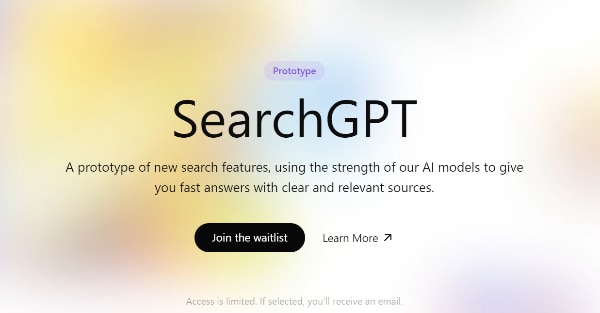
Come appare SearchGPT ora

The timing and manner of the actual launch are not known, but this move is certainly the most important gauntlet in recent years against Google, which with Google Search dominates the online search market with percentages that leave only crumbs to its rivals.

Loading...

Limited number of users

.

SearchGPT will reportedly be available in browsers like any other search engine. And OpenAI announced that users will see answers to their queries with inline attribution to news creators and publishers, including the growing number of media companies that have entered into licensing agreements with the start-up in recent months. SearchGPT will also allow users to ask follow-up questions without losing the context of the original query.

As mentioned, the timing for the actual launch of SearchGPT is unknown, but the San Francisco start-up said that it will initially be available to users who sign up for the waiting list.

Research is the new frontier of AI

.

With the launch of ChatGPT in late 2022, OpenAI triggered the rush of generative artificial intelligence, making it consumer and immediately available to billions of users. A move that forced Big Tech companies to respond, with Google and Microsoft (OpenAI supporters) accelerating their plans, trying to bring GenAI into the search world immediately.

In this story, therefore, it is fair to mention that the first search engine to implement artificial intelligence functions was Microsoft's Bing. And the results were quite disappointing, since the usage rates remained almost unchanged (we wrote about it here). A sign that not even curiosity about artificial intelligence is able to quickly change users' search engine habits.

The real challenge for SearchGPT, therefore, will be to try to undermine Google's leadership. An impregnable fortress, so far, with over 90 per cent of global online search in the hands of Big G.

The challenge of accurate information

.

"For decades, search has been a key way for publishers and creators to reach users," OpenAI wrote in a blog post . "Now, we are using artificial intelligence to enhance this experience by highlighting high-quality content in a conversational interface with multiple opportunities for users to interact."

A key challenge for OpenAI and its rivals, however, is to provide accurate information to users, particularly when they seek information on current events. Chatbots can often hallucinate or invent false answers to questions when they do not know the answer. OpenAI has licensing agreements with publishers such as News Corp., Axel Springer SE and Time magazine to train its artificial intelligence models and integrate more authoritative and up-to-date information into its products. As part of some of these agreements, OpenAI has also agreed to provide users with attributed news summaries.

Litigation with publishers

.

"The truly talented OpenAI team innately understands that in order for AI-based research to be effective, it must be based on the most reliable and highest quality information from trusted sources," said Robert Thomson, CEO of News Corp. in a statement.

While OpenAI entered into agreements with major publishers, it was also hit by lawsuits from several newspapers, including the New York Times, for allegedly using copyrighted articles without permission. At the same time, OpenAI's rivals faced some resistance on their search products.

OpenAI said it will provide publishers with a way to manage the way they appear in its new search functionality. Altman's company also said that websites will be able to choose to be displayed in search results even if they choose not to have their content used to train OpenAI's templates.

Copyright reserved ©
Loading...

Brand connect

Loading...

Newsletter

Notizie e approfondimenti sugli avvenimenti politici, economici e finanziari.

Iscriviti