
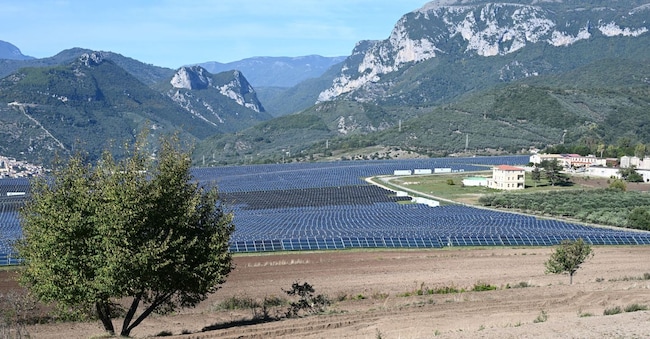
Ground-mounted solar panels: ban on installation in agricultural areas deemed lawful
It is in line with constitutional values and EU principles, reaffirming the need to protect land set aside for crop cultivation and livestock farming as far as possible

Key points
Is the ban on installing photovoltaic panels with modules situated on the ground in areas classified by town planning schemes as land designated for agricultural use.
What did the Lazio Regional Administrative Court challenge?
In Judgment No. 127/2026, filed on Thursday 16 July, the Constitutional Court referred back to the Lazio Regional Administrative Court the questions of constitutional legitimacy raised by that court – through four non-final judgments of 13 May 2025 – concerning the provision establishing the veto. This refers to Article 5, paragraphs 1 and 2, of Decree-Law 63/2024 – also known as the Agriculture Decree, converted into Law 101/2024 and containing urgent measures for agricultural, fisheries and aquaculture businesses – and to Article 2, paragraph 2 of Legislative Decree 190/2024, which regulates ‘the administrative regimes for the production of energy from renewable sources’.
In the administrative court’s view, the risk was that the legislative provisions would conflict with various principles of the Constitution, including those on the protection of the landscape and those relating to obligations in this area energy transition arising from European law.
The Council’s position
To untangle this knot, therefore, the Constitutional Court first of all highlighted the error that had been made: the Regional Administrative Court had failed to take into account that the provision in question did not – indiscriminately – prohibit the installation of all solar power plants on agricultural land, but only those with modules placed in close contact with the ground. Other systems with modules not mounted on the ground and which do not damage the plots are therefore excluded.
Subsequently, the focus shifted to the absence of a legislative definition of ‘ground-mounted modules’. This is a recognised shortcoming which, however, may be offset by the objectives of the law, which was introduced to curb the consumption of agricultural land and safeguard crops and livestock. This is also confirmed by Decree-Law 175/2025, which links the label ‘agrivoltaic plant’ only to those equipped with modules raised off the ground.

